India, UK start talks on free-trade deal

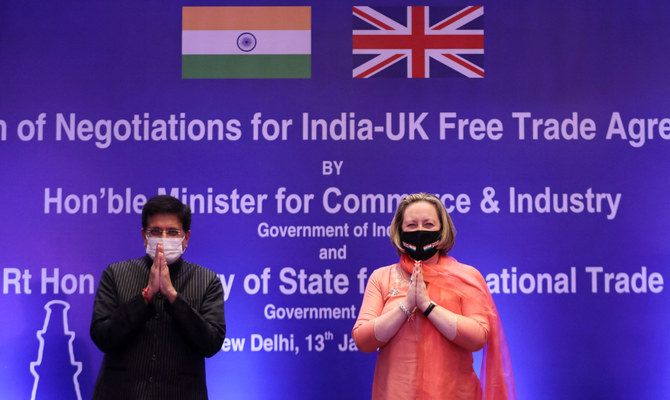
India's Minister of Commerce and Industry, Piyush Goyal, and British Secretary of State for International Trade Anne-Marie Trevelyan pose for a picture during the launch of free trade agreement negotiations in New Delhi on Thursday. (Reuters)
Short Url
Updated 13 January 2022
Follow

India, UK start talks on free-trade deal

  • Britain’s International Trade Secretary Anne-Marie Trevelyan is in New Delhi for the discussions
  • Deal expected to boost two-way trade by $38.4bn a year by 2035

NEW DELHI: India and the United Kingdom on Thursday formally launched talks for a free-trade deal expected to double their bilateral trade by 2030.

The UK has made the agreement with India one of its post-Brexit priorities, with London aiming to anchor its trade policy toward the fast-growing economies in the Indo-Pacific region.

India’s Trade and Commerce Minister Piyush Goyal started the talks with Britain’s International Trade Secretary Anne-Marie Trevelyan, who arrived in New Delhi on Wednesday.

Actual negotiations are scheduled to begin next week.

“The FTA with the UK is expected to provide certainty, predictability and transparency and will create a more liberal, facilitative and competitive services regime,” Goyal said in a joint press conference with Trevelyan.

“The negotiations with the UK are expected to increase our exports in leather, textile, jewelry and processed agriproducts, and register a quantum jump in the export of marine products.”

Trevelyan said the deal, under which the countries would double bilateral trade by 2030, would help strengthen their post-pandemic recovery.

“With the commencement of the first full round of talks this month, the trade deal between the United Kingdom and India will put us in pole position to recover from the pandemic and to strengthen our mutually beneficial ties and to grasp the enormous opportunities that lie ahead,” she said.

“We aim to double trade between our countries by the end of this decade supporting jobs, businesses and communities in both countries.”

The British Embassy in New Delhi said in a statement the agreement would boost two-way trade by $38.4 billion a year by 2035.

Foreign policy expert Harsh V. Pant of the New Delhi-based Observer Research Foundation told Arab News the deal would give “new momentum” to India’s trade relations with the UK, with both countries seeking to reposition themselves for a post-pandemic world order.

“This is important for both sides, as Britain looks to diversify and it looks to engage with the post-Brexit economic order, and India looks at a post-COVID global economic environment,” he said.

“There is a recognition that at the time of global economic fragmentation and the supply chain restructuring, India has to get its economic act in order.”

He added that for India, signing free-trade agreements would be important in its goal to be a part of the “global economic map,” while for the UK, the Indo-Pacific push was part of its post-Brexit economic.

“India, with such a big market, is one of the largest economies of the world. It is in Britain’s interests to see that this this deal is signed,” Pant said.

“Even with limited tariff reduction, it will lead to a significant increase in trade volumes.”


International baby milk recall leads to French legal action

Updated 2 sec ago
Follow

International baby milk recall leads to French legal action

  • Eight French families have joined a lawsuit filed by Foodwatch
  • The complaint, while not naming the manufacturers or government agencies, calls for a legal investigation

PARIS: A recall of potentially contaminated infant milk formula in some 60 countries has taken a legal turn in France after a watchdog and eight families filed a lawsuit accusing manufacturers and the government of acting too slowly.
Eight French families, who said their babies suffered severe digestive problems after drinking formula named in the recall, have joined a lawsuit filed by Foodwatch, which AFP has seen.
The complaint, while not naming the manufacturers or government agencies, calls for a legal investigation.
Foodwatch, a European consumer association, believes that producers could not have ignored the risks to babies by leaving their milk on sale in France and in more than a dozen European countries, as well as in Australia, Russia, Qatar or Egypt.
Several manufacturers, including giants like Nestle, Danone, and Lactalis have issued recalls of infant formula in more than 60 countries, including France, since December due to a risk of cereulide contamination.
Cereulide, a toxin produced by certain bacteria, is “likely to cause primarily digestive problems, such as vomiting or diarrhea,” according to the French health ministry, though it said last week it so far had not determined a link to the symptoms experienced by the infants.
In the complaint, Foodwatch accuses milk powder manufacturers of delaying action between the initial warnings in December and the recalls, some of which were not widely publicized. They became more widespread in January.
Foodwatch believes that parents were told too little, too late, and in a confusing manner. French agriculture minister Annie Genevard said however that procedures had been “very well followed.”
Two separate criminal investigations have already been opened in France following the deaths of two infants who consumed infant formula recalled by Nestle due to “possible contamination” by a bacterial substance, although no “causal link” has yet been established, according to authorities.
Authorities are accused in the Foodwatch complaint of delaying action and of deficiencies in their controls.
The European Food Safety Authority (EFSA) announced meanwhile that it had been asked by the European Commission to establish a standard for cereulide in children’s products. It will issue an opinion on February 2.