

‘No end to mounting repression’ in Iran: HRW

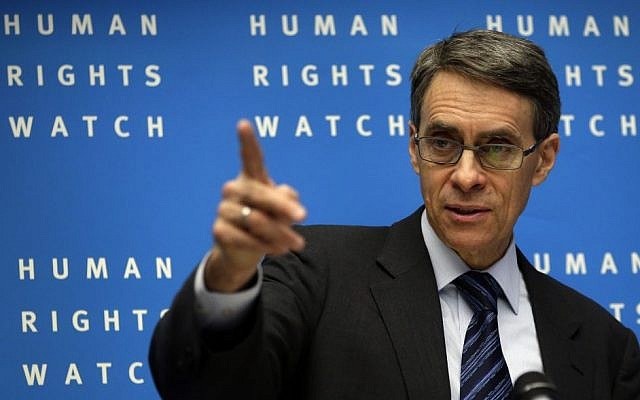
Kenneth Roth, as head of human rights watch, has long campaigned against Iranian rights violations. (File/AP)
Short Url
Updated 13 January 2022
Follow

‘No end to mounting repression’ in Iran: HRW

  • Country makes up significant portion of Human Rights Watch’s World Report 2022
  • Deputy Mideast director: Repression ‘causing an entire nation irreplaceable harm’

LONDON: Human Rights Watch has decried another year of abuses and repression in Iran in its World Report 2022.

“Iranian intelligence and judicial authorities continued their crackdown on dissent in 2021, while lawmakers passed and debated laws that further violate human rights,” HRW said on Thursday, in a statement supporting the release of the report.

The annual World Report challenges human rights violations globally, and this year a significant portion of the 752-page paper was dedicated to Iran.

“Iranian authorities repressing popular demands for civil and political as well as economic, social, and cultural rights is causing an entire nation irreplaceable harm,” said Michael Page, deputy Middle East director at HRW. “Change, of course, is necessary, unavoidable, and urgent.”

HRW said poverty has increased and living conditions have deteriorated in Iran over the past year “due to government mismanagement, the Covid-19 pandemic, and US sanctions.”

But instead of taking constructive action to deal with the array of internal challenges such as COVID-19 effectively, Tehran has “mismanaged and politicized its response to the pandemic, especially its national vaccine procurement plan that was slow and untransparent during the first months of 2021.”

In the early days of the pandemic, Supreme Leader Ali Khamenei made the controversial decision to ban vaccines made by the UK and US — then the most effective vaccines available. He later reversed that decision, but many Iranians had already died.

HRW also slammed Tehran’s continued use of arbitrary detention against human rights campaigners to quell dissent, and highlighted the judiciary’s continued opacity in its investigation of the Iranian downing in 2020 of a Ukrainian plane that killed 176 people.


The UN says Al-Hol camp population has dropped sharply as Syria moves to relocate remaining families

Updated 15 February 2026
Follow

The UN says Al-Hol camp population has dropped sharply as Syria moves to relocate remaining families

  • Forces of Syria’s central government captured the Al-Hol camp on Jan. 21 during a weekslong offensive against the SDF, which had been running the camp near the border with Iraq for a decade

DAMASCUS: The UN refugee agency said Sunday that a large number of residents of a camp housing family members of suspected Daesh group militants have left and the Syrian government plans to relocate those who remain.
Gonzalo Vargas Llosa, UNHCR’s representative in Syria, said in a statement that the agency “has observed a significant decrease in the number of residents in Al-Hol camp in recent weeks.”
“Syrian authorities have informed UNHCR of their plan to relocate the remaining families to Akhtarin camp in Aleppo Governorate (province) and have requested UNHCR’s support to assist the population in the new camp, which we stand ready to provide,” he said.
He added that UNHCR “will continue to support the return and reintegration of Syrians who have departed Al-Hol, as well as those who remain.”
The statement did not say how residents had left the camp or how many remain. Many families are believed to have escaped either during the chaos when government forces captured the camp from the Kurdish-led Syrian Democratic Forces last month or afterward.
There was no immediate statement from the Syrian government and a government spokesperson did not respond to a request for comment.
At its peak after the defeat of IS in Syria in 2019, around 73,000 people were living at Al-Hol. Since then, the number has declined with some countries repatriating their citizens. The camp’s residents are mostly children and women, including many wives or widows of IS members.
The camp’s residents are not technically prisoners and most have not been accused of crimes, but they have been held in de facto detention at the heavily guarded facility.
Forces of Syria’s central government captured the Al-Hol camp on Jan. 21 during a weekslong offensive against the SDF, which had been running the camp near the border with Iraq for a decade. A ceasefire deal has since ended the fighting.
Separately, thousands of accused IS militants who were held in detention centers in northeastern Syria have been transferred to Iraq to stand trial under an agreement with the US
The US military said Friday that it had completed the transfer of more than 5,700 adult male IS suspects from detention facilities in Syria to Iraqi custody.
Iraq’s National Center for International Judicial Cooperation said a total of 5,704 suspects from 61 countries who were affiliated with IS — most of them Syrian and Iraqi — were transferred from prisons in Syria. They are now being interrogated in Iraq.