QatarEnergy to be shareholder in LNG terminals being set up at Port Qasim 

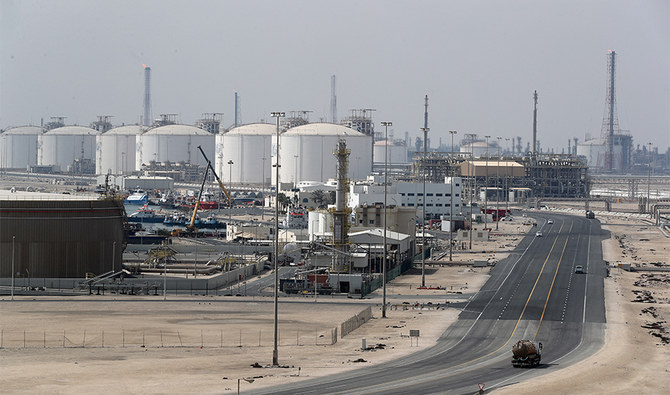
A picture shows Qatar's principal site for the production of liquefied natural gas, administrated by Qatar Petroleum near the capital Doha, on February 6, 2017. (AFP/FILE)
Short Url
Updated 12 January 2022
Follow

QatarEnergy to be shareholder in LNG terminals being set up at Port Qasim 

  • Pakistan has become emerging buyer in international LNG market over last few years
  • Pakistan imports more than half of its LNG through long-term contracts

ISLAMABAD: State-owned QatarEnergy will be a shareholder in a private sector LNG terminal being set up at Pakistan’s Port Qasim, the ministry of maritime affairs said this week.
Port Qasim, one of Pakistan’s largest ports, is located 28 miles south-east of the country’s largest city, Karachi. The South Asian country has become an emerging buyer in the international LNG market over the last few years, with an increasing gap between demand and supply of gas.
Pakistan and Qatar agreed to address all issues related to the development of LNG terminals during a video conference held on Tuesday between Qatari energy minister Saad Sherida Al-Kaabi, and Pakistani Federal Minister for Maritime Affairs, Syed Ali Haider Zaidi.
“Minister Al-Kaabi, who is also the President and CEO of QatarEnergy apprised the participants that QatarEnergy fully supports and will be a shareholder in one of the private sector LNG Terminals being set up at Port Qasim,” the maritime affairs ministry said on Twitter.
“Minister Al-Kaabi will visit Pakistan at the signing of implementation agreement,” the tweet added.
Pakistan imports more than half of its LNG through long-term contracts, which buffers it somewhat from spot price volatility. In recent months, there have been a spate of cancellations of cargoes.
The country with a population of over 200 million has struggled with energy shortages and rising power prices, with electricity still not available to 50 million people in the country who need it, according to a 2018 World Bank report.


Pakistani stocks breach 176,000 points barrier as investors expect further rate cuts

Updated 01 January 2026
Follow

Pakistani stocks breach 176,000 points barrier as investors expect further rate cuts

  • Pakistani financial analyst attributes surge to falling inflation, investors expecting further policy rate cuts
  • Pakistan’s finance ministry said Thursday that inflation had slowed to 5.6 percent year-on-year in December 

KARACHI: Pakistani stocks continued their bullish run on Thursday, breaching the 176,000 points barrier for the first time after trading ended, with analysts attributing the surge to investors expecting further cuts in the policy rate. 

The KSE-100 benchmark gained 2,301.17 points at close of business on Thursday, marking an increase of 1.32 percent to settle at 176,355.49 points. 

Pakistan’s central bank cut its key policy rate by 50 basis points to 10.5 percent last ‌month, breaking a four-meeting ‌hold in a move ‌that ⁠surprised ​markets. Pakistan’s consumer price inflation slowed to 5.6 percent year-on-year in December, while prices fell on a monthly basis as per data from the finance ministry. 

“Upbeat data for consumer price index (CPI) inflation at 5.6pc in December 2025 [with] investors expecting a further State Bank of Pakistan rate cuts on falling inflation data,” Ahsan Mehanti, CEO of Arif Habib Commodities Ltd., told Arab News. 

The stock market witnessed a trading volume of 1,402.650 million shares, with a traded value of Rs48.424 billion ($173 million), compared with 957.239 million shares valued at Rs44.231 billion ($158 million) during the previous session.

Topline Securities, a leading brokerage firm in Pakistan, credited the surge to strong buying at the first session.

“This positivity can be accredited to buying by local institutions on the start of the new calendar year,” it said. 

Pakistan’s Finance Adviser Khurram Schehzad highlighted that the bullish trend at the stock market reflected “strong investor confidence.”

“With lower inflation, affordable fuel, stronger reserves, rising digitization and a buoyant capital market, Pakistan’s economic outlook is clearly improving--supporting greater confidence, better investment sentiment and more positive momentum for 2026,” he said on social media platform X.