

French official says 300-400 Russian mercenaries operate in Mali

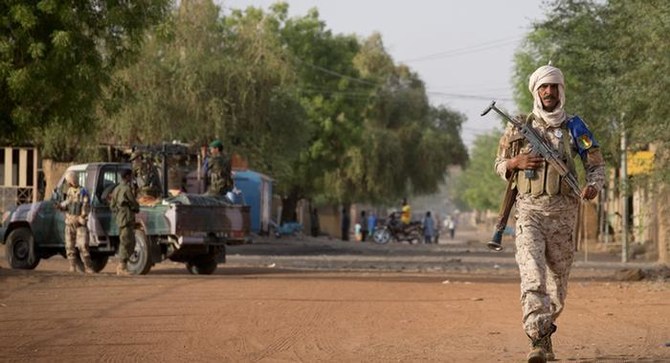
A Malian army soldier patrols in Gao. (AFP)
Short Url
Updated 11 January 2022
Follow

French official says 300-400 Russian mercenaries operate in Mali

  • French official: ‘I would say there are around 300-400 members of Wagner and there are also Russian trainers, who provide equipment’
  • Mali’s junta has said the new forces are military instructors who came with equipment they bought from Russia

PARIS: From 300 to 400 Russian mercenaries are operating in central Mali, a senior French armed forces ministry official said, challenging an assertion by the West African country’s junta that only Russian military trainers are deployed there.

Other West African nations have closed their borders with Mali, severed diplomatic ties and imposed economic sanctions in response to its delay in holding elections following a 2020 military coup, the 15-state regional bloc said on Sunday.

The moves were also a response to the arrival of private military contractors from the Russian Wagner Group, whose members are mostly ex-service personnel.

“I would say there are around 300-400 members of Wagner and there are also Russian trainers, who provide equipment,” the French official told reporters at a briefing late on Monday.

The official, who spoke on condition of anonymity, said the Russian mercenaries had deployed with Malian forces to the center of the country.

Mali’s junta, which has proposed a five-year transition rather than stepping down in February as initially planned, has said the new forces are military instructors who came with equipment they bought from Russia.

The European Union has imposed sanctions on the Wagner Group, accusing it of clandestine operations on the Kremlin’s behalf. President Vladimir Putin has said the group does not represent the Russian state, but that private military contractors have the right to work anywhere in the world as long as they do not break Russian law.

France has thousands of troops fighting extremist militants in the Sahel region and in December joined 15 other countries, mostly European states operating in Mali, in condemning the possible arrival of mercenaries.

Paris has said any such move would be incompatible with the French presence in Mali.
“The fact that Wagner is in a different part of Mali limits the risk of interaction which would be very difficult (for us) to accept,” the French official said. “They (the junta) made the choice to turn their backs on the Europeans, the Americans and Africans and that brings consequences.”

He said consultations were under way between France and its European partners, who have provided special forces in Mali, on how to respond. Decisions are likely at European Union level at the end of January, he said.


Duterte killed thousands, ICC prosecutors say

Updated 3 sec ago
Follow

Duterte killed thousands, ICC prosecutors say

  • His defense team countered that Duterte had murdered no one and that the prosecution’s argument was based on “hearsay” and “conjecture“
  • “He’s proud of his killings. He wants to be remembered for them,” said Julian Nicholls, summing up for the prosecution

THE HAGUE: Rodrigo Duterte killed thousands during his anti-drug campaign, an International Criminal Court prosecutor alleged Friday, as the crimes against humanity hearing against the former Philippines president wrapped up.
His defense team countered that Duterte had murdered no one and that the prosecution’s argument was based on “hearsay” and “conjecture,” falling far short of the bar needed to confirm the charges against him.
“He’s proud of his killings. He wants to be remembered for them,” said Julian Nicholls, summing up for the prosecution.
“Decades of murdering his own people, murdering the children of the Philippines, and he claims that he did it all for his country. He doesn’t deny it.
“He ran a death squad in Davao (city) that he created. He ran it for over 20 years before he became president. His promise was to kill thousands and he did.”
Throughout the week, a panel of three judges has heard from the prosecution, defense, and victims’ representatives as they weigh whether to proceed to a full trial.
Duterte has not been in the courtroom. The defense says he is too ill to attend. Victims say he does not want to face the loved ones of those he killed.
He faces three counts of crimes against humanity over his so-called “war on drugs” when he was mayor of Davao City and then as president of the Philippines.
The prosecution has put forward 76 cases of alleged murder, which they say is an “emblematic fraction” of those killed, which rights groups say number thousands.
Duterte’s defense lawyer Nicholas Kaufman, summing up his case, said that if his client could be faulted for anything, it was his “inappropriate choice of language.”
“But he murdered nobody,” Kaufman told the court.
He urged the judges not to confirm the charges and to free Duterte to “live out the rest of his days in peace” in the Philippines.
He said that during a visit to explain proceedings to his client, he “lost the desire to follow me within a minute.”
However, he cited the former leader as asking how the prosecutors could prove that he murdered anyone, again denying the charges against him.
Gilbert Andres, a lawyer representing victims, summed up by saying that his clients experienced defense rebuttals “like their murdered loved-ones are being murdered again.”
He called on the court to confirm the charges so that the victims can be “reintegrated into their communities.”
Following the hearing, judges will have up to 60 days to issue a written verdict.
They can confirm all of the charges and proceed to trial, throw out some of the charges, or reject the case outright, in which case Duterte would walk free.