

Rice exporters say high freight charges may cost Pakistan $400 million in revenue

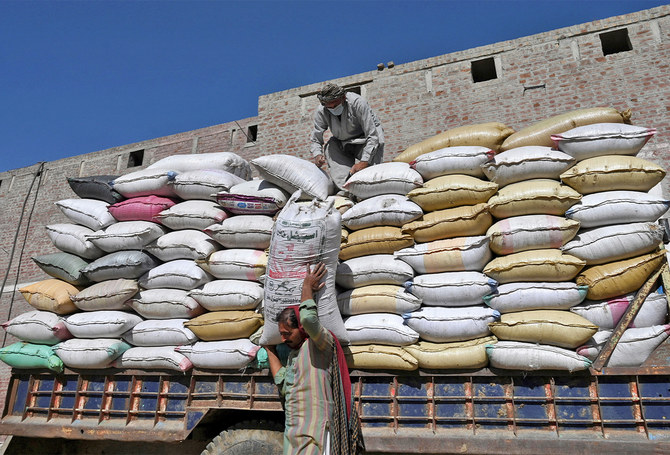
In this picture taken on March 31, 2021, workers unload sacks of rice for a refining process at the Al-Barkat Rice Mills on the outskirts of Lahore, Pakistan. (AFP/File)
Short Url
Updated 11 January 2022
Follow

Rice exporters say high freight charges may cost Pakistan $400 million in revenue

  • Pakistani exporters blame shipping companies for exploiting global supply chain crisis
  • The country’s rice exporters association maintains container charges to China have increased over 1,500 percent within a year

KARACHI: Pakistani rice exporters on Tuesday warned the country could lose $400 million in export revenue due to high freight charges and lack of containers availability.
The global shortage of containers and high freight charges have affected Pakistan’s rice exports, making people associated with the business seek government intervention to restrict the exit of empty containers from the country.
“Due to the lack of availability of containers and high fright costs, 250,000 tons of rice could not be exported last year and this quantity may increase to 500,000 tons this year due to the severity of the situation,” Muhammad Anwar Mianoor, senior vice chairman of the Rice Exporters Association of Pakistan (REAP), said during a news conference.
“The county is likely to lose $400 million in export revenue if timely steps are not taken through policy measures by restricting the movement of empty containers,” he said, adding: “The government should come up with policies for return of empty containers and should bound shipping companies to cap a fixed percentage of empty containers which will be available for export purposes.”
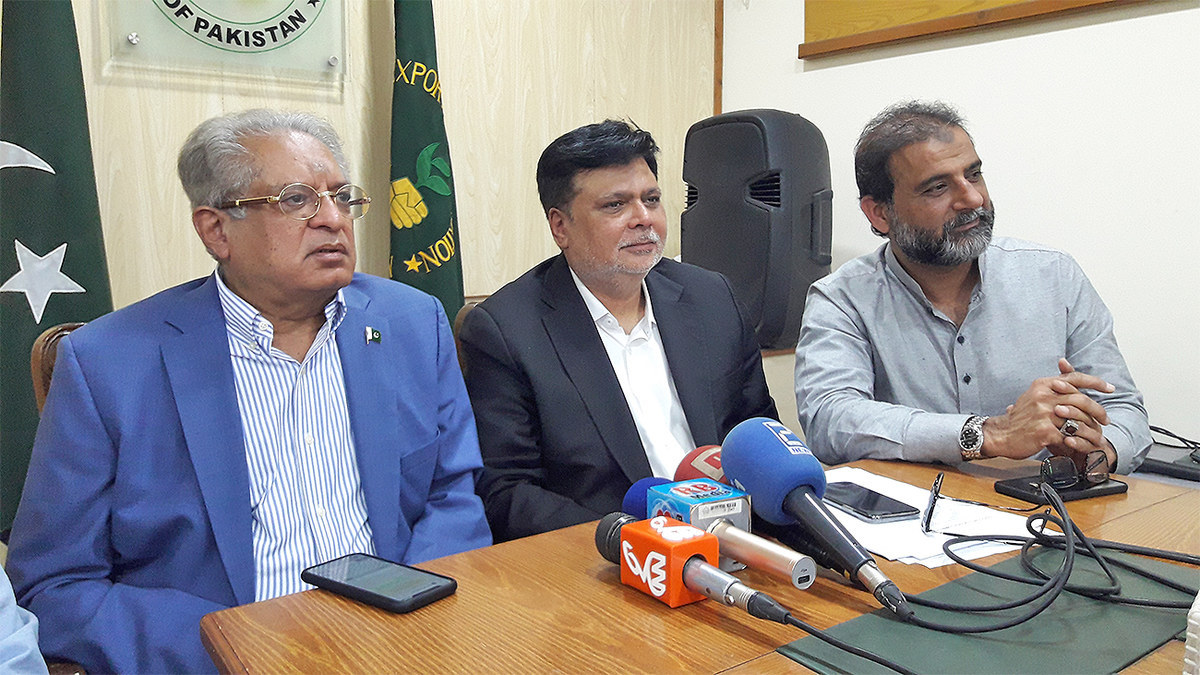


Muhammad Anwar Mianoor (center), senior vice chairman of the Rice Exporters Association of Pakistan (REAP), is addressing a joint news conference with former REAP chairmen Abdul Rahim Janoo (left), Rafique Suleman and other officials in Karachi, Pakistan, on January 11, 2022. (AN photo) 

The REAP official noted India had already taken such steps to facilitate its export sector by allowing imported containers to remain in the country for re-use.
Rice exporters said the container charges had gone up over 1,500 percent by shipping companies which had been steadily increasing the cost of the commodity.
“Over a year, container charges which were $70-80 last year have increased to over $1,300 per container for their Chinese destination,” Mianoor said.
The Pakistani rice exporter called for a complete audit of shipping companies and freight forwarders, saying they were making money by disturbing the export sector.
“Shipping companies have made cartel and are blackmailing us,” he continued.
However, government officials said rice export was continuing from the country, adding that 55,000 tons of it had already been exported this week from the Karachi port.
They also maintained that appropriate measures had been taken to make containers available for exports.
“Around 5,000 containers at the ports are stuck up and we have asked the Federal Board of Revenue to clear them,” Mahmood Moulvi, special assistant to prime minister on maritime affairs, told Arab News.
Pakistan exported around 1.6 million metric tons of rice worth over $826 million, up by 13 percent, during the July-November 2021 period of the current fiscal year.
The country’s exports fell by six percent to over $2 billion, according to the Pakistan Bureau of Statistics.


Pakistan launches final nationwide polio drive of 2025 to vaccinate 45 million children

Updated 4 sec ago
Follow

Pakistan launches final nationwide polio drive of 2025 to vaccinate 45 million children

  • Campaign comes as Pakistan records 30 polio cases this year, one of only two countries where virus is endemic
  • Health minister urges parents to welcome vaccinators as insecurity, misinformation hinder eradication efforts

ISLAMABAD: Pakistan on Thursday launched its final polio vaccination campaign of the year, with Health Minister Mustafa Kamal administering drops to children under five as part of a nationwide effort to reach 45 million children, the country’s polio program said.

The Dec. 15–21 drive is part of Pakistan’s decades-long struggle to eliminate wild poliovirus. Pakistan and neighboring Afghanistan are the only two countries where the virus remains endemic, keeping global eradication efforts at risk.

Pakistan has reported 30 polio cases so far this year. The incurable and highly infectious virus can cause lifelong paralysis and can only be prevented through repeated oral vaccinations and routine immunization, health officials say.

“I want to take this opportunity to speak directly to parents and caregivers. When our polio vaccinator knocks at your door, I urge you to welcome them in and ensure that every child under five in your house receives two drops of this essential vaccine,” the polio program quoted Health Minister Kamal as saying.

“I also urge you to advocate for vaccination in your families and communities and create a welcoming environment for our vaccinators.”

The new campaign comes days after Pakistan conducted a nationwide measles, rubella and polio vaccination drive from Nov. 17–29, which targeted 22.9 million children across 89 high-risk districts.

Pakistan recorded 74 polio cases in 2024, a steep rise from six in 2023 and just one in 2021, underscoring the volatility of eradication efforts in a country where misinformation, vaccine hesitancy and political instability have repeatedly disrupted progress.

Violence has also hampered the program. Polio teams and their security escorts have been attacked frequently by militants and religious hard-liners in parts of northwestern Khyber Pakhtunkhwa and southwestern Balochistan. Officials say continued security threats, coupled with natural disasters such as recent flooding, pose major obstacles to reaching every child.

Pakistan has drastically reduced polio prevalence since the 1990s, when annual cases exceeded 20,000. By 2018, the number had fallen to eight. But health authorities warn that without consistent access to children, particularly in high-risk, underserved region, eradication will remain out of reach.