Committee to probe deaths of 22 snow-tourists in Murree begins work today

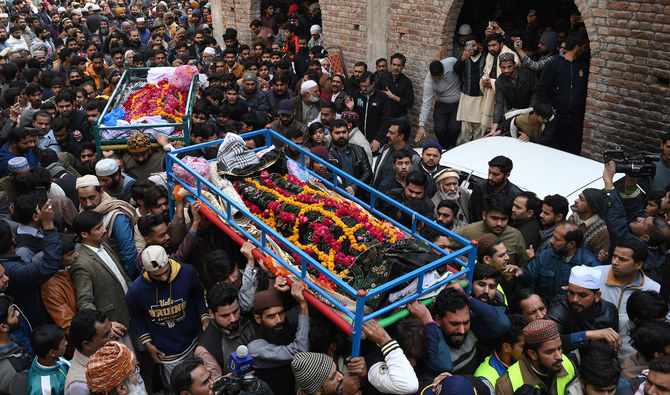
Mourners carry the coffins of snow-tourists in Murree during the funeral in Lahore, Pakistan, on January 9, 2022. (AFP)
Short Url
Updated 11 January 2022
Follow

Committee to probe deaths of 22 snow-tourists in Murree begins work today

  • 22 people died at resort town after being stuck in cars overnight during snowstorm as temperatures plummeted
  • Punjab chief minister formed committee to investigate deaths, announced financial assistance package for families of victims

ISLAMABAD: A five-member committee set up by the Punjab government to investigate the deaths of 22 people, including 10 children, at the popular mountain resort town of Murree last weekend formally started functioning today, Tuesday.

More than 4 feet (1 meter) of snow fell in the area of the Murree Hills resort in the town of Murree near the capital Islamabad on Friday night and early Saturday, trapping the cars of snow-tourists who had thronged to the area in the thousands. The heavy snowfall also caused a massive traffic jam. 

Most of the victims suffered hypothermia as temperatures fell to minus 8 degrees Celsius (17.6 Fahrenheit). Officials said some died of carbon monoxide poisoning from running their car heaters while their mufflers were choked by snow.

Critics of the government say local authorities were ill-equipped to handle the annual influx of snow-tourists and did not prepare to deal with an emergency situation amid unusually heavy snowfall. They say even though authorities warned last weekend that too many vehicles were trying to enter Murree, they failed to discourage hordes of day trippers from going up the mountain over the weekend.

“The committee — led by Additional Chief Secretary Home Zafar Nasrullah and assisted by provincial government secretaries Ali Sarfraz and Asad Gillani, Additional Inspector General of Punjab Police Farooq Mazhar and an opted member — is likely to reach Murree in the next two days to proceed with the investigation,” Pakistan’s Dawn newspaper reported. 

“The committee has been tasked with completing its report and det­er­­mining responsibility within seven days.”

Members of the committee will interview senior police and traffic officers and officials of the district administration, communication and works department, National Highway Authority, National Disaster Management Authority and Provincial Disaster Management Authority as part of the investigation. It will also review the record of phone calls made by tourists to the emergency police number ‘15’ and Rescue 1122 to assess their response.

On Monday, opposition parties rejected Buzdar’s probe committee, asking instead for a judicial probe into the case. 

“The entire opposition demands that a judicial commission be constituted to hold all those responsible for the negligence accountable, we won’t settle for less than this,” leader of the opposition Shehbaz Sharif said during Monday’s National Assembly session where lawmakers debated the Murree deaths. “People remained stuck for 20 hours and there was no one to take care of them.” 

“This is a straight case of administrative failure which can’t be pardoned,” he said, holding the government responsible for what he said was “manslaughter.”

According to a statement released by the interior ministry on Monday, the federal government has extended a ban on entry into Murree for another  24 hours due to ongoing rescue operations in the surrounding areas. The ban does not apply to residents of the areas.

“The situation in Murree and its surrounding Galyat areas is continuously being assessed,” the statement said. “The decision to lift the ban on entry would be taken after reviewing the situation.”


IMF warns against policy slippage amid weak recovery as it clears $1.2 billion for Pakistan

Updated 11 December 2025
Follow

IMF warns against policy slippage amid weak recovery as it clears $1.2 billion for Pakistan

  • Pakistan rebuilt reserves, cut its deficit and slowed inflation sharply over the past one year
  • Fund says climate shocks, energy debt, stalled reforms threaten stability despite recent gains

ISLAMABAD: Pakistan’s economic recovery remains fragile despite a year of painful stabilization measures that helped pull the country back from the brink of default, the International Monetary Fund (IMF) warned on Thursday, after it approved a fresh $1.2 billion disbursement under its ongoing loan program.

The approval covers the second review of Pakistan’s Extended Fund Facility (EFF) and the first review of its climate-focused Resilience and Sustainability Facility (RSF), bringing total disbursements since last year to about $3.3 billion.

Pakistan entered the IMF program in September 2024 after years of weak revenues, soaring fiscal deficits, import controls, currency depletion and repeated climate shocks left the economy close to external default. A smaller stopgap arrangement earlier that year helped avert immediate default, but the current 37-month program was designed to restore macroeconomic stability through strict monetary tightening, currency adjustments, subsidy rationalization and aggressive revenue measures.

The IMF’s new review shows that Pakistan has delivered significant gains since then. Growth recovered to 3 percent last year after shrinking the year before. Inflation fell from over 23 percent to low single digits before rising again after this year’s floods. The current account posted its first surplus in 14 years, helped by stronger remittances and a sharp reduction in imports. And the government delivered a primary budget surplus of 1.3 percent of GDP, a key program requirement. Foreign exchange reserves, which had dropped dangerously low in 2023, rose from US$9.4 billion to US$14.5 billion by June.

“Pakistan’s reform implementation under the EFF arrangement has helped preserve macroeconomic stability in the face of several recent shocks,” IMF Deputy Managing Director Nigel Clarke said in a statement after the Board meeting.

But he warned that Islamabad must “maintain prudent policies” and accelerate reforms needed for private-sector-led and sustainable growth.

The Fund noted that the 2025 monsoon floods, affecting nearly seven million people, damaging housing, livestock and key crops, and displacing more than four million, have set back the recovery. The IMF now expects GDP growth in FY26 to be slightly lower and forecasts inflation to rise to 8–10 percent in the coming months as food prices adjust.

The review warns Pakistan against relaxing monetary or fiscal discipline prematurely. It urges the State Bank to keep policy “appropriately tight,” allow exchange-rate flexibility and improve communication. Islamabad must also continue raising revenues, broadening the tax base and protecting social spending, the Fund said.

Despite the progress, Pakistan’s structural weaknesses remain severe.

Power-sector circular debt stands at about $5.7 billion, and gas-sector arrears have climbed to $11.3 billion despite tariff adjustments. Reform of state-owned enterprises has slowed, including delays in privatizing loss-making electricity distributors and Pakistan International Airlines. Key governance and anti-corruption reforms have also been pushed back.

The IMF welcomed Pakistan’s expansion of its flagship Benazir Income Support Program, which raises cash transfers for low-income families and expands coverage, saying social protection is essential as climate shocks intensify. But it warned that high public debt, about 72 percent of GDP, thin external buffers and climate exposure leave the country vulnerable if reform momentum weakens.

The Fund said Pakistan’s challenge now is to convert short-term stabilization into sustained recovery after years of economic volatility, with its ability to maintain discipline, rather than the size of external financing alone, determining the durability of its gains.