

‘Very wrong decision’:Karachi Eat festival to be held this week despite COVID-19 surge

The file photo shows people attending a concert at Karachi Eat festival in Karachi, Pakistan, on January 12, 2020. (Photo courtesy: Karachi Eat)
Short Url
Updated 11 January 2022
Follow

‘Very wrong decision’:Karachi Eat festival to be held this week despite COVID-19 surge

  • The health department reported a 15.52 percent positivity rate in Karachi, the positivity rate was 6.62 percent on January 4
  • Festival organizers say will strictly impose coronavirus rules, no entry without vaccination certificate, booster shots offered at event

KARACHI: The Karachi Eat food festival will be held on Friday this week despite a surge in coronavirus infections in the port city, organizers and provincial health authorities said on Monday as experts warned against holding the event amid a steady rise in cases, driven by the omicron variant.
The festival, which launched in 2014, attracts hundreds of thousands of foodies each year, offering a diverse range of local and international cuisines and live performances at Karachi’s Beach View Park.
But this year, experts have warned against holding the festival as the health department reported a 15.52 percent positivity rate in Karachi. The positivity rate was 6.62 percent on January 4.
“At the moment the organizers at Karachi Eat are assuring that SOPs [social distancing precautions] will be enforced to the best of their abilities, only vaccinated folks are be allowed entry into the festival and vaccine awareness and boosters will also be provided at the site of the festival,” Mehar Khursheed, a spokesperson for the Sindh health department, said.
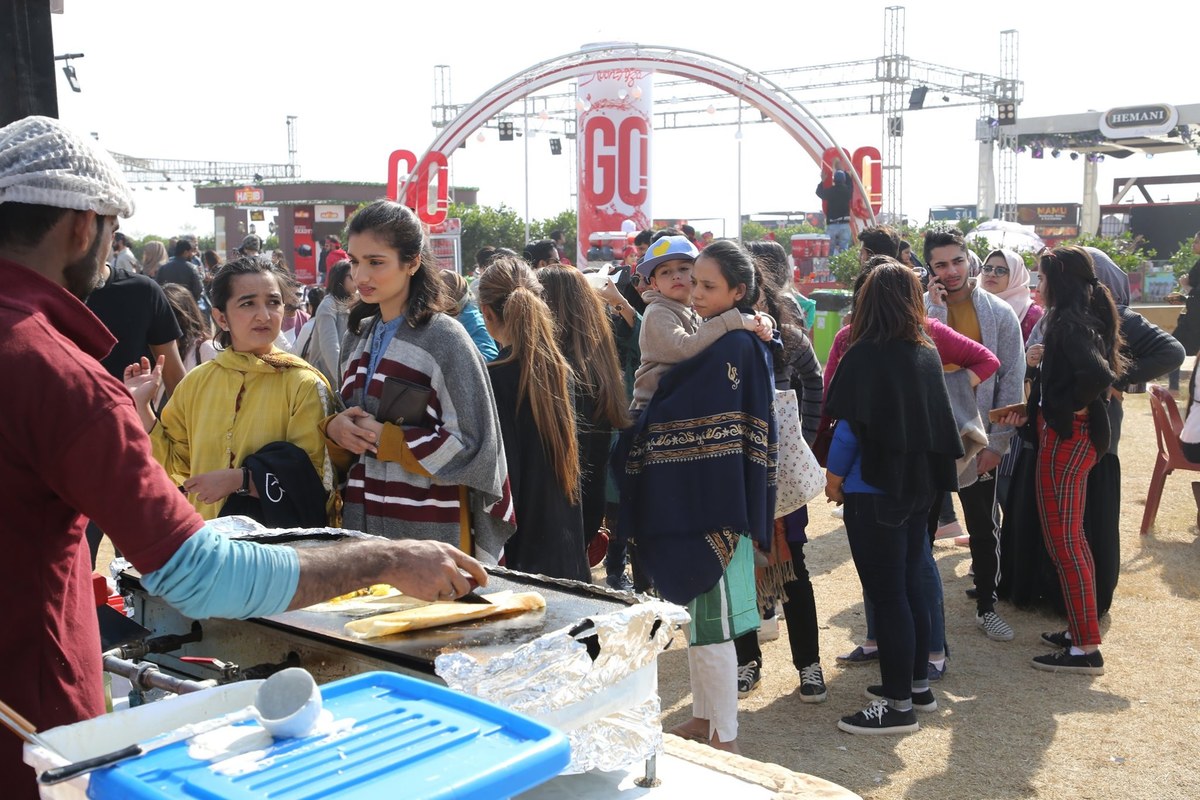


People wait for their turn at a food stall in Karachi Eat festival in Karachi, Pakistan, on January 12, 2020. (Photo courtesy: Karachi Eat/File)

Amna Saleem, an organizer for the festival, said strict coronavirus precautions would be imposed at the event.
“Karachi Eat has been thinking a lot about it and have conclusively decided to maintain strict SOPs,” she said. “We have a COVID-19 Prevention partner that’s giving free booster shots at the festival. Sanitization tunnels and hygiene in washrooms are in place. Ambulances and sanitizers would be seen at the festival too.”
She said only people who were fully vaccinated would be allowed to enter and there would be no entry without proof of vaccination or a computerized national identity card. 
“The Karachi Eat management is in talks with the government officials and there’s no sign of lockdown,” she said, adding that the festival organizers would ensure the “best of the best measures.”
“Having said that, if the festival gets postponed, Karachi Eat will make the official announcement early this week,” Saleem said. “In the meanwhile, the management is trying to help out the food industry people and startups and make Karachi Eat the most successful food festival ever.”
Health experts, however, have warned against holding the event.
“The new omicron strain is spreading fast. If the number of cases grows it can mutate to another, a more lethal strain,” Dr. Qaiser Sajjad, Secretary General of the Pakistan Medical Association, told Arab News. “Secondly, the delta variant is also present in the city and it together with omicron may create another strain or make the existing ones from mild to severe.”
“Holding such a huge gathering is very undesirable in such a situation. The government should not only ask the organizers to postpone the event but also take other measures like limiting attendance in marriage ceremonies and other events that are taking place in the city,” Dr. Sajjad said.
Dr. Seemin Jamali, a senior health practitioner and former executive director of the Jinnah Post Graduate Medical Center (JPMC), said she doubted the festival’s organizers would be able to implement health guidelines adequately. 
“We have seen that the authorities have failed to implement SOPs, except during complete lockdown,” she told Arab News. “People don’t listen and I fear they will become the source of spread of the virus.”
She added: 
“Holding such a huge event when the positivity rate has crossed 15 percent and is expected to further rise is a very wrong decision.”


Pakistani, Bangladeshi officials discuss trade, investment and aviation as ties thaw

Updated 10 sec ago
Follow

Pakistani, Bangladeshi officials discuss trade, investment and aviation as ties thaw

  • Pakistan and Bangladesh were once one nation, but they split in 1971 as a result of a bloody civil war
  • Ties between Pakistan, Bangladesh have warmed up since last year and both nations have resumed sea trade

ISLAMABAD: Pakistan's High Commissioner to Bangladesh Imran Haider on Sunday met Chief Adviser Muhammad Yunus in Dhaka, the latter's office said on, with the two figures discussing trade, investment and aviation.

Pakistan and Bangladesh were once one nation, but they split in 1971 as a result of a bloody civil war, which saw the part previously referred to as East Pakistan seceding to form the independent nation of Bangladesh.

Ties between Pakistan and Bangladesh have warmed up since former prime minister Sheikh Hasina’s ouster as a result of a student-led uprising in August 2024. Relations remain frosty between Dhaka and New Delhi over India’s decision to grant asylum to Hasina.

Pakistan has attempted to forge closer ties with Bangladesh in recent months and both South Asian nations last year began sea trade, followed by efforts to expand government-to-government commerce.

"During the meeting, both sides discussed ways to expand cooperation in trade, investment, and aviation as well as scaling up cultural, educational and medical exchanges to further strengthen bilateral relations between the two South Asian nations," Yunus's office said in a statement on X.

In 2023-24 Pakistan exported goods worth $661 million to Bangladesh, while its imports were only $57 million, according to the Trade Development Authority of Pakistan. In Aug. this year, the Pakistani and Bangladeshi commerce ministries signed a memorandum of understanding to establish a Joint Working Group on Trade, aiming to raise their bilateral trade volume to $1 billion in the financial year that began in July.

The Pakistani high commissioner noted that bilateral trade has recorded a 20 percent growth compared to last year, with business communities from both countries actively exploring new investment opportunities, according to the statement.

He highlighted a significant increase in cultural exchanges, adding that Bangladeshi students have shown strong interest in higher education opportunities in Pakistan, particularly in medical sciences, nanotechnology, and artificial intelligence. Haider also said that Dhaka-Karachi direct flights are expected to start in January.

"Chief Adviser Professor Muhammad Yunus welcomed the growing interactions between the two countries and emphasized the importance of increased visits as well as cultural, educational and people-to-people exchanges among SAARC (South Asian Association for Regional Cooperation) member states," the statement read.

"Professor Yunus also underscored the need to further boost Bangladesh–Pakistan trade and expressed hope that during Mr. Haider’s tenure, both countries would explore new avenues for investment and joint venture businesses."