ISLAMABAD: Pakistan’s top commerce official is pushing the government to bet big on the export industry by maintaining tens of millions of dollars of policy support even as the South Asian nation looks to tighten its fiscal belt in a mid-year budget this month.
The country’s all-important textile industry is at the center of this export-led growth strategy, said Abdul Razak Dawood, adviser to Pakistan’s prime minister, as the government targets ambitious growth of 4.8 percent in the 2021-2022 financial year.
Authorities have supported the export industry since coming to power in 2018 by securing competitive energy prices and offering cheap credit. Dawood told Reuters he had spoken to the prime minister and finance minister about the need for continued support.
The government is looking to end tax exemptions in a number of areas in its mid-year budget as part of fiscal tightening efforts aimed at securing the release of $1 billion in IMF funds. Pakistan entered a $6 billion support program with the International Monetary Fund in 2019.
“People in this country don’t understand what the importance of exports … export-led growth strategy (is),” Dawood said in an interview with Reuters on Friday.
He said continuing support for exports is the best way to tackle Pakistan’s long-standing economic woes and achieve sustained growth.
Pakistan’s exports hit a historic high of $25.3 billion in the 2020-2021 financial year, with textiles making up a whopping 60 percent of those exports. That helped the country achieve 3.94 percent GDP growth last year after a coronavirus-induced slump.
Pakistan’s exports have risen 24.7 percent year-on-year in the first half of the 2021-2022 financial year, official data showed last week.
“You can see that there’s been a remarkable jump,” Dawood said.
One driver has been the government’s policy of securing regionally competitive power rates to allow Pakistani exporters to match prices offered by peers such as India, Bangladesh and Vietnam, he said.
The central bank has also offered cheap credit to the industry after the coronavirus-induced economic slowdown.
To sustain this, Dawood is encouraging the government to push through with a textile export policy which has faced push-back from various government departments.
The policy could include billions of rupees in regionally competitive energy rate assurances, concessional funds, drawbacks and tax rebates, experts and local media reports say.
While Dawood said months of negotiation between the commerce and other ministries have delayed the policy’s release, it could be enacted as early as this month with certain “conditionalities.”
Growing exports have been accompanied by a surging import bill, which Dawood said has been driven by rising global fuel and food prices and purchases of COVID-19 vaccines.
Imports grew 65 percent year-on-year to reach over $40 billion in the first half of this financial year, putting a strain on the country’s $24 billion foreign exchange reserves.
The spike has not unnerved Dawood, who said it also reflected “good imports” of capital goods and raw materials — a sign that the country’s industries are growing.
Some economic experts have criticized Pakistan’s over-reliance and continuous support for the textile industry.
Dawood said he did not agree that the textile sector was “too pampered” but acknowledged the need to diversify Pakistan’s exports: “In the long run, we should not just depend on just textiles … if something were to happen to textiles, where would the country go?“
Other experts do not agree with Dawood’s policy of sustained support.
“The government needs to evaluate subsidies given to export related sectors in light of the fiscal challenges as well as misuse of those subsidies,” said Mohammed Sohail, CEO of brokerage Topline Securities. “In the past we have seen that such support has not yielded desired results.”


Pakistan’s top commerce official wants continued support for exports despite fiscal tightening

https://arab.news/4uyxn
Pakistan’s top commerce official wants continued support for exports despite fiscal tightening
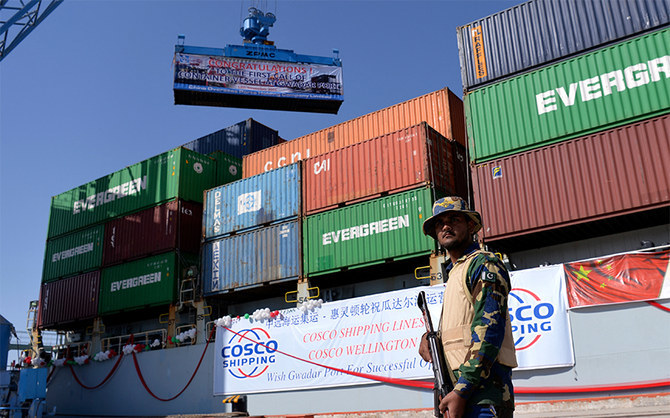
- Pakistani government is looking to end tax exemptions in a number of areas in its mid-year budget
- PM’s aide Abdul Razak Dawood says continuing support for exports best way to tackle economic woes

Pakistan PM attends inaugural Gaza peace board meeting as Islamabad backs Palestinian statehood
- Shehbaz Sharif poses with US President Donald Trump, world leaders as meeting kicks off in Washington
- Pakistan’s foreign office says Sharif will also meet senior US leadership, other heads of states on the sidelines
ISLAMABAD: Prime Minister Shehbaz Sharif on Thursday arrived at the Donald J. Trump US Institute of Peace to attend the inaugural meeting of the Board of Peace in Washington, as Islamabad says its participation is aimed at securing a ceasefire, reconstruction and an independent Palestinian state.
The visit comes at Trump’s invitation and will run from Feb. 18–20, according to the Prime Minister’s Office, with Sharif accompanied by Deputy Prime Minister and Foreign Minister Ishaq Dar and other senior officials.
The Board of Peace, formed under a UN Security Council resolution following a fragile October 2025 ceasefire between Israel and Hamas, is intended to oversee international stabilization and rebuilding efforts in Gaza after months of war.
The session began with Trump posing for photographs with world leaders gathered at the venue, including Sharif. The American president was flanked by US Secretary of State Marco Rubio, White House chief of staff Susie Wiles, Vice President JD Vance and Trump’s son-in-law, Jared Kushner, a member of the organization’s executive board.
“Pakistan Prime Minister Shehbaz Sharif has arrived at the Donald Trump Institute of Peace in Washington to attend the inaugural meeting of the Board of Peace at the invitation of President Trump,” state-run Pakistan TV Digital reported.
Pakistan formally joined the body last month after Sharif signed its charter alongside other world leaders in Davos. The forum includes an eight-nation Muslim bloc comprising Türkiye, Egypt, Jordan, Indonesia, Qatar, Saudi Arabia and the United Arab Emirates.
“Pakistan joined the Board of Peace as part of its almost eight decades-long support for the rights and dignity of the Palestinian people,” Prime Minister’s spokesperson for foreign media Mosharraf Zaidi told Arab News on Wednesday.
“This begins and ends with the establishment of a Palestinian state based on pre 1967 borders and Al Quds Al Sharif as its capital.”
Islamabad hopes involvement in the forum will allow it to shape post-war governance arrangements while protecting Palestinian political rights.
“Pakistan’s participation is explicitly tied to a pathway to Palestinian statehood and international law,” Zaidi said.
He added that participation did not signal recognition of Israel.
“Participating in this historic initiative is not recognition of Israel and does not change Pakistan’s principled position on Palestine.”
He also stressed that multilateral engagement does not equal diplomatic normalization.
“Engagement in multilateral mechanisms that includes Israel does not equal diplomatic relations. Israel is a UN member state, and a member of the World Bank and IMF since 1954–but this does not entail normalization.”
Pakistan’s foreign office says the prime minister will also meet senior US leadership and other heads of government on the sidelines.
“The occasion will provide an opportunity for discussions on bilateral matters, as well as global issues of mutual concern,” the PMO statement said.


