

Pakistan's National Assembly meets today with mini-budget on agenda

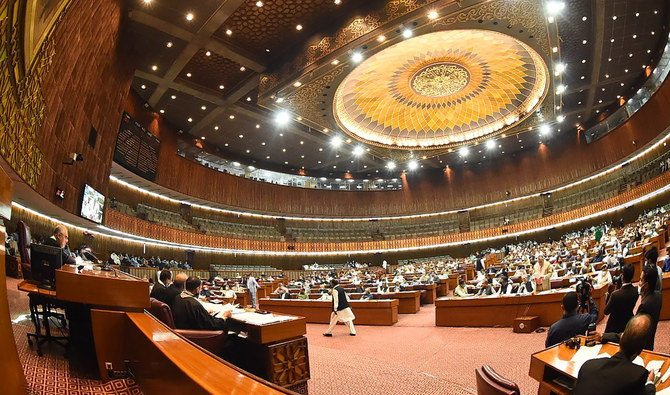
This photograph released by Pakistan National Assembly on January 7, 2022, shows a general view of a parliament session in Islamabad. (Photo courtesy: @NAofPakistan/Twitter)
Short Url
Updated 10 January 2022
Follow

Pakistan's National Assembly meets today with mini-budget on agenda

  • Approval of mini-budget is one of five IMF conditions for revival of Pakistan's $6 billion loan program
  • Revival of IMF program will allow release of over $1 billion loan tranche to the South Asian country

ISLAMABAD: A session of the National Assembly of Pakistan will be held on Monday (today) with the Finance (Supplementary) Bill, commonly referred to as the mini-budget, on its agenda. 

The Finance (Supplementary) Bill 2021, which was presented in the lower house of parliament last month, aims to end tax exemptions on nearly 150 items as a prior action for the revival of the IMF program. It will empower the government to level a uniform 17 percent General Sales Tax (GST) on goods that were taxed at 5 percent or 12 percent rates. The amendment will also enable the government to generate over Rs343 billion in additional revenue. 

The National Assembly Secretariat earlier issued a 48-point agenda for the Monday’s session, which included a motion in the name of Pakistani finance minister Shaukat Tarin, seeking the passage of the finance bill.  

In late December 2021, the Pakistani government tabled the Finance (Supplementary) Bill 2021 and State Bank (Amendment) Bill 2021 in the National Assembly to meet one of the five conditions set by the International Monetary Fund (IMF) for the revival of $6 billion loan program Pakistan secured in 2019. 

Pakistan has asked the IMF to delay a board meeting meant to consider 6th review of the loan program until the end of January, its finance ministry said on Monday. 

"Government of Pakistan has introduced both the bills in the National Assembly and IMF has moved the 6th tranche recommendation to its board for consideration on the 12th January," it said in a statement.  

"As soon as the legislative procedures are completed, the IMF board will consider it for approval." 

Five reviews of the IMF loan program had been completed by March. The sixth review has been pending since June 2021. The revival of the IMF program would allow the release of over $1 billion loan tranche to Pakistan, which would bring total disbursements to over $3 billion. The IMF program revival would also unlock significant funding from bilateral and multilateral donors. 

Meanwhile, National Assembly Opposition Leader Shehbaz Sharif will preside over a meeting of opposition parties to finalize a strategy to block the passage of the finance bill, a spokesperson for the Pakistan Muslim League-Nawaz (PML-N) opposition party said on Sunday. 

Opposition leaders will also hold consultation on the foreign funding case against the ruling Pakistan Tehreek-e-Insaf (PTI) party and other affairs, PML-N spokesperson Marriyum Aurangzeb said. 

The meeting has been scheduled for 3pm on Monday afternoon, she added. 


Pakistan rice exports slump 40% as India’s return hits pricing power

Updated 5 sec ago
Follow

Pakistan rice exports slump 40% as India’s return hits pricing power

  • Statistics show non-Basmati shipments have fallen over 50 percent in July-January period
  • Government offers 9 percent tax drawback on premium Basmati exports to support sector

ISLAMABAD: Pakistan’s rice exports fell 40.5 percent to $1.31 billion in the first seven months of the fiscal year, official data showed on Tuesday, as India’s return to the global market squeezed Islamabad’s market share and pricing power.

According to the Pakistan Bureau of Statistics (PBS), non-Basmati exports dropped 50.8 percent to $827.8 million, with volumes falling to 2.0 million tons from 3.15 million tons a year ago. Basmati exports declined 6.62 percent to $477.7 million, with volumes easing to 436,484 tons from 487,278 tons.

The Ministry of National Food Security told a parliamentary committee in two separate meetings in December and January that India’s re-entry into the global rice market was a key factor behind the decline, saying increased Indian supplies had made Pakistani rice less competitive.

Officials told lawmakers that India benefits from free trade agreements and provides substantial support to its rice sector, putting additional pressure on Pakistani exporters.

In response, the Ministry of Commerce last month issued a notification under the “Drawback of Local Taxes and Levies for Rice Order, 2026,” allowing a rebate of 9 percent of the free-on-board (FOB) value for Basmati exports priced above $750 per metric ton.

The government said the measure, announced on January 23, aims to ease liquidity pressures on exporters and improve competitiveness.

While PBS data for July-January shows a 40.5 percent decline, figures from the Federal Board of Revenue (FBR) for July-December show an even steeper 47 percent drop to $973 million from $1.82 billion in the same period last year, reflecting a deficit of over $800 million.

Industry representatives say they are now focusing on market diversification to counter the slowdown.

“Currently Basmati is mainly exported to Middle East and EU. Non-Basmati is exported to Philippines, Indonesia, Malaysia and African countries,” Malik Faisal Jahangir, chairman of the Pakistan Rice Exporters Association, told Arab News last week.

“For the new markets for our non-basmati rice exports, we are looking to increase our volumes to China, Philippines, Indonesia and Bangladesh,” he added.