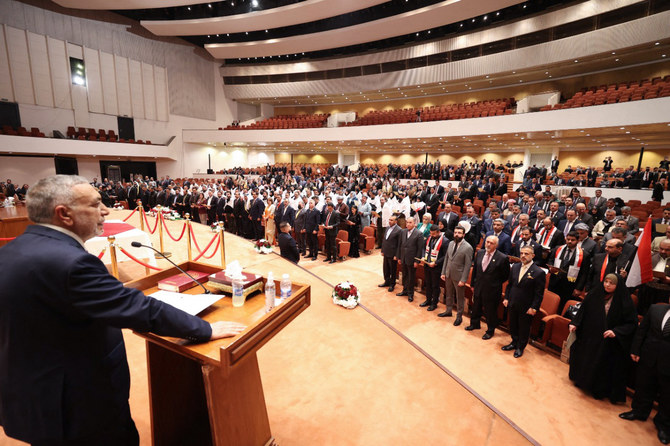
BAGHDAD: Iraq’s parliament held its first session on Sunday electing Sunni lawmaker Mohammed Al-Halbousi as speaker, marking an important step toward establishing a new government three months after a national election.
Following a brief delay, parliament resumed its meeting when a new temporary speaker presided over the session after Mahmoud Al-Mashahadani, who, at 73 is the oldest member of parliament, was suddenly taken ill and taken to hospital.
Earlier, the speaker selection process was disrupted as competing political Shiite blocs each claimed to hold a parliamentary majority. After heated debates and shouting among lawmakers, the temporary leader of the assembly, Mahmoud Al-Mashahadani, decided to adjourn the session.
Iran-backed Shiite political coalition Fatah and the State of Law coalition, which is led by former Prime Minister Nuri Al-Maliki, submitted a document to Mashhadani requesting their coalition to be the largest bloc in parliament.
Lawmaker from Shiite cleric Moqtada Al-Sadr’s party, which came first in October elections, have strongly objected the request, defending their position as the largest bloc.
“The debate between Shi’ite parties over which bloc is the largest in parliament has disrupted the session and forced a brief delay,” said Jamal Kojar, a Kurdish lawmaker.
The main winner of the Oct. 10 election was Shiite cleric Moqtada Al-Sadr, a populist who has positioned himself as a staunch opponent of both Iran and the United States.
Sadr’s bloc, already the biggest in the 329-seat parliament, will expand to 73 seats from 54. Its main rivals for years, the Fatah bloc of factions linked to pro-Tehran militia, meanwhile, saw its parliamentary representation collapse to just 17 seats from 48.
Parliament was due to elect two deputies for the speaker during its first meeting on Sunday.
Parliament also has 30 days from the first session to elect the country’s new president, who will then ask the largest bloc in parliament to form a government.
Under Iraq’s governing system in place since the post-Saddam Hussein constitution was adopted in 2005, the prime minister is a member of the Shi’ite majority, the speaker a Sunni and the largely ceremonial president a Kurd.
Iraqi parliament holds first session, elects speaker
https://arab.news/p6jnd
Iraqi parliament holds first session, elects speaker
- Sunni lawmaker Mohammed Al-Halbousi was elected as speaker
- Mahmoud Al-Mashahadani, the oldest member of parliament, was suddenly taken ill and taken to hospital
NGOs condemn settler attack on activists in West Bank
- Herzog said on X he strongly condemned the violence that “stands in complete opposition to the values of the State of Israel“
- The attack occurred in the Palestinian village of Qusra in the northern West Bank
JERUSALEM: Two Israeli NGOs denounced an attack Friday in which settlers used sticks to beat two activists in the occupied West Bank, calling the incident “state violence” and “Jewish terrorism.”
Israeli President Isaac Herzog said on X he strongly condemned the violence that “stands in complete opposition to the values of the State of Israel.”
“This serious incident adds to a series of recent... unacceptable events that harm, above all, the (West Bank colonization) enterprise and the reputation of the State of Israel,” he added.
The attack occurred in the Palestinian village of Qusra in the northern West Bank.
Israeli human rights group B’Tselem released a video filmed by one of the activists, which showed at least four masked men armed with sticks jumping out of a four-wheel drive vehicle that arrived at high speed.
Someone was then heard yelling “No, please, no” in Hebrew, followed by thuds and cries of pain, before the attackers departed.
Two people were left on the ground, one of them motionless and stretched out face down with a bleeding head.
Israeli emergency service Magen David Adom said the two wounded individuals, who are in their fifties, were taken by helicopter to a hospital in Israel.
The Israeli military said it was searching for suspects.
Excluding Israeli-annexed east Jerusalem, more than 500,000 Israelis live in West Bank settlements and outposts, which are illegal under international law.
Around three million Palestinians live in the territory, which Israel has occupied since 1967.
In recent months, attacks attributed to Israeli settlers have multiplied in the West Bank, targeting Palestinians, Israeli and foreign anti-settlement activists and sometimes Israeli soldiers.
The Israeli government, considered one of the most right-wing in the country’s history, has fast-tracked settlement expansion.
B’Tselem said “the unrestrained attacks carried out by settlers throughout the West Bank constitute state violence.”
“They are carried out with full backing, participation, and assistance from state authorities, as part of a strategy of Israel’s apartheid regime seeking to advance and complete the takeover of Palestinian land,” it added.
Avi Dabush, executive director of Rabbis for Human Rights, said “the blood of our friends is on the hands of those who support and finance Jewish terrorism, either directly, through the government or by turning a blind eye.”
He also condemned “the army’s impotence” in a statement that called on “Israeli society to pull itself together ... in order to put an end to this endemic terrorism.”