

What goes into creating a fragrance for the Middle East?

Christian Louboutin produced a perfume line crafted specifically for regional consumers. Supplied
Short Url
Updated 09 January 2022
Follow

What goes into creating a fragrance for the Middle East?

  • French nose Fanny Bal reveals the secrets behind appealing to regional customers

DUBAI: Scent is an essential part of the beauty regimes of Arab men and women. According to Euromonitor, the fragrance market in the Middle East is projected to reach $4.4 billion in 2027, with Saudi Arabia and the UAE making up the region’s two largest markets for scents.

These statistics prove extremely beneficial for the revenue of luxury brands, many of which have produced perfume lines crafted specifically for regional consumers.

“The Middle Eastern consumers, they are really in love with perfume,” said the renowned French nose Fanny Bal, who recently dreamed up Loubiprince, one of the musk-infused scents that makes up Christian Louboutin Beauty’s unisex fragrance collection launched exclusively for the region.


Loubiprince is the brainchild of French nose Fanny Bal. Supplied

“Fragrance is part of the culture in the Middle East. It goes way deeper than in any other region in the world,” she added.

When it comes to their preferences, Saudi Arabia and the UAE both favour traditional scents, and tend to gravitate towards perfumes boasting potent ingredients such as oud and musk, she said.

“It was very interesting developing the fragrances because you can go deeper in terms of intensity and the choice of the ingredients. Unlike in Europe or America, where consumers prefer fruity or floral scents, we were able to explore stronger notes that we wouldn’t typically use for the European market,” said Thomas James, Chief Brands Officer for Niche Brands at Puig. “For instance, we wouldn’t use incense for European customers, but in the Middle East, of course, incense is so important.”

For this specific fragrance, Bal — who has conceived perfumes for Givenchy, Frederic Malle, Issey Miyake and even popstar Shakira — looked at ingredients that have become synonymous with Middle Eastern fragrances, including resin, amber, spice and sandalwood.
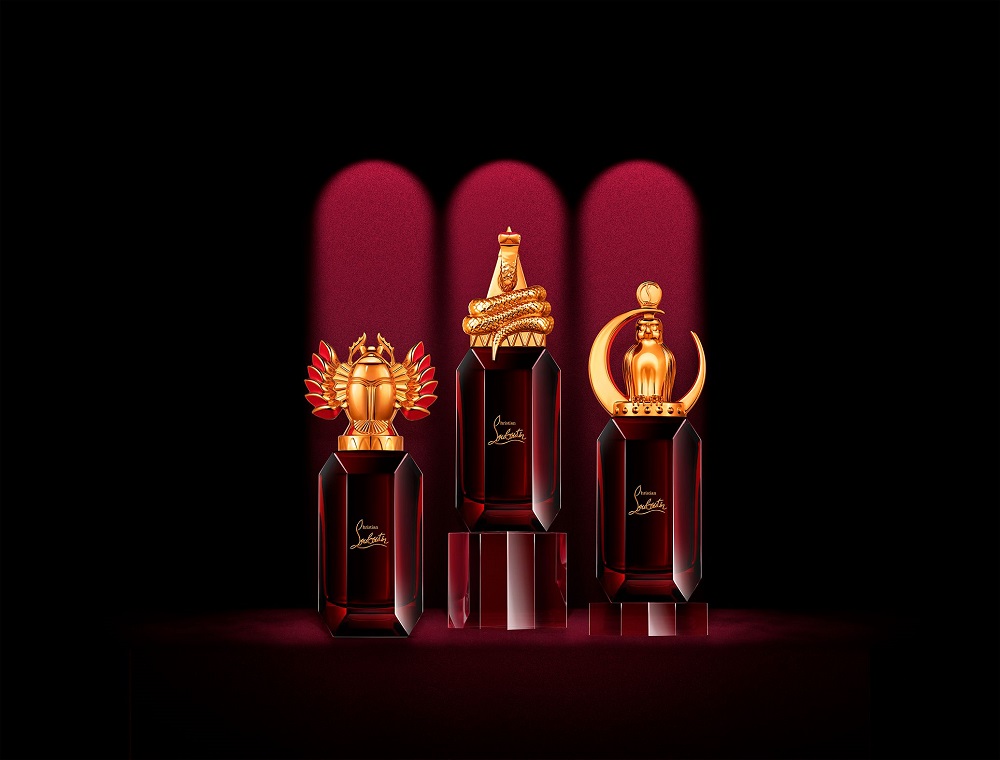


The three-piece fragrance collection pays homage to the Middle East. Supplied

There are two other fragrances that make up the exclusive Louboutin collection: Loubicharme and Loubiluna by French perfumer Christophe Raynaud.

Loubiluna is a blend of fig milk, cedar wood and papyrus, while Loubicharme boasts floral notes of geranium and rose balanced by incense and patchouli.

In addition to the ingredients, Christian Louboutin also paid homage to the region in the presentation of each scent. They come in an opulent red bottle with a gold cap depicting a scarab beetle, pyramid and a crescent moon. 

Bal reveals that Louboutin’s roots served as the starting point of the collection. The designer, best known for his red-soled footwear, was born in Paris to a French mother and an Egyptian father, a discovery he only made recently. The godfather of part-Egyptian model Elisa Sednaoui, he has always felt a connection to the North African country. He owns property in Luxor, a purchase made well before he discovered his heritage.

For instance, one of the main ingredients used in the perfumes is papyrus, a thick paper-like material that was used in ancient Egypt for writing on. “When you think of papyrus, you also think of Egypt. Perfumers don’t use papyrus often, but it made sense with Louboutin’s story,” shared Bal.


Book Review: ‘Padma’s All American’ Cookbook

Updated 19 December 2025
Follow

Book Review: ‘Padma’s All American’ Cookbook

  • For her, the true story of American food proves that immigration is not an outside influence but the foundation of the country’s culinary identity

Closing out 2025 is “Padma’s All American: Tales, Travels, and Recipes from Taste the Nation and Beyond: A Cookbook,” a reminder that in these polarizing times within a seemingly un-united US, breaking bread really might be our only human connection left. Each page serves as a heaping — and healing — helping of hope.

“The book you have before you is a personal one, a record of my last seven years of eating, traveling and exploring. Much of this time was spent in cities and towns all over America, eating my way through our country as I filmed the shows ‘Top Chef’ and ‘Taste the Nation’,” the introduction states.

“Top Chef,” the Emmy, James Beard and Critics Choice Award-winning series, which began in 2006, is what really got Padma Lakshmi on the food map.

“Taste the Nation,” of course, is “a show for immigrants to tell their own stories, as they saw fit, and its success owes everything to the people who invited us into their communities, their homes, and their lives,” she writes.

Working with producer David Shadrack Smith, she began developing a television series that explored American immigration through cuisine, revealing how deeply immigrant food traditions shaped what people considered American today.

She was the consistent face and voice of reason — curious and encouraging to those she encountered.

Lakshmi notes that Americans now buy more salsa and sriracha than ketchup, and dishes like pad Thai, sushi, bubble tea, burritos and bagels are as American as apple pie — which, ironically, contains no ingredients indigenous to North America. Even the apples in the apple pie came from immigrants.

For her, the true story of American food proves that immigration is not an outside influence but the foundation of the country’s culinary identity.

“If I think about what’s really American … it’s the Appalachian ramp salt that I now sprinkle on top of my Indian plum chaat,” she writes.

In this book Lakshmi tells the tale of how her mother arrived in the US as an immigrant from India in 1972 to seek “a better life.”

Her mother, a nurse in New York, worked for two years before Lakshmi was brought to the US from India. At 4 years old, Lakshmi journeyed alone on the 19-hour flight.

America became home.

Now, with visibility as a model and with a noticeable scar on her arm (following a horrific car accident), she is using her platform for good once again.

Lakshmi is merging her immigrant advocacy with her long career in food media.

The photo of her on the cover, joined by a large American flag, is loud, proud and intentional.

The book contains pages dedicated to ingredients and their uses, actual recipes and, most deliciously, the stories of how those cooks came to be.