



RIYADH: Saudi Arabia’s campaign to resolve the Yemeni crisis and reach a political solution will continue despite growing Houthi aggression, the spokesman for the Coalition to Support Legitimacy in Yemen has said.
Brig. Gen. Turki Al-Maliki’s comments came during a press conference held on Saturday in Riyadh amid a surge in fighting in Yemen as a result of Houthi setbacks.
Al-Maliki said: “The Saudi initiative to resolve the Yemeni crisis exists despite the evidence of the Houthi militia’s militarization of Sanaa International Airport and the port of Hodeidah, using them to target civilians in Saudi Arabia and Yemen and as ballistic missile stores.
“Any initiative presented by the coalition or the Kingdom is certainly provided for the benefit of the Yemeni people, and we believe that a political solution is the appropriate solution to the Yemeni crisis, but the Houthi militia is intransigent.”
This week, the militia seized a UAE vessel, Rwabee, that was transporting urgent medical supplies to Yemen.
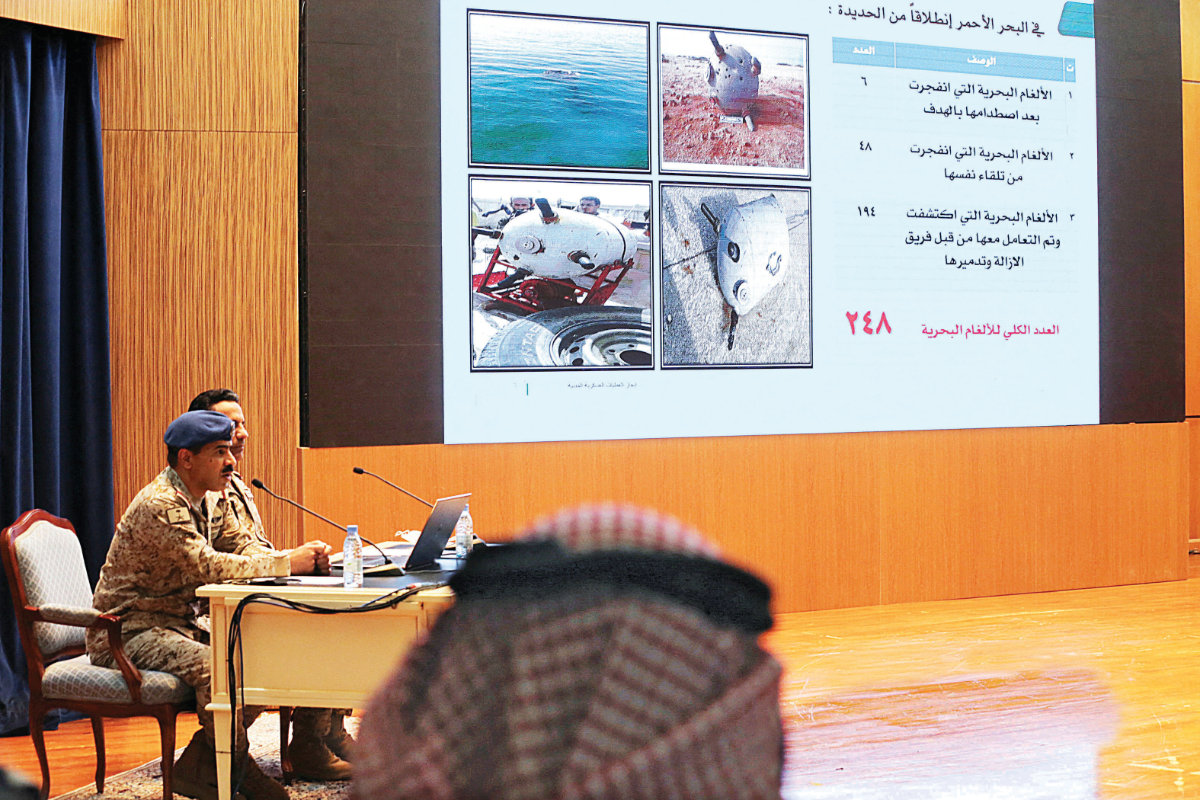
Brig. Gen. Turki Al-Maliki, spokesman for the Arab Coalition, shows at a press conference in Riyadh some of the devices that were used to attack ships. (Reuters)
The coalition “has known for some time about the Houthi militia’s use of the ports of Hodeidah and Saleef in hostilities,” Al-Maliki said, adding: “There was no military action against these positions because the coalition takes into account the interests of the Yemeni people.
“The Houthis also must take into account the interests of the Yemeni people, and therefore the Houthi intransigence cannot be linked to the continuation of humanitarian initiatives.”
Al-Maliki said: “We cannot blame the UN for what the Houthi militia is doing to the port of Hodeidah after the Stockholm Agreement, because the UN deals with all parties on the principle of good intentions.
“The Houthi militia has not allowed the UN to implement the Stockholm Agreement, There is a re-coordination committee in Hodeidah yet there has been no full commitment to military redeployment in Hodeidah.”
The spokesman warned that the two key ports of Saleef and Hodeidah, as well as Ras Issa, have not been handed over by the Houthis as required by the Stockholm Agreement.
There is evidence that the militia has used the Saleef and Hodeidah ports to launch ballistic missiles toward coalition targets and Saudi Arabia, Al-Maliki said, adding that the sites are also used to launch explosive-laden vessels.
He warned that “it is in the interests of the Houthis” to ignore the Stockholm Agreement so that it can “continue its hostile operations, maintain the status quo and keep control over financial resources and the black market.”
He added: “The Houthi militia continued its violations of international navigation rules in the Red Sea and violation of international laws through piracy operations in international waters by launching 100 booby-trapped boats in the Red Sea.”
Maj. Gen. Pilot Abdullah Al-Hababi, director of the Civil Military Operations Department, said that the coalition “recorded 13 violations by the Houthi militia against commercial ships from Hodeidah,” adding that 248 sea mines launched by the Houthis in the Red Sea were destroyed.
Regarding the Rwabee incident, Al-Maliki said that the vessel was carrying aid for Yemenis on Socotra Island who were affected by hurricanes, adding that the Houthi militia “planned to attack and hijack the vessel in international waters.”
Al-Hababi reviewed a number of ships targeted by the Houthis, including Rabigh 3, Abqaiq and a Turkish ship loaded with wheat. He also unveiled the names of those involved in Houthi piracy operations in the Red Sea, noting that these operations were led by Mansour Al-Saadi, who has been on a US Treasury blacklist since last year.
Al-Maliki said: “The ships attacked by Houthi pirates were picked by the Iranian Revolutionary Guard Corps and former Iranian ambassador to the Houthis, Hassan Irloo.
“The Iranian ship Saviz is a military vessel with civilian cover that transports Iran’s weapons and experts to Hodeidah,” he added.
The spokesman said that the Houthi militia use another Iranian vessel, Noor, to target commercial vessels.
Al-Maliki also presented evidence on the Houthi militia’s recruitment of children.

keywords


