UN calls on all involved in Kazakhstan unrest to choose peace over violence 

Kazakhstan on Jan. 5, 2022 declared a nationwide state of emergency after protests over a fuel price hike erupted into clashes and saw demonstrators storm government buildings. (AFP)
Short Url
Updated 08 January 2022
Follow

UN calls on all involved in Kazakhstan unrest to choose peace over violence 

  • Killing of both police officers and protesters is “unacceptable,” said the spokesperson for Secretary-General Antonio Guterres
  • The UN’s high commissioner for human rights urged authorities to fully restore internet service to avoid fueling the violence and unrest 

NEW YORK: The UN on Friday appealed to all those involved in the unrest in Kazakhstan to exercise restraint, refrain from violence and resolve their grievances through peaceful means.

The country is experiencing the worst street protests it has witnessed since the nation gained independence from the Soviet Union three decades ago, and dozens reportedly have been killed.

“It’s important that there be a stop to the violence,” Stephane Dujarric, spokesperson for Secretary-General Antonio Guterres, told reporters at the UN headquarters in New York.

“The killing of police officers is unacceptable; the killing of protesters is as well. There is a clear need in any situation to respect human rights and international standards while we reestablish public order.”

Kazakhstan’s President Kassym-Jomart Tokayev has referred to demonstrators as “terrorists.” On Friday, he authorized security forces to shoot to kill when responding to anti-government protests.

The demonstrations began on Jan. 2, following a near-doubling of fuel prices, and quickly spread across the country.

On Thursday, Michelle Bachelet, the UN’s high commissioner for human rights, reminded the Kazakh authorities that any use of force must be subject to “strict requirements of necessity and proportionality.”

She added: “Lethal force, in particular live ammunition, should only be used as a last resort against specific individuals to address an imminent threat of death or serious injury.”

A police spokesperson in Kazakhstan’s main city of Almaty said that security forces have killed dozens of protesters. More than 1,000 people reportedly have been injured.

According to the Kazakh interior ministry, 12 police officers were killed during the unrest and more 300 have been injured.

“International law is clear: People have the right to peaceful protest and freedom of expression,” Bachelet said. “At the same time, protesters, no matter how angry or aggrieved they may be, should not resort to violence against others.”

Internet service in Kazakhstan has been severely disrupted since Sunday, including intermittent complete shutdowns. Bachelet warned against denying people access to information and their right to freedom of expression, and added: “Shutting down the internet is not the answer to a crisis but risks fueling the violence and unrest.”

She urged the Kazakh government to immediately restore full access to the internet, pointing out that it is “vital for emergency health services during the COVID-19 pandemic.”

She also called on the authorities to enshrine the importance of dialogue and the protection of human rights during the state of emergency and beyond.


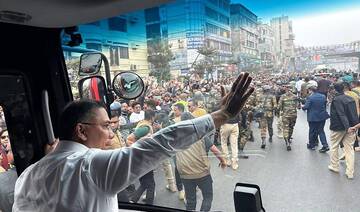
Bangladesh’s religio-political party open to unity govt

Updated 01 January 2026
Follow

Bangladesh’s religio-political party open to unity govt

  • Opinion polls suggest that Jamaat-e-Islami will finish a close second to the Bangladesh Nationalist Party in the first election it has contested in nearly 17 years

DHAKA: A once-banned Bangladeshi religio-political party, poised for its strongest electoral showing in February’s parliamentary vote, is open to joining a unity government and has held talks with several parties, its chief said.

Opinion polls suggest that Jamaat-e-Islami will finish a close second to the Bangladesh Nationalist Party in the first election it has contested in nearly 17 years as it marks a return to mainstream politics in the predominantly Muslim nation of 175 million.

Jamaat last held power between 2001 and 2006 as a junior coalition partner with the BNP and is open to working with it again.

“We want to see a stable nation for at least five years. If the parties come together, we’ll run the government together,” Jamaat chief Shafiqur Rahman said in an interview at his office in a residential area in Dhaka, ‌days after the ‌party created a buzz by securing a tie-up with a Gen-Z party.

Rahman said anti-corruption must be a shared agenda for any unity government.

The prime minister will come from the party winning the most seats in the Feb. 12 election, he added. If Jamaat wins the most seats, the party will decide whether he himself would be a candidate, Rahman said.

The party’s resurgence follows the ousting of long-time Prime Minister Sheikh Hasina in a youth-led uprising in August 2024. 

Rahman said Hasina’s continued stay in India after fleeing Dhaka was a concern, as ties between the two countries have hit their lowest point in decades since her downfall.

Asked about Jamaat’s historical closeness to Pakistan, Rahman said: “We maintain relations in a balanced way with all.”

He said any government that includes Jamaat would “not feel comfortable” with President Mohammed Shahabuddin, who was elected unopposed with the Awami League’s backing in 2023.