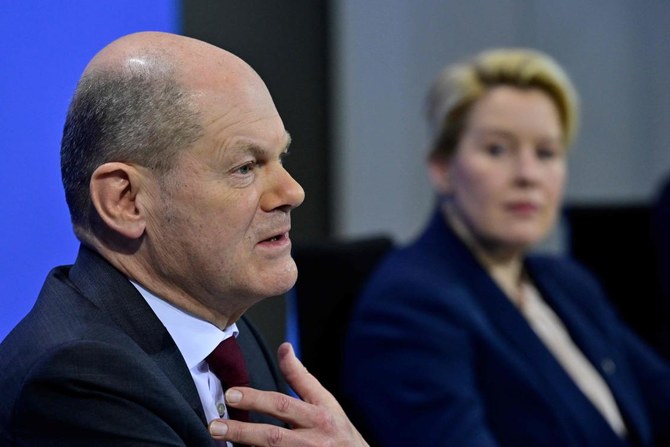
BERLIN: Germany’s leaders agreed Friday to toughen requirements for entry to restaurants and bars, and decided to shorten quarantine and self-isolation periods as the omicron variant spreads fast through the country.
Chancellor Olaf Scholz and the 16 state governors built on restrictions introduced just after Christmas that limited private gatherings to 10 people and effectively shut nightclubs.
People have already been required for some time to show proof of full vaccination or recovery to enter restaurants and bars — as well as many nonessential shops, theaters and cinemas.
Friday’s decision calls for the requirements to be ratcheted up for restaurants and bars across the country. Customers will have to show either that they have received a booster shot or provide a negative test result on top of proof that they have been vaccinated or recovered.
“This is a strict rule ... but it is a necessary one,” Scholz said.
Scholz and the governors also agreed to shorten quarantine or self-isolation periods that are currently as long as 14 days, something that many other countries already have done.
People who have received boosters will no longer have to go into quarantine after having contact with coronavirus cases, Scholz said. All others can end their quarantine or self-isolation period after 10 days if they don’t have — or no longer have — symptoms; that can be cut to seven days with a negative test.
“These are strict rules, but they are pragmatic and mean an easing of the current rules,” Scholz said.
The COVID-19 situation in Germany has been foggy for the past two weeks because of very patchy testing and slow reporting over the holiday period. Official figures, which authorities have acknowledged don’t yet show the full picture, have shown a steady increase in the infection rate over the past week.
On Friday, the national disease control center, the Robert Koch Institute, reported an official rate of 303.4 new cases per 100,000 residents over the past seven days. Over the past 24 hours, 56,335 new cases were reported.
In its weekly report on Thursday, the institute said that omicron accounted for 44.3 percent of cases tested for variants in Germany last week, up from 15.8 percent the previous week.
Germany’s vaccination campaign is regaining speed after the holidays. As of Friday, 71.6 percent of the population had received a full first vaccine course and 41.6 percent had had a booster shot.

Germany to toughen restaurant rules, cut COVID quarantine
https://arab.news/892de
Germany to toughen restaurant rules, cut COVID quarantine
- Chancellor Olaf Scholz and the 16 state governors built on restrictions introduced just after Christmas
- Friday’s decision calls for the requirements to be ratcheted up for restaurants and bars across Germany
Nigeria mosque bombing kills at least seven
- The bomb went off inside a crowded mosque in the city’s Gamboru market during early evening prayers
- Maiduguri is the capital of Borno state, home to a years-long insurgency by Boko Haram jihadis
MAIDUGURI, Nigeria: An explosion ripped through a mosque in the northeastern Nigerian city of Maiduguri and killed at least seven worshippers Wednesday, witnesses and security sources told AFP.
No armed groups immediately claimed responsibility for what anti-jihadist militia leader Babakura Kolo said was a suspected bombing.
Maiduguri is the capital of Borno state, home to a years-long insurgency by jihadist groups Boko Haram and an offshoot, Islamic State West Africa Province, though the city itself has not seen a major attack in years.
The bomb went off inside a crowded mosque in the city’s Gamboru market, as Muslim faithful gathered for evening prayers around 6 p.m. (1700 GMT), according to witnesses.
One of the leaders of the mosque, Malam Abuna Yusuf, put the toll at eight dead, though officials have not yet released a casualty count.
“We can confirm there has been an explosion,” police spokesman Nahum Daso told AFP, adding that an explosive ordnance disposal team was already on-site.
Kolo said that seven were killed.
He said it was suspected that the bomb was placed inside the mosque and exploded midway through prayers, while some witnesses described a suicide bombing.
It was not immediately clear how many people were injured, though witness Isa Musa Yusha’u told AFP: “I saw many victims being taken away for medical treatment.”
Videos taken in the aftermath and seen by AFP showed a person covered in blood writhing on the ground, and what appeared to be bodies covered by a sheet.
A security alert sent by an international NGO to its staff in Maiduguri, seen by AFP, advised its workers to stay away from the Gamboru market area.
Deadly insurgency
Nigeria has been battling a jihadist insurgency since 2009 in a conflict that has killed at least 40,000 and displaced around two million from their homes in the northeast, according to the UN.
Though the violence has waned since its peak a decade ago, it has spilt into neighboring Niger, Chad and Cameroon.
And concerns are growing about a resurgence of violence in parts of the northeast, where insurgent groups remain capable of mounting deadly attacks despite years of sustained military operations.
Maiduguri itself — once the scene of nightly gunbattles and bombings — has been calm in recent years, with the last major attack recorded in 2021.
But reminders of the conflict are never far off in the state capital, where major military operations are headquartered.
Military pick-ups lumber through town daily, their beds filled with soldiers whose helmets shield them from the hot afternoon sun.
Evening checkpoints are still in effect, even as markets that once closed in the early afternoon throng into the night.
Meanwhile, in the countryside, the insurgency continues to rage, with analysts warning of an uptick in jihadist violence this year.


