Pakistan to host next Organization of Islamic Cooperation meeting on March 22

Pakistan's Foreign Minister Shah Mahmood Qureshi addresses the opening of a special meeting of the 57-member Organisation of Islamic Cooperation (OIC) in Islamabad, Pakistan, on December 19, 2021. (AFP/File)
Short Url
Updated 07 January 2022
Follow

Pakistan to host next Organization of Islamic Cooperation meeting on March 22

  • OIC Foreign Ministers Council will attend Pakistan Day parade on March 23
  • Pakistan hosted a special Afghanistan-focused session of the OIC last month

ISLAMABAD: Pakistani Foreign Minister Shah Mahmood Qureshi said on Thursday the next meeting of the Organization of Islamic Cooperation (OIC) would be held on March 22 in Islamabad.
He was addressing a high tea event organized in honor of the ambassadors of Muslim countries by Special Aide to Prime Minister on Religious Harmony and Middle East, Tahir Mahmood Ashrafi. Saudi Arabia’s ambassador to Pakistan Nawaf Saeed Al-Maliki represented the OIC at the event. 
“We will celebrate our 75th Pakistan Day with our brothers and the OIC Foreign Ministers Council will attend the March 23 parade as guest,” Qureshi was quoted by The News as saying. 
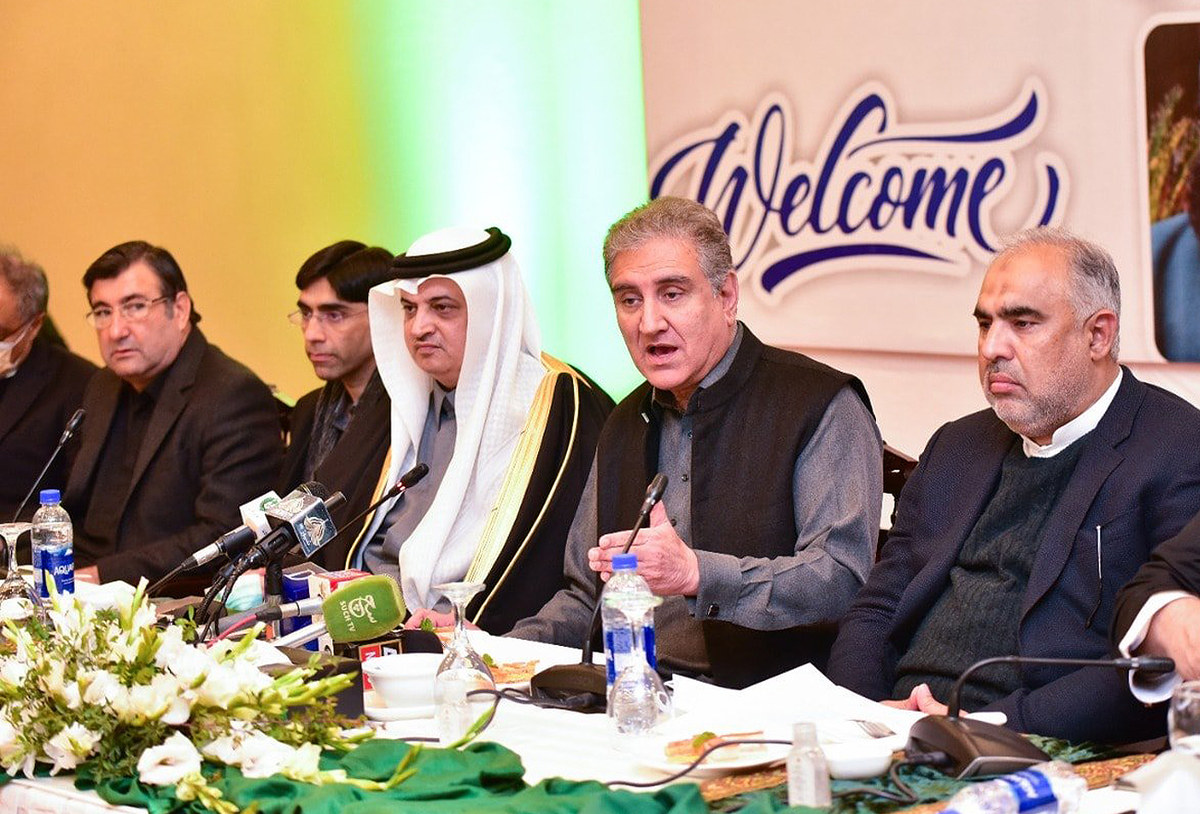


Pakistan's foreign minister Shah Mahmood Qureshi (2R) addresses a high tea event organized in honor of the ambassadors of Muslim countries in Islamabad, Pakistan, on January 7, 2022. (APP)

On December 19, Pakistan hosted the 17th Extraordinary Session of the Organization of Islamic Corporation’s Council of Foreign Ministers. The focus of the summit was the looming economic and humanitarian crisis in Afghanistan. Around 70 delegations from OIC member states, non-members and regional and international organizations attended the summit in Islamabad. Around 20 delegations were led by foreign ministers and 10 by deputies or ministers of state.
Other than foreign ministers from Islamic countries, delegations from the European Union and the P5+1 group of the UN Security Council, including the United States, Britain, France, Russia, China and Germany, were also in attendance.
At the conclusion of the summit, OIC members states agreed to establish a Humanitarian Trust Fund to channel assistance to Afghanistan, appoint a special envoy and work together with the UN in the war-ravaged country. 


Pakistan discovers new oil, gas reserves in push to cut costly imports

Updated 5 sec ago
Follow

Pakistan discovers new oil, gas reserves in push to cut costly imports

  • Exploration firm announces modest discovery of 225 barrels of oil, 1.01 MMSCFD of gas per day
  • Multiple discoveries together could boost domestic production and reduce reliance on imports

ISLAMABAD: Pakistan has announced a modest discovery of new oil and gas reserves in its northwestern Khyber Pakhtunkhwa (KP) province, state media reported on Friday, amid the country efforts to boost exploration to cut costly imports.

Pakistan faces a widening energy gap due to rising demand and limited domestic output, forcing reliance on costly fuel imports that expose the economy to global price swings. Its petroleum, oil, and lubricants import bill fell 4.39 percent to $9.046 billion in July 2025-January 2026.

The discovery was made at Lumshiwal Formation of Baragzai X-01 exploratory well. During Cased Hole Drill Stem Test (CHDST-04) conducted in the Hangu and Lumshiwal formations, the well produced 225 barrels of oil per day (BOPD) and 1.01 million standard cubic feet per day (MMSCFD) of gas through a 32/64’’ choke at a wellhead flowing pressure of 190 psig.

“Baragzai X-01 (Slant) was spudded on December 30, 2024, as an exploratory well to assess the hydrocarbon potential of multiple formations, including Lockhart, Hangu, Lumshiwal, Samana Suk, Shinawari, Datta and Kingriali.

The well was successfully drilled to a total depth of 5,170 meters into the Kingriali Formation,” the state-run APP news agency reported, citing the Oil and Gas Development Company (OGDC).

“Based on wireline log evaluations, three earlier cased hole drill stem tests were conducted in the Kingriali, Datta, and Samana Suk plus Shinawari formations, which also resulted in oil and gas discoveries. The latest test over Lumshiwal further confirms the commercial viability and hydrocarbon prospectivity of the block.”

The discovery was made under the Nashpa Exploration License. OGDC has a 65 percent working interest in the license, in partnership with Pakistan Petroleum Limited (30 percent) and Government Holdings Private Limited (5 percent).

“This discovery will strengthen Pakistan’s energy security by enhancing indigenous hydrocarbon production,” the exploration firm said. “It will add to the reserves base of OGDC and its joint venture partners while contributing toward narrowing the country’s energy supply-demand gap.”

Pakistan has reported several oil and gas discoveries recently. Although modest individually, their combined potential could boost domestic production and reduce reliance on imported energy.

In January, a discovery regarding an exploratory well, flowing at the rate of 4,100 barrels of oil per day (BOPD) and 10.5 million standard cubic feet per day (MMSCFD) of gas, was made in Kohat. In September 2025, Pakistan Petroleum Limited announced a discovery in Attock district, while Mari Energies reported a new gas find in North Waziristan.

Pakistan’s Sindh province dominates gas production with a 62 percent share and contributes 40 percent to oil output, while Khyber Pakhtunkhwa accounts for 41 percent of crude oil production. Punjab produces 18 percent of the nation’s oil, and Balochistan contributes just one percent, according to Topline Securities.