

Kazakh President Tokayev gives shoot-to-kill order to quell protests

1 / 2
This handout image taken and released by the Kazakh presidential press service on January 7, 2022 shows Kazakh President Kassym-Jomart Tokayev making a public address in Alamaty. (AFP)
2 / 2
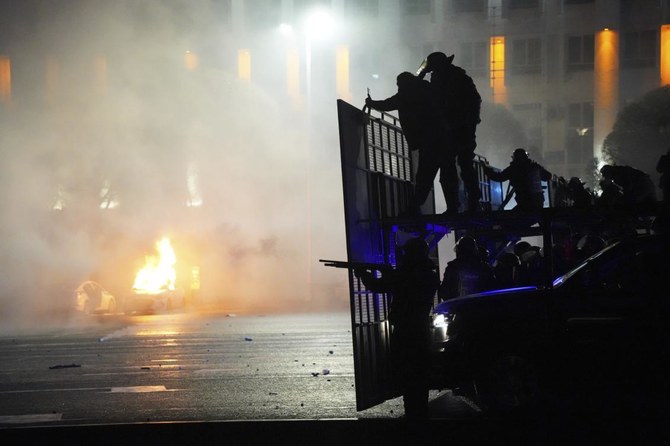
Demonstrators denouncing the doubling of prices for liquefied gas have clashed with police in Kazakhstan’s largest city and held protests in about a dozen other cities in the country. (AP)
Short Url
Updated 08 January 2022
Follow

Kazakh President Tokayev gives shoot-to-kill order to quell protests

  • Kazakh interior ministry: 26 ‘armed criminals’ had been ‘liquidated’ and more than 3,000 of them detained
  • Uprising prompts a military intervention by Moscow at a time of high tension in East-West relations

ALMATY: Security forces appeared to have reclaimed the streets of Kazakhstan’s main city on Friday after days of violence, and the Russian-backed president said he had ordered his troops to shoot to kill to put down a countrywide uprising.

A day after Moscow sent paratroopers to help crush the insurrection, police were patrolling the debris-strewn streets of Almaty, although some gunfire could still be heard.
Dozens have died and public buildings across Kazakhstan have been ransacked and torched in the worst violence the former Soviet republic has experienced in 30 years of independence.
Moscow said more than 70 planes were ferrying Russian troops into Kazakhstan, and that these were now helping control Almaty’s main airport, recaptured on Thursday from protesters.
The uprising has prompted a military intervention by Moscow at a time of high tension in East-West relations as Russia and the US gear up for talks next week on the Ukraine crisis.
Kazakh President Kassym-Jomart Tokayev blamed foreign-trained terrorists for the unrest, without providing evidence.
“The militants have not laid down their arms, they continue to commit crimes or are preparing for them,” Tokayev, 68, said in a televised address.
“Whoever does not surrender will be destroyed. I have given the order to law enforcement agencies and the army to shoot to kill, without warning.”
The demonstrations began as a response to a fuel price hike but swelled into a broad movement against the government and former President Nursultan Nazarbayev.

Whoever does not surrender will be destroyed. I have given the order to law enforcement agencies and the army to shoot to kill, without warning.

Kassym-Jomart Tokayev, President of Kazakhstan

Nazarbayev, 81, was the longest-serving ruler of any ex-Soviet state until he turned over the presidency to Tokayev in 2019. His family is widely believed to have retained influence in Nur-Sultan, the purpose-built capital that bears his name.
Russian President Vladimir Putin has discussed the situation with Tokayev in several phone calls during the crisis, the Kremlin said on Friday.
The protesters in Almaty appear mainly to come from the city’s poor outskirts or surrounding towns and villages. The violence has come as a shock to urban Kazakhs, used to comparing their country favorably to more repressive and volatile ex-Soviet Central Asian neighbors.
“At night when we hear explosions, I am scared,” a woman named Kuralai said.
“It hurts to know that young people are dying. This has clearly been planned ... probably our government has relaxed somewhat.”
In a state where scant political opposition is tolerated, no high-profile leaders of the protest movement have emerged to issue any formal demands.
One man who attended the first night of protests and who did not want to be identified said most of those who initially turned up wanted to “express solidarity spontaneously,” before 100-200 “aggressive youths” started hurling rocks at police.
The Interior Ministry said 26 “armed criminals” had been “liquidated,” while 18 police and national guard members had been killed. Those figures appeared not to have been updated since Thursday.
State TV reported more than 3,800 arrests.
Fresh gunfire could be heard on Friday near the main square in Almaty, where troops had fought protesters on Thursday. Armored personnel carriers and troops occupied the square.
Pro-government politician Yermukhamet Yertysbayev, speaking on state television, suggested there were traitors within the ranks of Kazakhstan’s security forces.
He said the security forces had been ordered to leave the Almaty airport before militants seized it, and that the National Security Committee building had been left undefended, allowing protesters to gain access to weapons.
Unrest has been reported in other cities, but the Internet has been shut off since Wednesday, making it difficult to determine the extent of the violence.
In Aktau, a city on the Caspian Sea in western Kazakhstan, some 500 protesters gathered peacefully on Friday in front of a government building to call for Tokayev’s resignation, a witness told Reuters.
State television said more than 60 people, including civilians, police and military, had been injured in the southern city of Shymkent since the unrest began, adding that the situation there was calm on Friday.
Moscow’s swift deployment demonstrated Putin’s readiness to use force to maintain influence in the former Soviet Union, at a time when he has also alarmed the West by massing troops near Ukraine, whose Crimean peninsula Russia seized in 2014.
The mission falls under the umbrella of the Collective Security Treaty Organization, comprising Russia and five ex-Soviet allies. Moscow said its force would number about 2,500.
White House spokeswoman Jen Psaki said Washington was watching Russia’s troops for any “actions that may lay the predicate for the seizure of Kazakh institutions.”
Tokayev’s administration said the Russians had not been engaged in combat or the “elimination of militants.”
Mukhtar Ablyazov, an exiled ex-banker and Cabinet minister turned opponent of the government, said the West must counter Russia’s moves, or watch Putin “methodically impose his program — the recreation of a structure like the Soviet Union.”
Kazakhstan’s other major neighbor, China, has backed Tokayev. State television said President Xi Jinping had told him Beijing opposed any use of force to destabilize Kazakhstan.
Nazarbayev has not been seen or heard since the protests began. Tokayev removed Nazarbayev and his nephew from security posts on Wednesday.
Kazakhstan is a major oil producer and the world’s top miner of uranium. Global oil prices rose on Friday, fueled by supply worries.


Somali president to Asharq Al-Awsat: Working with Saudi-led partners to void Israel’s Somaliland recognition

Updated 59 min 8 sec ago
Follow

Somali president to Asharq Al-Awsat: Working with Saudi-led partners to void Israel’s Somaliland recognition

  • Hassan Sheikh Mohamud unveils three-pronged diplomatic and legal strategy to defend Somalia’s sovereignty and territorial unity
  • Says Mogadishu coordinates with Saudi Arabia and Arab, African partners to counter what he calls a dangerous precedent

RIYADH: Somali President Hassan Sheikh Mohamud unveiled a three-pronged political and legal strategy to nullify what he described as Israeli recognition of the breakaway region of Somaliland, warning that such a move threatens Somalia’s sovereignty and regional stability.

Speaking to Asharq Al-Awsat, Mohamud said his government is acting in close coordination with partners led by Saudi Arabia to safeguard stability and shield the Horn of Africa from what he called “reckless escalation.”

Without naming specific countries, the Somali leader said some regional states may see the Israeli recognition as an opportunity to pursue “narrow, short-term interests at the expense of Somalia’s unity and regional stability.”

“I do not wish to name any particular country or countries,” he said. “But it is clear that some may view this recognition as a chance to achieve limited gains.”

Somali President Hassan Sheikh Mohamud visiting the country's soldiers in the frontline. (X)

He stressed that Somalia’s unity is a “red line,” adding that Mogadishu has taken firm positions to protect national sovereignty. “We warn against being misled by reckless Israeli adventurism,” he said.

Mohamud was referring to recognition announced by Israeli Prime Minister Benjamin Netanyahu of the self-declared Republic of Somaliland as an independent state.

“I affirm with the utmost clarity and firmness that any recognition of Somaliland as an independent state constitutes a blatant violation of the sovereignty and unity of the Federal Republic of Somalia,” he said.

He described the move as a grave breach of international law, the UN Charter, and African Union resolutions that uphold respect for inherited African borders.

On that basis, Somalia has adopted and will continue to pursue three parallel measures, he revealed.

The first involves immediate diplomatic action through the UN, African Union, and Organization of Islamic Cooperation to reject and legally and politically invalidate the recognition.

Mohamud said Somalia called for and secured a formal session at the UN Security Council to address what he termed a “flagrant Israeli violation” of Somalia’s sovereignty and territorial integrity.

The session, he said, marked a significant diplomatic victory for Mogadishu, particularly given Somalia’s current membership on the council.

He expressed “deep appreciation” for statements of solidarity and condemnation issued by the African Union, Arab League, OIC, Gulf Cooperation Council, Intergovernmental Authority on Development (IGAD), and the EU, among others.

The second step centers on coordinating a unified Arab, Islamic, and African position. Mohamud praised Saudi Arabia for being among the first to issue a clear statement rejecting any infringement on Somalia’s unity.

He said the Saudi position reflects the Kingdom’s longstanding commitment to state sovereignty and territorial integrity, reinforced by the Saudi cabinet’s “firm and principled” support for Somalia during what he described as a delicate moment.

The third step focuses on strengthening internal national dialogue to address political issues within the framework of a single Somali state, free from external interference or dictates.

Mohamud warned that if left unchecked, the recognition could set a “dangerous precedent and undermine regional and international peace and security.”

He said it could embolden separatist movements not only in the Horn of Africa but across Africa and the Arab world, citing developments in countries such as Sudan and Yemen as evidence of the high cost of state fragmentation.

“This concerns a vital global shipping artery and core Arab national security,” he said, referring to the Red Sea.

“Any political or security tension along Somalia’s coast will directly affect international trade and energy security.”

He added that instability would impact Red Sea littoral states, particularly Saudi Arabia, Egypt, Sudan, Eritrea, Yemen, and Jordan. “Preserving Somalia’s unity is a cornerstone of collective Red Sea security,” he said.

Mohamud argued that Israel’s objective goes beyond political recognition. 

“We believe the goal extends beyond a political gesture,” he told Asharq Al-Awsat. “It includes seeking a strategic foothold in the Horn of Africa near the Red Sea, enabling influence over the Bab Al-Mandeb Strait and threatening the national security of Red Sea states.”

He described the move as a test of Somali, Arab, and African resolve on issues of sovereignty and territorial unity, emphasizing that Somalia’s opposition to secession is a principled and enduring national stance supported widely in the Arab and African worlds, “foremost by Saudi Arabia.”

He rejected any attempt to turn Somalia into a battleground for regional or international rivalries. “We will not allow Somalia to become an arena for settling conflicts that do not serve our people’s interests or our region’s security,” he declared.

Regarding Saudi-Somali relations, Mohamud described the partnership as “deep-rooted and strategic, rooted in shared history, religion, and a common destiny.” Saudi Arabia, he said, “remains a central partner in supporting Somalia’s stability, reconstruction, development, and Red Sea security.”

He voiced admiration for Saudi Arabia’s Vision 2030 and the economic and development gains achieved under the leadership of Custodian of the Two Holy Mosques King Salman bin Abdulaziz and Prince Mohammed bin Salman, Crown Prince and Prime Minister.

Asked about the recent Saudi Cabinet decision rejecting any attempt to divide Somalia, Mohamud said the federal government received it with “great appreciation and relief.”

He said the position extends the Kingdom’s historic support for Somalia’s territorial unity and sovereignty, reinforces regional stability, and sends an important message to the international community on the need to respect state sovereignty and refrain from interference in internal affairs.