DUBAI: Kuwait has reimposed COVID-19 measures in mosques and marriage ceremonies amid a spike in infections and the emergence of the new omicron variant.
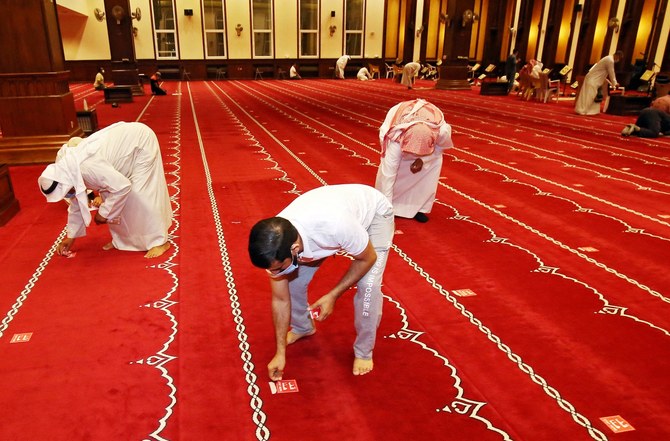
Worshippers visiting mosques are now required to maintain social distancing, wear facemasks, bring their own prayer mats and avoid direct contact, state news agency KUNA reported.
Mosque officials must also keep doors and windows open during sermons and prayer times. There must also be a time-cap of 15 minutes to Friday afternoon sermons, the report said.
In marriage contract-writing ceremonies, only six individuals are allowed to attend beginning Jan. 9.
The government also banned all kinds of public gatherings in closed places as from Jan. 9 until Feb. 28.
Kuwait reported 2,413 new COVID-19 infections in the past 24 hours after conducting 27,541 new tests. The country’s total caseload is 425,455, with 412,749 recoveries and 2,469 deaths.

Kuwait reimposes social distancing measures for mass events, mosque prayers
https://arab.news/puur3
Kuwait reimposes social distancing measures for mass events, mosque prayers
- Mosque officials must keep doors and windows open during sermons and prayer times
- In marriage contract-writing ceremonies, only six individuals are allowed to attend beginning Jan. 9
‘Speed over scale’: Saudi Arabia positioned to shape future of industry, say experts
- WEF p anelists also discussed how global industrial forces are evolving
DAVOS: Saudi Arabia is primed to position itself at the forefront of the global industrial transformation, leveraging its scale, strategic vision, and competitive energy infrastructure to become a leader in sectors such as clean industries and advanced technologies, experts said on Tuesday.
Speaking at a panel at the World Economic Forum in Davos, Rayan Fayez, deputy CEO at NEOM, highlighted how the Kingdom’s industrial city, Oxagon, is driving diversification and clean manufacturing.
The city is already home to several key sectors, including green hydrogen, renewable manufacturing and AI data centers.
The world’s largest green hydrogen project, a collaboration with ACWA Power and Air Products, is 90 percent complete and expected to be operational by 2027, Fayez said.
Renewable manufacturing partnerships are also taking off, with Chinese companies establishing solar and wind production outside China for the first time.
Fayez highlighted that NEOM’s success rests on four core competitive advantages: digital infrastructure, abundant renewable energy, ready-to-use land and strategic location.
“The location is not only strategic for the Kingdom, but also in connection to the rest of the world through the port of NEOM,” he said, adding that the city is poised to serve as a hub for both domestic and export-oriented industries.
Panelists also discussed how global industrial forces are evolving.
Frederico Torti from the WEF highlighted the structural volatility in supply chains, driven by geopolitics, technological change, natural disasters, cybersecurity risks and talent shortages.
He highlighted the importance of agility, collaboration and holistic operational transformation.
“The only way to make this happen is through collaboration, dialogue, and cooperation across public and private sectors,” he said.
Saudi Arabia’s strategic position, combined with its low-cost energy and infrastructure readiness, make it a magnet for industrial investment, Torti said.
“Countries that invest in the right factors will attract manufacturing investments and create value for the next decade,” he said, pointing to NEOM as a prime example of this approach.
ACWA Power CEO Marco Arcelli highlighted why Saudi Arabia is a compelling market for gigascale renewable energy and water desalination projects.
“In a world of uncertainty, Saudi Arabia is a country where you can really smell the hope,” he said.
“It speaks with China and the US, with Russia and Ukraine, with Europe and Southeast Asia and Africa, and looks to partner to solve problems and to develop domestically but also abroad.”
ACWA Power is now the largest water desalination company in the world, with operations across the Middle East and new projects in Azerbaijan, Senegal and China, he added.
Arcelli highlighted the water-energy nexus, where low-cost renewable power enables large-scale, sustainable desalination.
“Countries that are moving faster in these sectors are typically countries that will enjoy higher economic growth,” he said.
Looking ahead, panelists highlighted that the future of competitiveness will rely less on scale and more on speed and collaboration.
“You cannot be good at everything,” Arcelli said. “It’s going to be more about cooperation. It’s an economy of speed, not economy of scale anymore to thrive and be the best around.”
Torti reiterated the need for cross-border partnerships and dialogue, adding: “Open up, connect and make best use of forums like this to get different perspectives on solving problems. Collaboration is invaluable.”
Fayez added that investing in talent remains a critical element to drive industrial transformation in the Kingdom as well as globally, alongside infrastructure and technology.


