

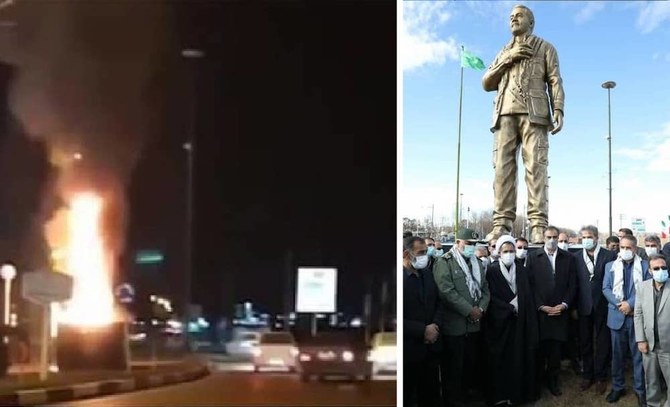
Newly unveiled statue of Iran’s Qassem Soleimani torched

Supporters of the Iranian opposition movement burned the newly installed statue at the Hazrat Qamarbani Hashem Square in Shahrekord of central Iran. (Supplied)
Short Url
Updated 06 January 2022
Follow

Newly unveiled statue of Iran’s Qassem Soleimani torched

  • Qassem Soleimani killed in a US drone strike in Baghdad ordered by President Donald Trump

DUBAI: A statue in central Iran of Qassem Soleimani, commander of the Quds Force who was killed in a targeted US operation on Jan. 3, 2020, was torched after it has been unveiled to commemorate his death anniversary.
Supporters of the Iranian opposition movement the People’s Mojahedin Organization of Iran burned the newly installed statue at the Hazrat Qamarbani Hashem Square in Shahrekord of central Iran on Wednesday evening, a few hours after government officials unveiled the sculpture.
“The Iranian people despised Soleimani for his active and direct role in the bloody suppression of several nationwide uprisings in Iran, his involvement in six deadly attacks on members of the Mujahedin-Khalq (MEK), when they were based in camps Ashraf and Liberty in Iraq, and his activities in directing, arming and financing Iran regime’s proxy groups in Syria, Iraq, Lebanon and Yemen,” Ali Safavi, a member of the Foreign Affairs Committee of the National Council of Resistance of Iran, told Arab News.
“The fact that the resistance units acted so quickly, just a few hours after the unveiling of the statue points to their resilience and capabilities, considering that the regime's security forces would be watchful.”
Soleimani was killed in a US drone strike in Baghdad ordered by Trump, along with his Iraqi lieutenant Abu Mahdi Al-Muhandis, infuriating Iran and its allies. Iranian officials have vowed repeatedly that the Quds Force commander’s death would be avenged.
“The MEK has developed a vast network of activists inside Iran, who are quite active despite the many arrests and the extreme security measures the regime has been undertaking,” Safavi said.
Iranian news agency ISNA has confirmed that Soleimani’s statue “in a brazen act was set on blaze last night by some unknown individuals.”

The forgotten Arabs of Iran
A century ago, the autonomous sheikhdom of Arabistan was absorbed by force into the Persian state. Today the Arabs of Ahwaz are Iran's most persecuted minority

Enter


keywords


Turkiye’s Kurdish party says Syria deal leaves Ankara ‘no excuses’ on peace process

Updated 58 min 12 sec ago
Follow

Turkiye’s Kurdish party says Syria deal leaves Ankara ‘no excuses’ on peace process

  • Turkish officials said earlier on Monday that the Syrian integration deal, if implemented, could advance the more than year-long process with the ​PKK, which is based in northern Iraq

ANKARA: Turkiye’s pro-Kurdish DEM Party said on Monday that the Turkish government had no more “excuses” to delay a peace process with the Kurdistan Workers Party (PKK) now that a landmark integration deal was achieved in neighboring Syria.
On Sunday in Syria, the Kurdish-led Syrian Democratic Forces (SDF) agreed to come under the control of authorities in Damascus — a move that Ankara had long sought as integral to ‌its own peace ‌effort with the PKK. “For more than a ‌year, ⁠the ​government ‌has presented the SDF’s integration with Damascus as the biggest obstacle to the process,” Tuncer Bakirhan, co-leader of the DEM Party, told Reuters, in some of the party’s first public comments on the deal in Syria.
“The government will no longer have any excuses left. Now it is the government’s turn to take concrete steps.” Bakirhan cautioned President Tayyip Erdogan’s ⁠government against concluding that the rolling back Kurdish territorial gains in Syria negated the need ‌for a peace process in Turkiye. “If the ‍government calculates that ‘we have weakened ‍the Kurds in Syria, so there is no longer a ‍need for a process in Turkiye,’ it would be making a historic mistake,” he said in the interview.
Turkish officials said earlier on Monday that the Syrian integration deal, if implemented, could advance the more than year-long process with the ​PKK, which is based in northern Iraq. Erdogan urged swift integration of Kurdish fighters into Syria’s armed forces. Turkiye, the strongest ⁠foreign backer of Damascus, has since 2016 repeatedly sent forces into northern Syria to curb the gains of the SDF — which after the 2011–2024 civil war had controlled more than a quarter of Syria while fighting Islamic State with strong US backing.
The United States has built close ties with Damascus over the last year and was closely involved in mediation between it and the SDF toward the deal.
Bakirhan said progress required recognition of Kurdish rights on both sides of the border.
“What needs to be done is clear: Kurdish rights must be recognized ‌in both Turkiye and Syria, democratic regimes must be established, and freedoms must be guaranteed,” he said.