

Exhibition in Lebanon forges dialogue between antiquity and modernity

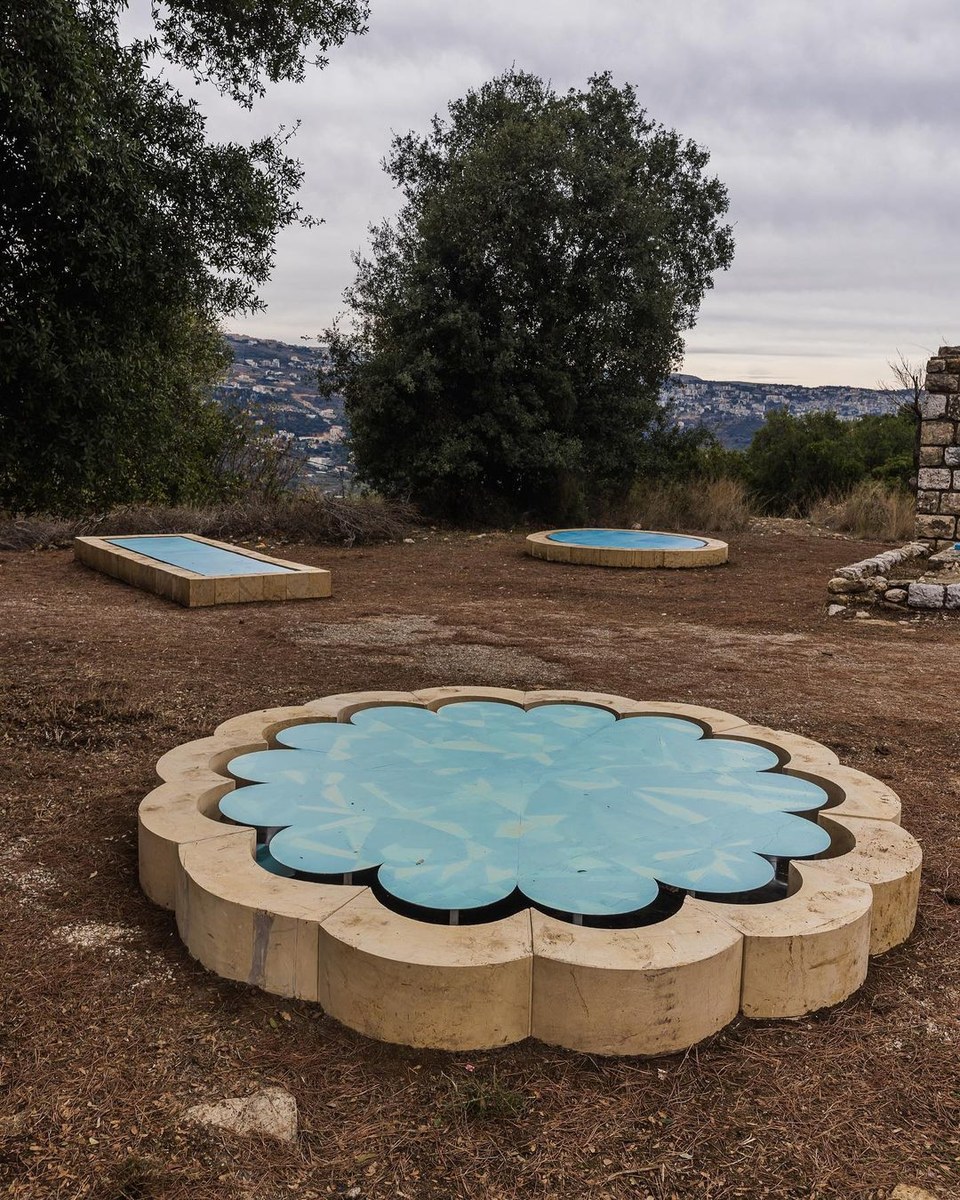
Mohamad Kanaan has crafted a series of seven mobile, interlocking sculptures which draw from Islamic, Roman and Phoenician mythologies. Instagram
Short Url
Updated 06 January 2022
Follow

Exhibition in Lebanon forges dialogue between antiquity and modernity

DUBAI: A fascinating exhibition is being held in the grounds of Deir El Kalaa, an eighteenth-century monastery with extensive Roman ruins in the hills above Beirut. The open-air show presents the works of 37 Lebanese and international contemporary artists, forging a dialogue between antiquity and modernity.


Gaïa Fodoulian and Nathaniel Rackowe, Drop by Drop, 2021. Painted stainless steel and LED lights. 100 x 100 x 240cm. Image courtesy of AD Leb

Titled “Lost in the Right Direction,” the exhibition showcases works of design, photography and installation in different parts of the ruins. Running until Jan. 9, it has been organized by Art Design Lebanon (AD Leb), a cultural space directed by Annie Vartivarian.

Vartivarian set up AD Leb in honor of her late daughter, the up-and-coming designer Gaïa Fodoulian, who was killed in the Beirut explosion in 2020. “What is important for me is to just keep Gaïa’s name and memory alive,” she told Arab News. The title of the show was taken from an Instagram post written by Fodoulian.


Installation by artist Hussein Nassereddine. Instagram

Archaeology professor Assad Seif gave the artists tours of the site, feeding ideas into their artworks to help in the layout of objects and to offer a deeper understanding of the monastery’s history. “Every piece is in its right place,” said Vartivarian, “It’s lost but people have to find it out.”

At a time when morale in Lebanon is low, the show’s themes are varied, exploring loss, memory, the passage of time, the Lebanese landscape and a sense of hope. In a setting of ruins and mosaic floors, it offers a contemplative experience.


Totem, Infinity table and Adam's box 2 are part of an ongoing project by designer Karen Chekerdjian. Instagram

Looking at the art on display, Cambridge-born Nathaniel Rackowe’s stainless steel sculpture of black beams, tipped with golden endings, was inspired by drawings made by Fodoulian, who sketched stalagmites found in the caves of Lebanon’s Jeita Grotto.

Beirut-based Adrian Pepe, versed in embroidery, presents “Hush” – a floor to ceiling work in felt, with its nomadic associations.

Furniture designer Karen Chekerdjian produced “Adam’s Box II,” a bench made of sand collected from different Lebanese regions, with a base of cylindrical and triangular forms.


‘Palestine 36’ set for Saudi cinemas in January

Updated 04 January 2026
Follow

‘Palestine 36’ set for Saudi cinemas in January

DUBAI: Filmmaker Annemarie Jacir’s “Palestine 36,” which screened at Jeddah’s Red Sea International Film Festival, is scheduled for release in Saudi cinemas on Thursday.

The sweeping historical epic — Palestine’s official entry to the Oscars this year, which made it to the official longlist — is a deep exploration of resistance, resilience and the struggle of the Palestinian people. 

“Palestine 36” is set during the 1936 Arab Revolt and follows five interconnected narratives as villages across Palestine confront British colonial rule.

With rising numbers of Jewish immigrants escaping antisemitism in Europe, and the Palestinian population uniting against Britain’s 30-year dominion, all sides spiral toward inevitable collision in a decisive moment for the British Empire and the future of the entire region. 

The film won the Best Film award at the Tokyo International Film Festival.

Jacir — whose three previous feature films “Salt of this Sea,” “When I Saw You,” and “Wajib” were also official Palestinian Oscar entries — hopes “Palestine 36” will provide a mirror for audiences, particularly those from colonized or war-affected countries.  

“I hope people see themselves in the film,” she told Arab News in December. “I don’t want to teach anyone anything. There’s a lot of history in the film and there’s a lot of history that’s been erased. I hope that’s something that comes through.” 

The film features an ensemble cast, including Oscar-winner Jeremy Irons, “Game of Thrones” star Liam Cunningham, and Tunisian actor Dhafer L’Abidine, alongside Palestinian talents Hiam Abbass, Yasmine Al-Massri, Kamel El Basha, and Saleh Bakri.

At the Red Sea International Film Festival premiere of the film in December, Jacir walked the red carpet with Palestinian Jordanian designer Reema Dahbour, who dressed the director for the event.

Dahbour created a custom piece titled “From the River to the Sea,” which she described on social media as “a dress born from our narrative, our symbols, and our enduring connection to the land. A garment that mirrors the spirit showcased so powerfully in the film.”