

Childhood map helps ‘trafficked’ Chinese man reunite with his family after decades

1 / 3
Li Jingwei points to a detail a map he drew from memory of his childhood village as he sits in Lankao in central China's Henan Province on Jan. 5, 2022. (Li Jingwei via AP)
2 / 3
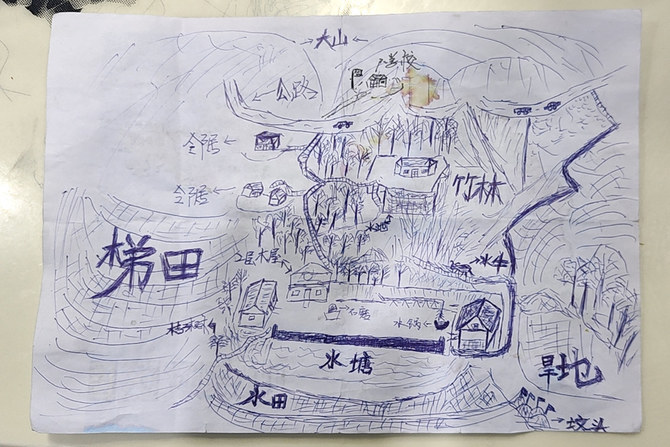
A map Li Jingwei drew from memory of his childhood village is shown in Lankao in central China's Henan Province on Jan. 5, 2022. (Li Jingwei via AP)
3 / 3
Li Jingwei, with back to camera, is reunited with his mother in Lankao in central China's Henan Province, on Jan. 1, 2022. (The Paper via AP)
Short Url
Updated 06 January 2022
Follow

Childhood map helps ‘trafficked’ Chinese man reunite with his family after decades

  • Li Jingwei was 4 years old when he was kidnapped in 1989 and taken to a far place and sold to a family in China 
  • A map of his hometown that he drew from memory led police later to pinpoint where Li was from

BEIJING: Since he was a child, Li Jingwei did not know his real name. He did not know where he was born, or for certain how old he was — until he found his biological family last month with the help of a long-remembered map.
Li was a victim of child trafficking. In 1989 when he was 4 years old, a bald neighbor lured him away by saying they would go look at cars, which were rare in rural villages.
That was the last time he saw his home, Li said. The neighbor took him behind a hill to a road where three bicycles and four other kidnappers were waiting. He cried, but they put him on a bike and rode away.
“I wanted to go home but they didn’t allow that,” Li said in an interview with The Associated Press. “Two hours later, I knew I wouldn’t be going back home and I must have met bad people.”
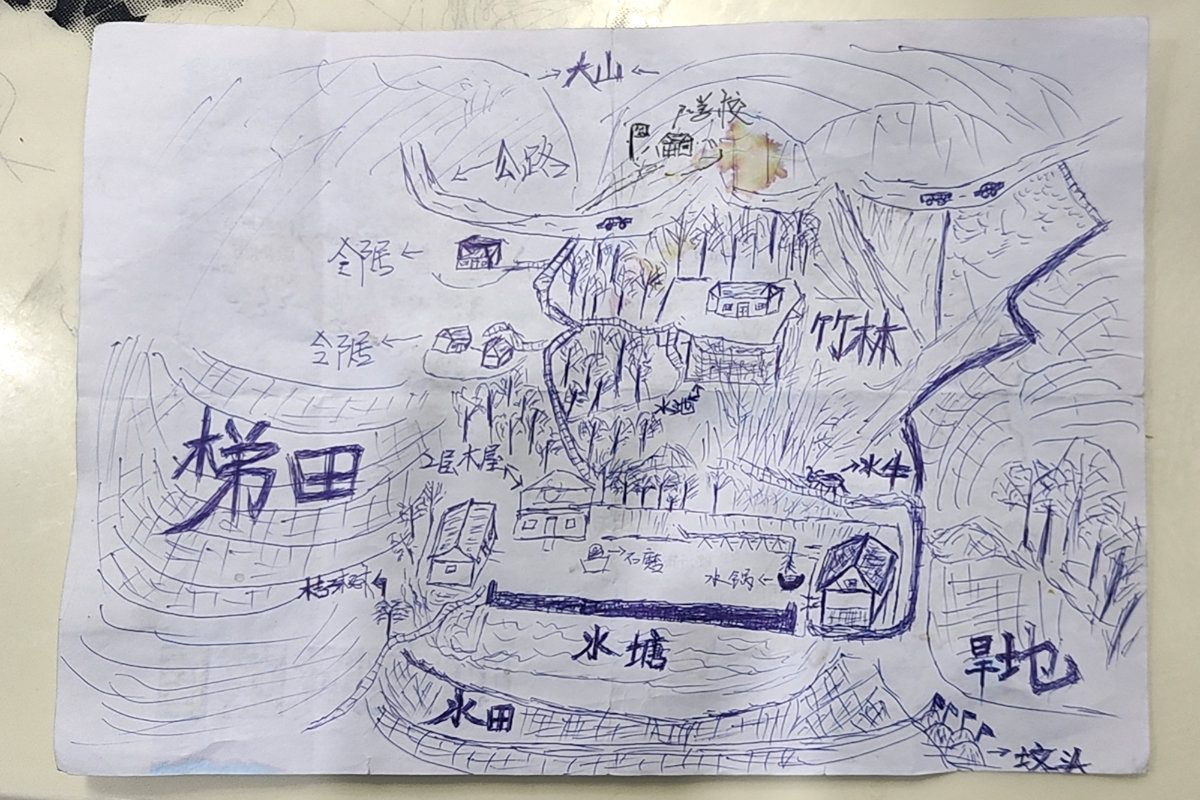


A map Li Jingwei drew from memory of his childhood village is shown in Lankao in central China's Henan Province  on Jan. 5, 2022. (Li Jingwei via AP)

He remembers being taken on a train. Eventually he was sold to a family in another province, Henan.
“Because I was too young, only 4, and I hadn’t gone to school yet, I couldn’t remember anything, including the names” of his parents and hometown, he said.
Etched in his memory, however, was the landscape of his village in the southwestern city of Zhaotong, Yunnan province. He remembered the mountains, bamboo forest, a pond next his home — all the places he used to play.
After his abduction, Li said he drew maps of his village every day until he was 13 so he wouldn’t forget. Before he reached school age, he would draw them on the ground, and after entering school he drew them in notebooks. It became an obsession, he said.
More than 30 years after his abduction, a meticulous drawing of his village landscape helped police locate it and track down his biological mother and siblings.
He was inspired to look for his biological family after two reunions made headlines last year. In July, a Chinese father, Guo Gangtang, was united with his son after searching for 24 years, and in December, Sun Haiyang was reunited with his kidnapped son after 14 years.
Reports of child abductions occur regularly in China, though how often they happen is unclear. The problem is aggravated by restrictions that until 2015 allowed most urban couples only one child.
Li decided to speak with his adoptive parents for clues and consulted DNA databases, but nothing turned up. Then he found volunteers who suggested he post a video of himself on Douyin, a social media platform, along with the map he drew from memory.



Li Jingwei, with back to camera, is reunited with his mother in Lankao in central China's Henan Province, on Jan. 1, 2022. (The Paper via AP)

It took him only 10 minutes to redraw what he had drawn hundreds, perhaps thousands of times as a child, he said.
That post received tens of thousands of views. By then, Li said police had already narrowed down locations based on his DNA sample, and his hand-drawn map helped villagers identify a family.
Li finally connected with his mother over the telephone. She asked about a scar on his chin which she said was caused by a fall from a ladder.
“When she mentioned the scar, I knew it was her,” Li said.
Other details and recollections fell into place, and a DNA test confirmed his heritage. In an emotional reunion on New Year’s Day, he saw his mother for the first time since he was 4.
As Li walked toward her, he collapsed on the ground in emotion. Lifted up by his younger brother and sister, he finally hugged his mother.
Li choked up when speaking about his father, who has passed away. Now the father of two teenage children, Li said he will take his family to visit his father’s grave with all his aunts and uncles during Lunar New Year celebrations next month.
“It’s going to be a real big reunion,” he said. “I want to tell him that his son is back.”


Cambodia takes back looted historic artifacts handled by British art dealer

Updated 28 February 2026
Follow

Cambodia takes back looted historic artifacts handled by British art dealer

  • The objects were returned under a 2020 agreement between the Ministry of Culture and Fine Arts and the family of the late Douglas Latchford, a British art collector and dealer who allegedly had the items smuggled out of Cambodia

PHNOM PENH, Cambodia: Cambodian officials on Friday received more than six dozen historic artifacts described as part of the country’s cultural heritage that had been looted during decades of war and instability.
At a ceremony attended by Deputy Prime Minister Hun Many, the 74 items were unveiled at the National Museum in Phnom Penh after their repatriation from the United Kingdom.
The objects were returned under a 2020 agreement between the Ministry of Culture and Fine Arts and the family of the late Douglas Latchford, a British art collector and dealer who allegedly had the items smuggled out of Cambodia.
“This substantial restitution represents one of the most important returns of Khmer cultural heritage in recent years, following major repatriations in 2021 and 2023 from the same collection,” the Culture Ministry said in a statement. “It marks a significant step forward in Cambodia’s continued efforts to recover, preserve, and restore its ancestral legacy for future generations.”
The artifacts were described as dating from the pre-Angkorian period through the height of the Angkor Empire, including “monumental sandstone sculptures, refined bronze works, and significant ritual objects.” The Angkor Empire, which extended from the ninth to the 15th century, is best known for the Angkor Wat archaeological site, the nation’s biggest tourist attraction.
Latchford was a prominent antiquities dealer who allegedly orchestrated an operation to sell looted Cambodian sculptures on the international market.
From 1970 to the 1980s, during Cambodia’s civil wars and the communist Khmer Rouge ‘s brutal reign, organized looting networks sent artifacts to Latchford, who then sold them to Western collectors, dealers, and institutions. These pieces were often physically damaged, having been pried off temple walls or other structures by the looters.
Latchford was indicted in a New York federal court in 2019 on charges including wire fraud and conspiracy. He died in 2020, aged 88, before he could be extradited to face charges.
Cambodia, like neighboring Thailand, has benefited from a trend in recent decades involving the repatriation of art and archaeological treasures. These include ancient Asian artworks as well as pieces lost or stolen during turmoil in places such as Syria, Iraq and Nazi-occupied Europe. New York’s Metropolitan Museum of Art is one of the prominent institutions that has been returning illegally smuggled art, including to Cambodia.
“The ancient artifacts created and preserved by our ancestors are now being returned to Cambodia, bringing warmth and joy, following the country’s return to peace,” said Hun Many, who is the younger brother of Prime Minister Hun Manet.