- Pakistan produced 22.12 million handsets and imported 9.95 million during January-November 2021 period
- Boom achieved under Mobile Device Manufacturing Policy 2020 which set 49 percent localization target by June 2023
KARACHI: Pakistani commerce chief Adbul Razak Dawood said on Wednesday Pakistan had achieved “big success” in the manufacturing of mobile phones in 2021, with local production exceeding imports for the first time, and the country was now eyeing expansion into exports.
Pakistan, a net importer of mobile phones prior to 2016, produced 22.12 million handsets during January-November 2021 and imported 9.95 million during the same period, data from the Pakistan Telecommunication Authority (PTA) shows. In 2020, Pakistan’s import of mobile phones was 24.51 million compared to 13.05 million sets produced locally.
Various Chinese mobile phone manufacturers have played a key role in Pakistan’s production boom in 2021. The Itel, with 3.91 million mobile devices manufactured, topped the list followed by VGO Tel at 2.97 million, Infinix 2.65 million Vivo 2.45 million, Techno 1.87 million, QQMEE 0.86 million and Oppo 0.67 million, according to the PTA.
Local manufacturing plants assembled 9.03 million smartphones while the number of 2G mobile phones was 13.09 million.
“I would say that our whole venture into manufacturing mobile phones has been a big success,” Dawood, adviser to the prime minister for commerce, told Arab News on Wednesday. “It has been very successful because we now see that every month the number of mobile phones coming into the country is decreasing and the numbers that are being produced and sold locally is increasing.”
The PM’s aide said the record levels of local manufacturing were achieved under a new “conducive policy” introduced by the current government.
The Mobile Device Manufacturing Policy 2020 set a 49 percent localization target by June 2023, including 10 percent localization of parts of the motherboard and 10 percent localization of batteries.
“We have developed a policy for local assembling of mobile phones … We are currently looking at becoming a world class assembler of mobile phones,” Dawood said. “We are right now concentrating on low-end mobile phone sets and we hope that soon we will be able to start getting into high-end phones with world class companies like Samsung.”
The PM’s aide said after achieving a milestone in manufacturing, Pakistan was eyeing exports to regional countries and Africa.
“We have started on an export journey, one or two containers have already moved out of the country. Our strategy is to get our mobile phone exported on a sustainable basis, ” Dawood said.
“Our strategy is that we export to Afghanistan, the Central Asian Republics and to Africa and as we become more and more experienced, we would be diversifying into the higher end market. We’re hopeful that [we can do this on a] sustainable basis sometime this year, 2022.”
Pakistani phone manufacturers said they were now assembling major brands and 90 percent of phones available in the country would be “made in Pakistan” soon.
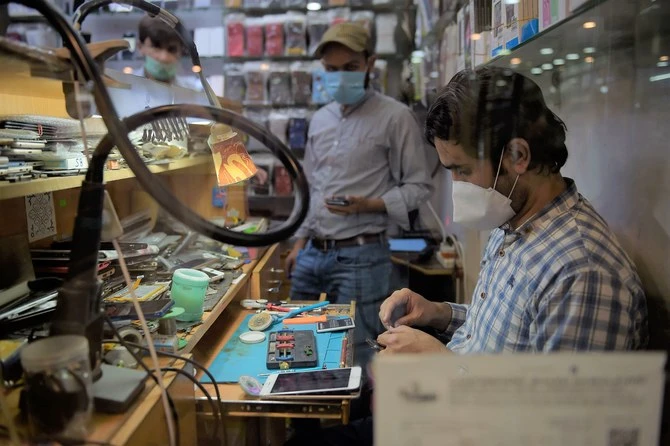
“Now almost all major brands except iPhone are being made in Pakistan,” Aamir Allawala, CEO of Tecno Pack Electronics, a manufacturer of Chinese mobiles, told Arab News. “With production of Xiaomi starting this month, 90 percent mobile phone manufacturing will be made in Pakistan.”
Allawala said 2.5 to 3 million sets of Xiaomi would be produced per year in Pakistan in collaboration with Airlink Communication, adding that the local manufacturing industry had created 50,000 jobs already.
He said local producers were gearing up to meet the challenges of localization and the export of phones from Pakistan.
“The manufacturers are gearing to meet the challenge of localization specified in the [mobile] policy and export mobile phones from Pakistan,”Allawala said, adding: “By increasing localization, production, and exports we have to create further 200,000 to half million jobs in the country”.”
Pakistan’s mobile phone imports increased by 51 percent to over $2 billion during the last fiscal year while the import bill increased by 18 percent during the current fiscal year, July-November 2021, according to the Pakistan Bureau of Statistics.
“Yes.. despite local manufacturing of mobile phone, the import bill is rising,” the PM’s commerce adviser said. “However it is not rising as fast as the amount of mobile phones that are now being manufactured.”
He said the main imports were high-end phones, those priced above $1000, a market segment that is not being manufactured in Pakistan currently.