

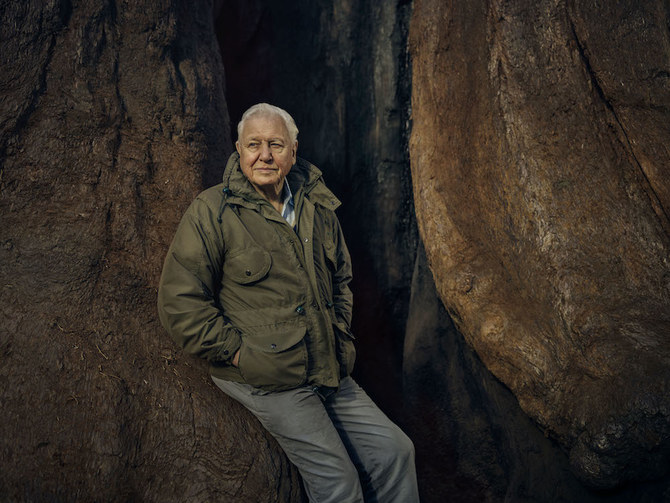

BOGOTA: Towering more than 250 feet above the forest floor, the sequoia trees of California are the biggest living things on the planet.
It is while standing at the foot of one of these 3,000-year-old giants that English broadcaster and natural historian Sir David Attenborough opens his new series, “The Green Planet,” which will be broadcast in the Middle East on BBC Earth on beIN from Jan. 10.
“Plants, whether they are enormous like this one or microscopic, are the basis of all life, including ourselves,” the 95-year-old broadcaster says in the opening minutes of the first episode, titled “Tropical.”
“We depend upon them for every mouthful of food that we eat and every lungful of air that we breathe,” he continues. “Plants flourish in remarkable ways. Yet, for the most part, the secrets of their world have been hidden from us. Until now.”
The five-part BBC production claims to offer a fresh look at the extraordinary world of plants. To do this, it is said to have used an array of pioneering technologies, from robotic rigs and drone cams to moving time-lapse photography, super-detailed thermal cameras, deep-focus macro frame-stacking, ultra-high-speed photography and the latest in microscopy.
The result is a series that transforms the seemingly static world of trees and plants into a dynamic journey through a parallel universe in which plants are as aggressive, competitive and dramatic as wild animals, locked in a life-or-death struggle for food, light and procreation.
One sequence in the opening episode features time-lapse footage of leafcutter ants demolishing the succulent leaves sprouting from a branch and carting them off to their underground lair, where a giant fungus waits to feast on the mulch. The ants are rewarded for their efforts by the fungus with a steady supply of tiny mushrooms.
The sequence depicting this strange symbiosis was filmed over a period of three weeks deep in the Costa Rican rainforest, where the camera operators wrestled their heavy equipment through dense jungle, braving bouts of torrential rain.
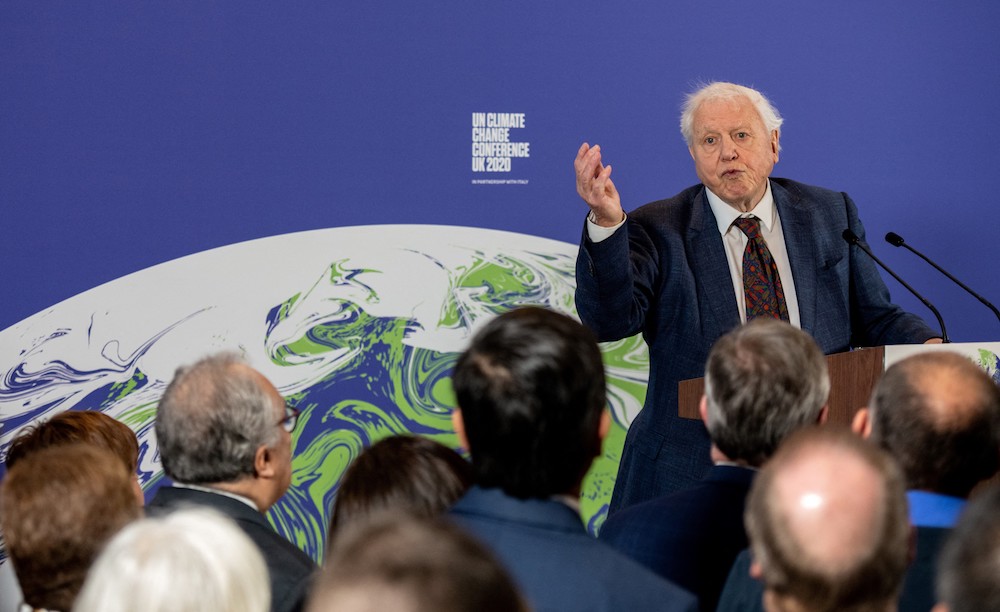
Sir David speaking during an event to launch the UN’s Climate Change conference, COP26, in central London in February 2020. (AFP/File Photo)
According to producers, the weather was not the only challenge they had to overcome. A team filming sequences in Borneo, for example, faced their share of adversity after accidentally disturbing a nest of Asian giant hornets, resulting in some nasty stings.
Later in the series, Sir David himself fell foul of an especially prickly cactus known as cholla. Even though he was wearing a Kevlar under-glove with a welding mitt on top, the plant’s dense rosette of spines was able to pierce the protection.
In another scene from episode one, viewers encounter a species of bat that, in a similar way to the ants and their friendly fungus, exists in perfect symbiosis with a night-blooming flower. It offers the small mammals exclusive dibs on its precious nectar in exchange for their services as pollinators-in-chief.
Viewers are also introduced to a rather repulsive-looking, meter-wide parasitic plant known as the corpse flower, which imitates both the appearance and stench of rotting meat — complete with fur and teeth — to attract pollinating flies.
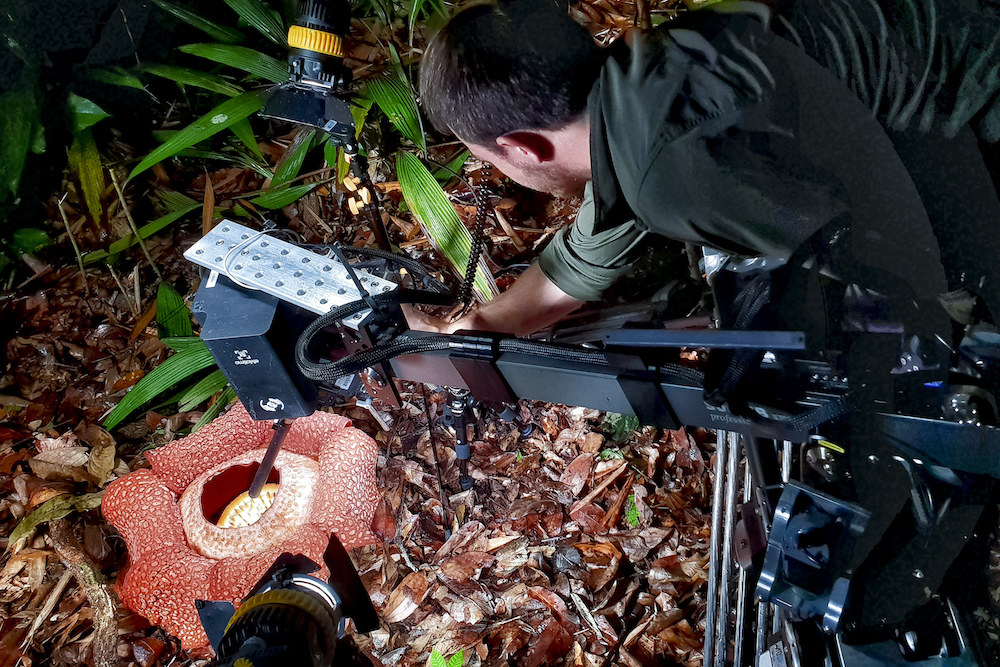
Behind the scences. Camera operator Oliver Mueller uses a specially built robotic camera system, known as the Triffid, to film the corpse flower (Rafflesia keithii), Borneo. (Supplied/BBC)
Covering 27 countries and produced over a period of four years, “The Green Planet” claims to provide the first comprehensive look at the world of plants since Sir David’s previous series, “The Private Life of Plants,” was broadcast 26 years ago.
“In ‘Private Life of Plants’ we were stuck with all this very heavy, primitive equipment, but now we can take the cameras anywhere we like,” Sir David said in a recent interview.
“So you now have the ability to go into a real forest, you can see a plant growing with its neighbors, fighting its neighbors, or moving with its neighbors or dying. And that, in my view, is what brings the thing to life and which should make people say, ‘Good lord, these extraordinary organisms are just like us.’”
Over the course of the series, Sir David traveled to the US, Costa Rica, Croatia and northern Europe, from deserts to mountains, rainforests to the frozen north, to create a fresh understanding of how plants live their lives, experience the seasons and interact with the animal world — including humanity.

Behind the scences. Team doctor, Dr Patrick Avery, in a canopy tram in Costa Rica with Sir David and drone pilot Louis Rummer-Downing. Patrick has just launched a drone carrying a camera, which will film David’s journey through the canopy. (Supplied/BBC)
The timing of the broadcast of “The Green Planet” could not be more critical, coming as it does just as many of the world’s ecosystems appear close to collapse, with climate change, deforestation and pollution causing ever-more extreme weather events and the loss of precious biodiversity.
In the Middle East, for instance, where temperatures regularly top 40 C for several months of the year, experts warn that climate change could soon render parts of the region uninhabitable for humans.
In response to the looming challenge, Saudi Arabia and the UAE have launched renewable-energy initiatives, embracing green fuels such as wind, solar and hydrogen power. Both nations also participated enthusiastically in COP26, the UN Climate Change Conference, in Glasgow, Scotland, in November.
The previous month, Saudi Arabia launched its Saudi Green and Middle East Green initiatives, committing the Kingdom to reaching net-zero greenhouse-gas emissions by 2060, and to planting 10 billion trees over the coming decades, rehabilitating 8 million hectares of degraded land and establishing new protected areas.

Behind the scenes. Sir David standing amoungst Giant Sequoias,Sequoiadendron giganteum, the largest trees in the world. California, USA. (Supplied/BBC)
Sir David addressed world leaders during COP26 to press home the need to drastically reduce greenhouse-gas emissions and prevent increases in global temperatures exceeding 1.5 C above pre-industrial levels.
“Perhaps the fact that the people most affected by climate change are no longer some imaginary future generations but young people alive today … perhaps that will give us the impetus we need to rewrite our story, to turn this tragedy into a triumph,” he told delegates.
“Our burning of fossil fuels, our destruction of nature, our approach to industry, construction and learning are releasing carbon into the atmosphere at an unprecedented pace and scale. We are already in trouble. The stability we all depend on is breaking.”
Sir David ought to know. During a career spanning almost seven decades, in which he has presented some of the most memorable nature documentaries ever filmed, he has witnessed this progressive destruction firsthand.

Clockwise from bottom: Khasi family using a living root bridge. Meghalaya, India; Saguaro cactus (Carnegiea gigantea), Sonoran desert, Arizona. A mature saguaro can store 5000 litres of water; and Winter in the Boreal Forests of Finland. Spruce, Pine and Birch dominate this landscape. (Supplied/BBC)
In 1937, when he was 11 years old, the population of the world stood at 2.3 billion, and the amount of carbon in the atmosphere at 280 parts per million. Today there are almost 7.8 billion people on the planet and the level of carbon in the atmosphere stands at about 415 parts per million.
Sir David joined the BBC in 1952 as a trainee producer. While working on a series called “Zoo Quest,” between 1954 and 1964, he was given his first opportunity to visit remote corners of the globe and capture footage of wildlife in its natural habitats.
He left filmmaking behind in 1965 to become the controller of BBC2, during which time he helped to introduce color television to the UK, before serving as director of programs for BBC Television.
But in 1973 he decided to quit the administrative side of television and return to making documentaries.

Clockwise from L: A Giant Sequoia, Sequoiadendron giganteum, the largest trees on Earth; flowers of the ‘7-hour flower’, Merinthopodium neuranthom, are pollinated by Underwood's Long-tongued Bat (Hylonycteris underwoodi); and Giant Water Lily, Victoria species, in the Pantanal region of Brazil. (Supplied/BBC/Paul Williams)
He soon established himself as Britain’s best-known natural history programmer, presenting the “Life on Earth” in 1979 and “The Blue Planet” in 2001.
It is as a result of this lifetime of filmmaking, and of course his gentle and instantly recognizable narration, that Sir David now stands at the forefront of issues related to conservation and the planet’s declining species — and is considered a British national treasure.
“The world has suddenly become plant-conscious,” he said recently. “There has been a revolution worldwide in attitudes toward the natural world in my lifetime. An awakening and an awareness of how important the natural world is to us all. An awareness that we would starve without plants, we wouldn’t be able to breathe without plants.”
Sir David believes the COVID-19 pandemic, and the resultant lockdowns, encouraged people to pay closer attention to the plant life around them.

Sir David now stands at the forefront of issues related to conservation and the planet’s declining species — and is considered a British national treasure. (AFP/File Photos)
“I think that being shut up and confined to one’s garden, if one is lucky enough to have a garden — and if not, to having plants sitting on a shelf — has changed people’s perspective and an awareness of another world that exists to which we hardly ever pay attention,” he said.
So, what does he hope audiences will take from “The Green Planet”?
“That there is a parallel world on which we depend and which, up to now, we have largely ignored, if I speak on behalf of urbanized man,” he said.
“Over half the population of the world, according to the UN, are urbanized, live in cities, only see cultivated plants and never see a wild community of plants.
“But that wild community is there, outside urban circumstances normally, and we depend upon it. And we better jolly well care for it.”


