Pakistan says will fast track vaccine campaign, push SOPs amid omicron surge

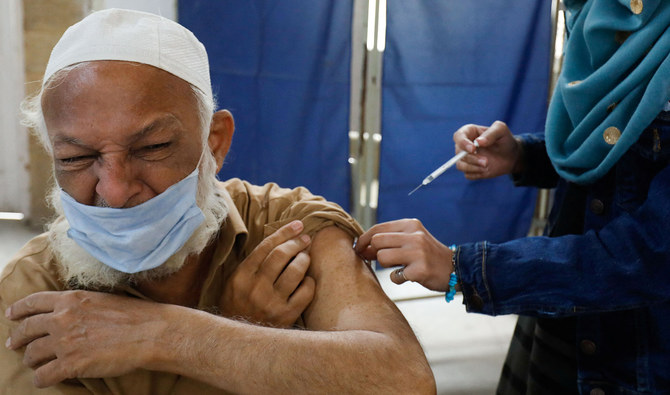
A man receives a dose of the coronavirus disease (COVID-19) booster vaccine at a vaccination centre in Karachi, Pakistan on January 3, 2022. (REUTERS)
Short Url
Updated 05 January 2022
Follow

Pakistan says will fast track vaccine campaign, push SOPs amid omicron surge

  • Government says omicron variant-driven fifth wave of the pandemic spreading at ‘great pace’ in Pakistan
  • 351 COVID-19 tests conducted in Sindh showed 175 samples, nearly 50 percent, infected with omicron strain

ISLAMABAD: Director General Health Dr. Rana Muhammad Safdar said on Tuesday Pakistan would adopt a “bi-pronged strategy” to deal with a fifth wave of the coronavirus in the country and a surge in cases of the omicron variant. 
Pakistan reported 708 new coronavirus cases on Monday, according to official figures, the first time daily infections crossed the 700 mark since October 30, 2021. In a statement released that day, the National Command and Operation Center, which oversees the country’s pandemic response, said an omicron-driven fifth wave of the virus was spreading at a “great pace.”
“Government of Pakistan going for bi-pronged strategy of fast tracking vaccination along side standard operating procedures,” Safdar told Arab News. “We would keep on monitoring and mapping new clusters of cases for targeted containment measures.”
The DG health said the threat of the omicron variant was “definitely serious given very high transmissibility and continued challenges of global vaccine equity.”
However, he said it was a good omen that Pakistan had achieved its goal of vaccinating over 70 million of its 220 million population by the end of 2021.
On Monday, Dr. Mumtaz Ali Khan, a focal person at the National Institute of Health in Islamabad, told Arab News the omicron variant was now transmitting locally in Pakistan.

“Vaccination of maximum people, including children above 12 is the only solution to curb its surge,” he said. “We are planning a massive countrywide vaccination campaign in March to boost the immunity of our people against new variants, including the omicron strain.”
In Sindh, the results of 351 COVID-19 tests conducted under a government initiative to determine the prevalence of the omicron variant showed that 175 samples, nearly 50 percent, were infected with the strain, the Dawn newspaper reported, citing a statement issued from the Sindh chief minister’s office. 
“Among the cases found infected with omicron, few had a travel history, predominantly from the United Kingdom, US, Dubai, Germany, Saudi Arabia, Nairobi and Angola,” the report read. 
Karachi Administrator Murtaza Wahab said coronavirus positivity rate in the southern Pakistani port city had crossed six percent and a majority of the cases were of the omicron variant. 


Pakistan says defense pact with Saudi Arabia elevated brotherly ties to ‘new heights’

Updated 25 February 2026
Follow

Pakistan says defense pact with Saudi Arabia elevated brotherly ties to ‘new heights’

  • Pakistan, Saudi Arabia signed strategic defense pact last year pledging aggression against one will be treated as attack on both
  • Deputy PM Ishaq Dar says enduring bonds with Islamic and Arab nations form vital pillar of Pakistan’s foreign policy 

ISLAMABAD: Deputy Prime Minister Ishaq Dar said on Wednesday that Pakistan’s defense pact with Saudi Arabia elevated its brotherly ties with the Kingdom to “new heights,” stressing that close ties with Arab and Islamic nations form a key pillar of Islamabad’s foreign policy. 

Pakistan and Saudi Arabia signed a Strategic Mutual Defense Agreement on Sept. 17 last year, pledging that aggression against one country would be treated as an attack on both, enhancing joint deterrence and formalizing decades of military and security cooperation.

Both nations agreed in October 2025 to launch an economic cooperation framework to strengthen trade and investment ties. 

“In the Middle East, our landmark Strategic Mutual Defense Agreement with Saudi Arabia has elevated our brotherly ties to new heights,” Dar said while speaking at the Pakistan Governance Forum 2026 event in Islamabad. 

The Pakistani deputy prime minister was speaking on the topic “Navigating International Relations Amidst Changing Geo-Politics.”

Dar noted that Pakistan has reinforced partnerships with other Middle Eastern nations such as the UAE, Qatar, Jordan, Oman, Egypt and Bahrain. He said these partnerships have yielded “concrete agreements” in investment, agriculture, infrastructure, and energy sectors. 

“Our enduring bonds with Islamic and Arab nations form a vital pillar of our foreign policy, and we will continue to expand our partnerships across Asia, Latin America, and Africa,” he said. 

Dar pointed out that the presidents of Kazakhstan, Uzbekistan and Kyrgyzstan have undertaken visits to Pakistan in recent months, reflecting Central Asian nations’ desire to boost cooperation with Islamabad.

On South Asia, the Pakistani deputy PM said Pakistan has successfully transformed its fraternal ties with Bangladesh into “a substantive partnership.”

“Similarly, the trilateral mechanism involving China, Pakistan, and Bangladesh has been launched with a view to expanding and deepening regional cooperation and synergy,” the Pakistani minister said. 

He said Islamabad has strengthened its “all-weather” partnership with China via the second phase of the multi-billion-dollar China-Pakistan Economic Corridor agreement and “unwavering support” from both sides for each other’s core interests. 

Dar said Pakistan had also reinvigorated its partnership with the US, advancing cooperation in trade, technology, investment, and regional stability. 

“This calibrated approach has enhanced our ability to navigate complexity with skill and confidence, ensuring that our national interests are served without compromising our core foreign policy principles,” he said.