

Pakistan government to present mini-budget in Senate today

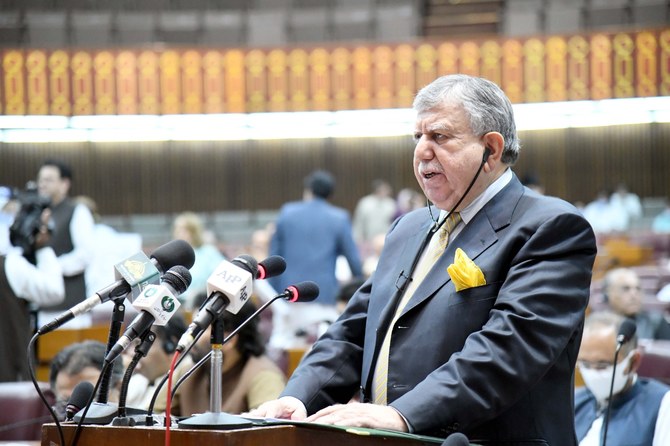
Pakistan's finance minister Shaukat Tarin presents federal budget for fiscal year 2021-22 at the National Assembly in Islamabad, Pakistan, on June 11, 2021. (Photo courtesy: Finance Ministry)
Short Url
Updated 04 January 2022
Follow

Pakistan government to present mini-budget in Senate today

  • Bill ends tax exemptions on nearly 150 items as prior action for revival of $6 billion IMF loan program
  • Opposition lawmakers and economists say the document is anti-growth and will trigger inflation

ISLAMABAD: Pakistan’s finance minister Shaukat Tarin will present a contentious supplementary finance bill, popularly known as the ‘mini budget,’ before the Senate today, Tuesday, amid warnings by opposition lawmakers and economists that the measures it introduces are anti-growth and will trigger inflation.

The bill was presented in the lower house of parliament last week and aims to end tax exemptions on nearly 150 items as a prior action for the revival of a $6 billion loan program from the International Monetary Fund (IMF).  Opposition politicians and economic experts say the new measures will usher in a new wave of inflation, which the government denies. 

According to a 16-point agenda issued by the Senate Secretariat on Monday, Finance Minister Shaukat Tarin will “lay before the Senate a copy of the money bill, the Finance (Supplementary) Bill, 2021, and move that the Senate may make recommendations, if any, to the National Assembly on the bill under Article 73 of the Constitution,” Pakistan’s Dawn newspaper reported. 

Meanwhile, Shehbaz Sharif, the current leader of the opposition in the National Assembly, has described the mini budget as a “death-knell” for the country while Bilawal Bhutto-Zardari, the leader of the major opposition party, the Pakistan Peoples Party, has called it an “anti-public budget.”

The new finance bill will empower the government to level a uniform 17 percent General Sales Tax (GST) on goods that were taxed at 5% or 12% rates. The amendment will also enable the government to generate over Rs343 billion in additional revenue. 

The measures Pakistan has agreed to meet for the IMF would have a monetary impact of around Rs600 billion, including around Rs350 billion through tax exemption withdrawals and new tax imposition, Rs200 billion through cuts in development funds, and Rs50 billion through other adjustments.

Apart from the tax exemption withdrawals, the mini-budget also proposes the imposition of new taxes on sectors which were earlier zero-rated.

The government has rejected the opposition’s fears of the mini-budget causing more inflation in Pakistan. Finance minister Shaukat Tarin has said new taxes worth only Rs2 billion were being imposed, which would not lead to widespread inflationary pressures.

Passing the mini-budget is not the only action the government has to take for the revival of the IMF program. The international money lender wants the government to grant complete autonomy to the State Bank of Pakistan (SBP) via amendments to the State Bank of Pakistan (SBP) Amendment Bill 2021.

The executive board of the IMF will meet on January 12, 2022, to decide if it will revive the stalled loan package for Pakistan, approved in 2019 to rein in mounting debts and stave off a looming balance of payments crisis, in exchange for tough austerity measures.


Security forces kill four militants in Pakistan’s volatile southwest, military says

Updated 13 January 2026
Follow

Security forces kill four militants in Pakistan’s volatile southwest, military says

  • Balochistan, Pakistan’s largest province by land area bordering Iran and Afghanistan, has long been the site of a low-level insurgency
  • The Balochistan government has recently established a threat assessment center to strengthen early warning, prevent ‘terrorism’ incidents

ISLAMABAD: Pakistani security forces gunned down four militants in an intelligence-based operation in the southwestern Balochistan province, the military said on Tuesday.

The operation was conducted in Balochistan’s Kalat district on reports about the presence of militants, according to the Inter-Services Public Relations (ISPR), the Pakistani military’s media wing.

The “Indian-sponsored militants” were killed in an exchange of fire during the operation, while weapons and ammunition were also recovered from the deceased, who remained actively involved in numerous militant activities.

“Sanitization operations are being conducted to eliminate any other Indian-sponsored terrorist found in the area,” the ISPR said in a statement.

There was no immediate response from New Delhi to the statement.

Balochistan, Pakistan’s largest province by land area bordering Iran and Afghanistan, has long been the site of a low-level insurgency involving Baloch separatist groups, including the Balochistan Liberation Army (BLA) and the Balochistan Liberation Front (BLF).

Pakistan accuses India of supporting these separatist militant groups and describes them as “Fitna Al-Hindustan.” New Delhi denies the allegation.

The government in Balochistan has also established a state-of-the-art threat assessment center to strengthen early warning and prevention against “terrorism” incidents, a senior official said this week.

“Information that was once scattered is now shared and acted upon in time, allowing the state to move from reacting after incidents to preventing them before they occur,” Balochistan Additional Chief Secretary Hamza Shafqaat wrote on X.

The development follows a steep rise in militancy-related deaths in Pakistan in 2025. According to statistics released by the Pakistan Institute for Conflict and Security Studies (PICSS) last month, combat-related deaths in 2025 rose 73 percent to 3,387.

These included 2,115 militants, 664 security forces personnel, 580 civilians and 28 members of pro-government peace committees, the think tank said.