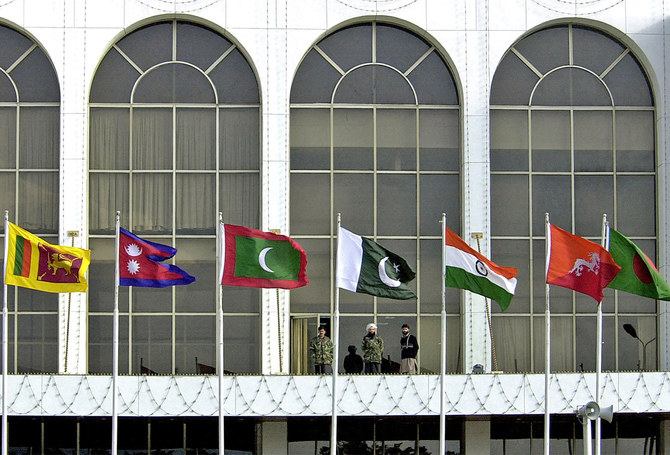
ISLAMABAD: Pakistan on Monday extended an olive branch to India and asked the nuclear arch-rival to “virtually” join the 19th summit of the South Asian Association for Regional Cooperation (SAARC), if Indian Prime Minister Narendra Modi could not come to Islamabad to attend it, local media reported.
Pakistan was to host the summit in 2016, but India boycotted the moot and persuaded a few other member states to do the same as well. According to the SAARC charter, the summit cannot take place if any of the members stays out.
Since 2016, New Delhi has consistently been staying away from the summit thus delaying the gathering of leaders of eight South Asian nations.
“Pakistan considers SAARC an important forum. We are willing to host the 19th SAARC summit and if India has any issue in attending the summit in person then it can attend the moot virtually,” the Express Tribune quoted Pakistani Foreign Minister Shah Mahmood Qureshi as saying at a news conference in Islamabad.
“If India cannot attend the summit in Islamabad, at least it should not stop other members,” he said, extending an invitation to all SAARC members for the next summit.
Despite Indian intransigence, he said, SAARC played an active role in tackling the COVID-19 pandemic, but could not realize its true potential.
Last month, SAARC Secretary-General Esala Ruwan Weerakoon had arrived in Islamabad on his first visit since assuming office in March 2020.
On his visit to the Pakistani foreign office, Qureshi said Pakistan was committed to host the SAARC summit if “artificial obstacles” created in its way were removed. He had reaffirmed Pakistan’s commitment to the principles and objectives of the SAARC charter for the welfare of the people of the region, economic integration and regional prosperity.
Speaking further at Monday’s news briefing, the foreign minister said his country would continue to fence its border with Afghanistan, amid a row with the new Afghan Taliban authorities.
Pakistan has fenced most of the 2,600 km (1,615 mile) border despite protestations from Kabul, which has always contested the British-era boundary demarcation that splits families and tribes on either side.
Multiple incidents have occurred in recent weeks, wherein local Taliban soldiers tried to remove the fence along the Pakistan-Afghan border.
The first such incident was reported a day before Pakistan hosted an extraordinary session of the Organization of Islamic Cooperation’s (OIC) Council of Foreign Ministers on Afghanistan last month.
The acting Afghan foreign minister was also part of the summit, which agreed to establish a Humanitarian Trust Fund to channel assistance to Afghanistan, appoint a special envoy and work together with the UN in the war-ravaged country.
“We are not silent [on border fencing issue]. We had installed fence on the Pak-Afghan border and our effort will continue,” Qureshi said at a press briefing in Islamabad.
“Afghanistan is our friend and neighboring country, we have engagement with them. We will overcome the problems which have been witnessed through diplomatic channels with them.”
The Pakistani foreign minister said there were a few people who wanted to play up this issue. “We think it is not in the interest of Pakistan to play up this issue, but we will protect our interests,” he said.
In the first incident on December 18, Taliban soldiers in Afghanistan disrupted the erecting of a security fence by the Pakistani military along the border between the two countries, Reuters reported, citing Afghan officials.
A video circulating on social media showed Taliban soldiers seizing spools of barbed wire and one senior official warning Pakistani soldiers stationed in security posts in the distance not to try to fence the border again.
Afghan defense ministry spokesman Enayatullah Khwarazmi said Taliban forces stopped the Pakistani military from erecting an “illegal” border fence along the eastern province of Nangarhar on Sunday.
He played down the incident, saying everything was now normal. The Pakistan army had not responded to Reuters’ request for comments.
The fencing was a main reason behind the souring of relations between previous US-backed Afghan governments and Islamabad. Recent standoffs indicate the matter remains a contentious one for the Taliban, despite their ties with Islamabad.
The lawless mountainous border was historically fluid before Pakistan began erecting a metal fence four years ago, of which it has completed 90 percent.


![]()

Pakistan asks India to attend SAARC summit ‘virtually’
Short Url
https://arab.news/m9chf
Pakistan asks India to attend SAARC summit ‘virtually’
- Pakistan was to host the summit in 2016, but India boycotted the gathering
- Foreign Minister Qureshi says will continue to fence border with Afghanistan
Latest updates


© 2026 SAUDI RESEARCH & PUBLISHING COMPANY, All Rights Reserved And subject to Terms of Use Agreement.