

Yemeni troops recapture district in Shabwa from Houthis

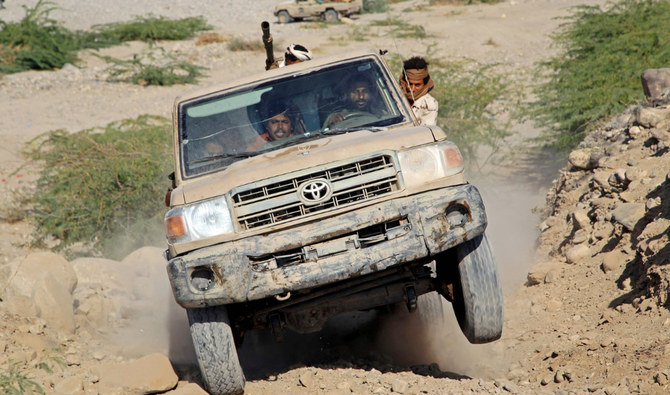
Fighters loyal to Yemen's government patrol in the Maqbana area of Yemen's southwestern province of Taez, on December 13, 2021. (AFP)
Short Url
Updated 02 January 2022
Follow

Yemeni troops recapture district in Shabwa from Houthis

  • With control of Ouselan, government effectively cuts supply routes to militia in Hareb district, south of Marib

AL-MUKALLA: Yemeni government troops pushed deeper into the Houthi-controlled territory in the southern province of Shabwa on Saturday, a day after seizing control of the district of Ouselan, local military officials said.

Fighting broke out between government troops, comprised from the Giants Brigades and army personnel, and the Houthis in Al-Nagoum and Al-Salem between Ouselan and Bayan in Shabwa province, as loyalists push to expel the Houthis from Bayhan and Al-Ain, two remaining districts in Shabwa under Houthi control, an army official told Arab News on Sunday.

The governor of Shabwa, Awadh Mohammed Al-Wazer, announced the liberation of the district of Ouselan from the Houthis during the early hours of a new offensive aimed at expelling them from oil-rich Shabwa.

Army commanders and local officials appeared in videos, taking group photos and speaking to jubilant people outside the center of Ouselan.

Giants Brigades official media also reported that their forces liberated the strategic Bin Ageel Mountain in Ouselan and surrounding areas, and are currently marching towards new areas in Bayhan district.

Warplanes from the Arab coalition on Saturday and Sunday carried out raids in Shabwa, targeting Houthi military vehicles and locations, Yemeni officials said.

By seizing control of Ouselan, the government troops have effectively cut the Houthi supply routes to their fighters in Hareb district, south of Marib, distracting the attention of the Houthis and alleviating pressure on government troops defend the city.

“This is a very important development. We have one goal, one battle and one enemy,” a military official said, adding that the Houthis moved some of their forces in Marib province to defend their territory in Shabwa, relieving pressure on government forces and enabling them to score limited gains on Sunday.

“The Houthis are amassing huge forces to defend Bayhan and are inciting tribal leaders to mobilize and recruit people to fight government troops,” the official said.

If the Giants Brigades and army troops fully capture Bayhan and Al-Aid in the coming days, they would surround pockets of Houthis south of Marib, including in Juba, Al-Abedia and Hareb, significantly weakening Houthi attacks on Marib from the south, and would also pave the way for government troops to attack the Houthis in Abyan and Al-Bayda.

In September, the Houthis besieged the district of Al-Abedia and opened a new front in the war south of Marib, taking advantage of their control of Bayhan in Shabwa.

The deployment of several brigades from the Giants Brigades that have long been positioned along the country’s west coast, in Shabwa province, is part of a new military strategy prepared by the Arab coalition.

The strategy is based on moving forces from less fraught areas such as Hodeidah to reinforce government troops on more intense battlefields such as Marib and Shabwa.

The liberation of large amounts of land in Shabwa has sparked joy in Yemen and has given government troops on the battlefields a big morale boost.

Yemen’s President Abed Rabbo Mansour Hadi called the governor of Shabwa to congratulate him on the latest military gains in the province and ordered him to press ahead with the offensive until the Houthis are driven out of the province, the official news agency SABA said.

Hadi added that his forces would defeat the Iran-backed militia and return peace and stability to war-torn Yemen.

In a telephone conversation with the governor of Shabwa, Yemen’s Prime Minister Maeen Abdul Malik Saeed, who is currently visiting the UAE, also praised the Yemeni troops and Giants Brigades forces for scoring military gains in Shabwa, pledging support to the governor and other commanders leading the fight against the Houthis.

The Saudi ambassador to Yemen, Mohammed Al-Jaber, also reacted to the news of the military success in Shabwa, by tweeting that the liberation of Ouselan is the “beginning of good.”


Abbas reiterates opposition to displacement of Palestinians

Russian President Vladimir Putin with Palestinian President Mahmoud Abbas at the Senate Palace of the Kremlin in Moscow. (AP)
Updated 23 January 2026
Follow

Abbas reiterates opposition to displacement of Palestinians

  • During Moscow talks, president calls for immediate halt to Israeli acts of terror
  • Historically, Russia has supported and stood by the Palestinian people at political and diplomatic levels

MOSCOW: The Palestinian National Authority’s President Mahmoud Abbas has reiterated his opposition to all attempts to displace Palestinian people from their land.

Speaking with Russian President Vladimir Putin at the presidential palace in Moscow, Abbas was reported by the Kremlin’s official website as saying that “the Palestinian people are holding on to their land, and we categorically oppose attempts by the Americans and Israelis to expatriate Palestinians beyond Palestinian territory.” 
He said the Palestinian people “will not abandon their land, whatever the cost.” Abbas stressed the need to fully implement US President Donald Trump’s peace plan, leading to the withdrawal of occupation forces and the launch of the reconstruction process.
He emphasized that the Palestinian Authority would assume a central role in administering the Gaza Strip, and that the enclave and the West Bank constituted two parts of a single territorial unit, with a unified and undifferentiated system of civilian institutions.
He stressed the need for an immediate halt to “Israeli settler colonialism and Israeli acts of terror in the West Bank, including Jerusalem, along with the release of withheld Palestinian funds and the cessation of all measures that undermined the Palestinian Authority and the two-state solution.”
He reaffirmed his commitment to continue the struggle for the realization of the Palestinian people’s right to self-determination and of their right to a fully sovereign, independent state based on the borders of June 4, 1967, with East Jerusalem as its capital, while living in security and peace with neighbors.
He told Putin: “What we need is peace, and we hope that with your help and support, we can achieve it — a peace built on the basis of international legal resolutions, decisions of the United Nations, and the principles established following the wars of 1967 and 1973.
“East Jerusalem remains the capital of Palestine, and we know that Russia has always supported — indeed, was the first to support — Palestine, maintaining a firm stance in support of our people.”
Abbas thanked his Russian counterpart for Moscow’s support and commended the bilateral “bonds of friendship” between both countries. He added: “We are friends of Russia and the Russian people. For over 50 years our nations have been bound by a strong friendship that has developed over the decades and continues on the correct path. Russia is a great friend and a nation upon which we rely in many spheres.
“Historically, Russia has supported and stood by the Palestinian people at political and diplomatic levels. Your economic and financial support is both significant in scale and crucial in importance.”
Abbas emphasized moving forward with the implementation of a comprehensive national reform program aimed at consolidating the rule of law, strengthening the principles of good governance, transparency, and accountability, and ensuring the separation of powers.
Putin affirmed Moscow’s “principled and consistent approach” to the Palestinian question.
He said: “We believe that only the establishment and full functioning of the Palestinian state can lead to a lasting settlement of the Middle East conflict.”