

Lebanon’s Bassil hits out at Hezbollah amid country’s political paralysis

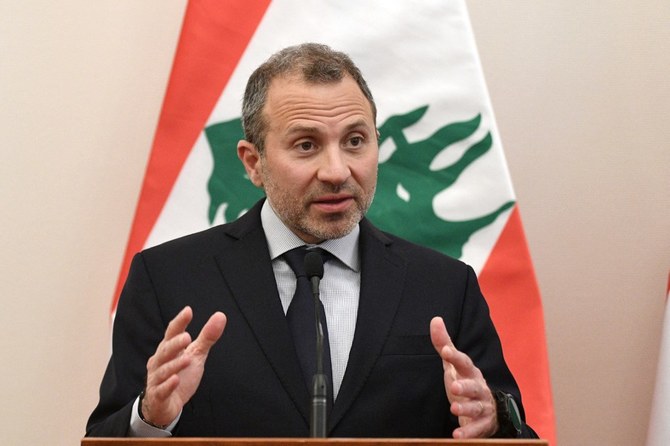
The televised speech by Gebran Bassil, who heads the Free Patriotic Movement, signaled an unprecedented level of frustration with Hezbollah. (File/AFP)
Short Url
Updated 02 January 2022
Follow

Lebanon’s Bassil hits out at Hezbollah amid country’s political paralysis

  • Better to be alone than with “bad company,” says Free Patriotic Movement leader
  • Hezbollah chief Hassan Nasrallah due to give speech Monday

BEIRUT: Lebanese lawmaker Gebran Bassil has hit out at ally Hezbollah, as the country entered 2022 experiencing the same political paralysis as the year before.

Cabinet sessions are yet to resume as the ministers of Hezbollah and the Amal movement are still refusing to attend sessions.

Bassil, who heads the Free Patriotic Movement, on Sunday sharply criticized what he called “the militia warlords and the leaders of corruption.”

Neither Hezbollah, Parliament Speaker Nabih Berri, nor Lebanese Forces party leader Samir Geagea were spared in his remarks. Nor did the governor of the central bank, Riad Salameh, emerge unscathed as Bassil took aim.

Bassil, who has been an ally of Hezbollah since 2006 through the Mar Mikhael Agreement, asked: “Where is the consensual democracy? Is it (by) paralyzing the Cabinet and attacking the president and his rule? Is it by attacking the Constitutional Council? Where is the defensive strategy to solve problems with sister countries?”

His comments come amid a devastating economic crisis in Lebanon and ahead of critical parliamentary elections in which his party is expecting tough competition.

He added: “Making empty promises then belittling us and what we represent is unacceptable. Of course, we would be more powerful in the elections if we were to ally with Hezbollah, but if we need to choose between winning the elections and keeping our dignity, then I would say it’s better to be alone than with bad company. 

“Hezbollah Secretary-General Hassan Nasrallah will say that such matters should only be discussed in closed meetings. That’s true, but we have tried and tried to see eye to eye.

“We do not want to disregard the understanding we have with Hezbollah because it is a sound understanding, based on national constants. However, we want a better one because it is no longer effective. Our priority is the state and reforms. Their priority is the resistance and defending it. We cannot lose the state and the resistance, but we can win both.”

His remarks also come amid a worsening division between President Michel Aoun and his team on the one hand and Hezbollah and Berri on the other.

Further bickering is expected against the backdrop of Berri's demand to hold an extraordinary parliament session, which requires Aoun’s signature, while Nasrallah is expected to give a highly anticipated speech on Monday.

Bassil said his party was the only one that stood against foreign projects such as the “deal of the century,” a reference to former US President Donald Trump’s Middle East peace plan, and local ones that “target our rights” as Christians.

“Those who disrupted the work of the Taif Agreement have turned our democracy into a disruptive one that prevents any decision from being taken, even if it is unanimous. I do not understand the obstruction, the Parliament approves the laws it wants and the rest is kept in the bottom drawer, including the gas law that feeds all electricity plants and the criminal audit law.”

Bassil said that Berri ultimately decided which laws were subject to discussion and which were not, and he reiterated Aoun’s demand for a decentralized administrative and financial system.

"Whoever thinks they can use force to get their way should reconsider and see where such attempts have led others.”

The lawmaker also attacked Salameh who, he said, was “politically protected by the pillars of the political system.”

He accused Salameh of orchestrating the largest organized robbery of people's money, claiming the top banking official was wanted in seven countries but “no one dares to address him in Lebanon.”

He alleged that the governor had obstructed the criminal audit into the central bank’s accounts and was sabotaging the financial recovery plan with the IMF.

Bassil further said that Salameh had “illegally applied a haircut on deposits and is still making profits and smuggling money abroad.”

He spoke about the price the FPM had to pay for supporting Hezbollah since the international community was working on isolating it.

“When we were asked to partake in this isolation, we refused. We provided political support to the resistance against Israel and Daesh. We also received political support from Hezbollah in return and attempts to isolate Hezbollah are ongoing.”

Bassil, whom political observers believe has lost a lot of his popularity in the Christian community, accused Geagea of being “a tool for foreign parties — Israel and the US — seeking sedition in Lebanon.”

Lebanese Forces lawmaker Imad Wakim tweeted in response to Bassil’s speech: “He unleashed his delusions. Of course, he had to talk about Aoun’s lost powers and the rights of the Christians, blaming everyone except the FPM. Has he forgotten that people now refer to him as Pinocchio and no longer believe anything he says?”


Iran’s unrelenting attacks on Mideast shipping and energy infrastructure send oil prices soaring

Updated 13 sec ago
Follow

Iran’s unrelenting attacks on Mideast shipping and energy infrastructure send oil prices soaring

  • With traffic in the Strait effectively stopped, the price of Brent crude oil, the international standard, rose another 9 percent on Thursday to more than $100 a barrel
DUBAI: Unrelenting Iranian attacks on shipping traffic and energy infrastructure pushed oil above $100 a barrel on Thursday, as American and Israeli strikes pounded the Islamic Republic with no sign of an end to the war in sight.
Iran hit a container ship off the coast of Dubai, caused a blaze near Bahrain’s international airport, targeted a major Saudi oil field with a drone attack and forced Iraq to halt operations at all the country’s oil terminals after an attack on its port of Basra on the Arabian Gulf.
Iran flouted a United Nations Security Council resolution from the previous day demanding that it halt strikes on its Gulf neighbors with new attacks also reported in Kuwait and the United Arab Emirates.
Sirens wailed before dawn in Jerusalem after Israel said it was working to intercept missiles launched from Iran. The country also announced it had begun a “wide-scale wave of strikes” on Tehran. In Lebanon, where Israel says it is targeting Iran-linked Hezbollah militants, 11 people were killed in two early morning strikes.
Since the United States and Israel sparked with war with a Feb. 28 attack on Iran, Tehran has embarked on a campaign generated at inflicting enough global economic pain to pressure them to relent in their attacks.
In addition to attacking energy infrastructure around the region, Iran has a stranglehold on the Strait of Hormuz, the strategic waterway leading from the Arabian Gulf toward the Indian Ocean through which a fifth of the world’s oil is transported.
With traffic in the Strait effectively stopped, the price of Brent crude oil, the international standard, rose another 9 percent on Thursday to more than $100 a barrel, up some 38 percent over what it cost when the war started.
Iran fires at multiple Gulf Arab countries and hits ship in Arabian Gulf
The UN Security Council voted Wednesday to approve a resolution demanding a halt to Iran’s “egregious attacks” on its Gulf neighbors, but Tehran showed no signs of changing its strategy.
As the day began Thursday, a container ship in the Arabian Gulf was hit with a projectile off the coast of Dubai, sparking a small fire, according to British military’s United Kingdom Maritime Trade Operations Center. It said the crew of the vessel were safe.
In Bahrain, an early Iranian attack sparked a major fire on Muharraq Island, home to the country’s international airport. Authorities urged people to stay indoors and close windows to avoid smoke. The airport has jet fuel tanks, and other tanks in the area serve the kingdom’s oil industry.
Kuwait’s Defense Ministry said an Iranian drone smashed into a residential building, wounding two people, the UAE said it had activated air defenses twice to protect Dubai from attacks, and firefighters extinguished a blaze at a tower in Dubai Creek Harbor after a drone hit.
Saudi Arabia said it had shot down a drone targeting the diplomatic quarter of the capital, Riyadh, and also reported downing drones in kingdom’s east, including at least one trying to target its Shaybah oil field in the Empty Quarter desert.
Following an attack on Iraq’s Basra port that killed at least one person, officials said Thursday that it had been forced to halt operations at all the country’s oil terminals.
Farhan Al-Fartousi, the director-general of the General Company for Ports of Iraq, said the attack targeted a vessel in a ship-to-ship transfer area of the Arabian Gulf port.
Explosions rock Jerusalem while Lebanon and Tehran are hit by Israeli strikes
Sirens wailed and loud explosions were heard shortly after midnight in Jerusalem and other parts of Israel. The Israeli military said it was responding with another “wide-scale wave of strikes” in Tehran.
Overnight missile launches from Iran and Hezbollah also sent Israelis to shelters in multiple other areas, including Tel Aviv and the northern border with Lebanon.
An Israeli strike hit a car Thursday in Ramlet Al-Bayda, a major seaside tourist area of Beirut where dozens of displaced people have been sheltering. Eight people were killed and 31 others were wounded, the Lebanese Health Ministry said. The Israeli military press office told The Associated Press it was “not aware” of a strike at that location.
In Aramoun, a town about 10 kilometers (six miles) south of Beirut, another three people were killed and a child was wounded in another early Israeli attack.
Casualties continue to climb as conflict continues
At least 634 people have been killed in Lebanon since the latest fighting began, the Lebanese Health Ministry said Wednesday.
The UN refugee agency said at least 759,000 people have been internally displaced in Lebanon.
Iranian authorities say more than 1,300 people have been killed there, and Israel has reported 12 people dead. The US has lost seven soldiers while another eight have suffered severe injuries.