

Philippines to tighten coronavirus curbs after domestic omicron detection

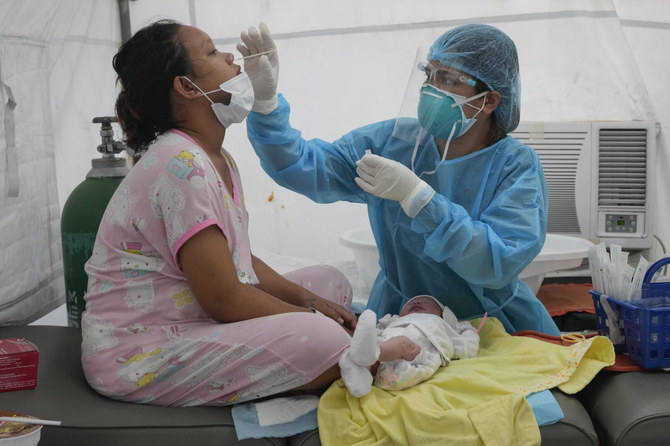
The Philippines has so far detected four omicron cases, all of which were in quarantine, although the country’s genome sequencing capacity is limited. (AP)
Short Url
Updated 31 December 2021
Follow

Philippines to tighten coronavirus curbs after domestic omicron detection

  • ‘We cannot sugarcoat this. This is not how we want to start the year 2022’

MANILA: The Philippines will impose tighter coronavirus curbs on Jan. 3 to 15 after the confirmation of three domestic cases of the omicron variant, the acting presidential spokesperson said on Friday.

“In the coming days, we might see an increase in active cases,” Karlo Nograles said.

Philippine officials earlier warned against a rise in COVID-19 cases over the New Year period as infections in the Southeast Asian country hit a two-month high, amid concerns that the highly contagious omicron variant of the virus could spread.

The health ministry recorded 2,961 new coronavirus infections on Friday and reported a positivity rate of 10.3 percent, double the 5 percent recommended by the World Health Organization.

“We cannot sugarcoat this. This is not how we want to start the year 2022,” presidential spokesperson Karlo Nograles told a regular news conference.

With roughly 2.84 million total confirmed cases and 51,504 deaths, the Philippines has the second highest number of COVID-19 cases and deaths in Southeast Asia, after Indonesia.

The Philippines has so far detected four omicron cases, all of which were in quarantine, although the country’s genome sequencing capacity is limited.

“It is prudent to assume that omicron is already in circulation, or is already in the community,” Health Secretary Francisco Duque told a separate news conference.


Czech Prime Minister Babiš faces confidence vote as government shifts Ukraine policy

Updated 4 sec ago
Follow

Czech Prime Minister Babiš faces confidence vote as government shifts Ukraine policy

  • “I’d like to make it clear that the Czech Republic and Czech citizens will be first for our government,” Babiš said
  • Babiš has rejected any financial aid for Ukraine and guarantees for EU loans

PRAGUE: The Czech Republic’s new government led by populist Prime Minister Andrej Babiš was set to face a mandatory confidence vote in Parliament over its agenda aimed at steering the country away from supporting Ukraine and rejecting some key European Union policies.
The debate in the 200-seat lower house of Parliament, where the coalition has a majority of 108 seats, began Tuesday. Every new administration must win the vote to govern.
Babiš, previously prime minister in two governments from 2017-2021, and his ANO, or YES, movement, won big in the country’s October election and formed a majority coalition with two small political groups, the Freedom and Direct Democracy anti-migrant party and the right-wing Motorists for Themselves.
The parties, which share admiration for US President Donald Trump, created a 16-member Cabinet.
“I’d like to make it clear that the Czech Republic and Czech citizens will be first for our government,” Babiš said in his speech in the lower house.
The political comeback by Babiš and his new alliance with two small government newcomers are expected to significantly redefine the nation’s foreign and domestic policies.
Unlike the previous pro-Western government, Babiš has rejected any financial aid for Ukraine and guarantees for EU loans to the country fighting the Russian invasion, joining the ranks of Viktor Orbán of Hungary and Robert Fico of Slovakia.
But his government would not abandon a Czech initiative that managed to acquire some 1.8 million much-needed artillery shells for Ukraine only last year on markets outside the EU on condition the Czechs would only administer it but would not contribute money.
The Freedom party sees no future for the Czechs in the EU and NATO, and wants to expel most of 380,000 Ukrainian refugees in the country.
The Motorists, who are in charge of the environment and foreign ministries, rejected the EU Green Deal and proposed revivals of the coal industry.