

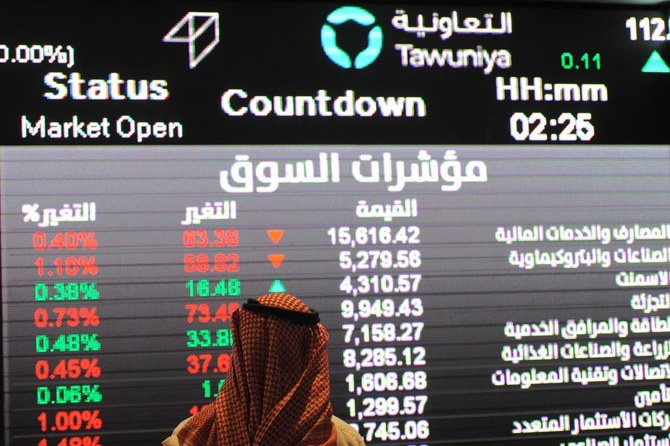
Saudi stock market ends 2021 with highest jump in 14 years despite omicron worries

GettyImages
Short Url
Updated 31 December 2021
Follow

Saudi stock market ends 2021 with highest jump in 14 years despite omicron worries

RIYADH: The Saudi exchange has concluded the final trading session of the year with its TASI index hitting the highest annual leap in 14 years, amounting to 30 percent, amid an unending series of pandemic-driven volatility.

The latest gains recorded stood at 0.73 percent for the main index TASI which closed at 11,282 points, and 0.09 percent for the parallel market Nomu, edging up to 25,976 points.

Most of the Kingdom’s major players ended higher including Al Rajhi Bank, Saudi Aramco, and SABIC, rising to SR142 ($37.82), SR35.8, and SR116, respectively.

ACWA Power saw the highest gains of 5.4 percent to close at SR84 — highest since listing, followed by Saudi Research and Media Group, SRMG, and Allied Cooperative Insurance Group, ACIG, which rose almost 5 percent to SR196 and SR23.6, respectively.

The hike in ACIG’s shares followed the approval to increase capital to SR291 million via a rights issue, where the fluctuation limits will be based on a share price of SR22.6 as announced today by the Saudi Exchange.

Sadr Logistics was the top decliner as it fell almost 10 percent to SR102, erasing its gains momentum from earlier this month where it hit an all-time closing high of SR138.

The fast rebound of Saudi stocks illustrated resilience against the recently re-imposed COVID-19 restrictions by the government which sent the market into free-fall on Wednesday, Dec. 29.

Throughout the year, the Kingdom’s major indexes saw unprecedented gains that were driven by a wave of initial public offerings, higher dividends, improving oil markets, promising financial results for companies, and overall recovery from 2020’s pandemic crisis.

Later in November when the omicron variant hit, a surge in coronavirus cases in the country followed which reignited investors’ fears as they witnessed a mixed trend in the equity markets.


Acwa signs key terms to develop 5GW of renewable energy capacity in Turkiye

Updated 23 February 2026
Follow

Acwa signs key terms to develop 5GW of renewable energy capacity in Turkiye

JEDDAH: Saudi utility giant Acwa has signed key investment agreements with Turkiye’s Ministry of Energy and Natural Resources to develop up to 5 gigawatts of renewable energy capacity, starting with 2GW of solar power across two plants in Sivas and Taseli.

Under the investment agreement, Acwa will develop, finance, and construct, as well as commission and operate both facilities, according to a press release.

The program builds on the company’s first investment in Turkiye, the 927-megawatt Kirikkale Independent Power Plant, valued at $930 million, which offsets approximately 1.8 million tonnes of carbon dioxide annually, the statement added.

A separate power purchase agreement has been concluded with Elektrik Uretim Anonim Sirketi for the sale of electricity generated by each facility.

Turkiye aims to boost solar and wind capacity to 120GW by 2035, supported by around $80 billion in investment, while recent projects have already helped prevent 12.5 million tonnes of CO2 emissions and reduced reliance on imported natural gas.

Turkiye’s energy sector has undergone a rapid transformation in recent years, with renewable power emerging as a central pillar of its strategy.

Raad Al-Saady, vice chairman and managing director of ACWA, said: “The signing of the IA (implementation agreement) and PPA key terms marks a pivotal moment in Acwa’s partnership with Turkiye, reflecting the country’s strong potential as a clean energy leader and manufacturing powerhouse.”

He added: “Building on our long-standing presence, including the 927MW Kirikkale Power Plant commissioned in 2017, this step elevates our partnership to a new level,” Al-Saady said.

In its statement, Acwa said the 5GW renewable energy program will deliver electricity at fixed prices, enhancing predictability for grid planning and supporting long-term industrial investment.

By replacing imported fossil fuels with domestically generated clean energy, the initiative is expected to reduce Turkiye’s exposure to global energy market volatility, strengthening energy security and lowering long-term power costs.

The company added that the economic impact will extend beyond the anticipated investment of up to $5 billion in foreign direct investment, with thousands of jobs expected during the construction phase and hundreds of high-skilled roles created during operations.

The energy firm concluded that its existing progress in Turkiye reflects a strong appreciation for Turkish engineering, construction, and manufacturing capacity, adding that localization has been a strategic priority, and it has already achieved 100 percent local employment at its developments in the country.