

Murabaha, Tawarruq gain in importance as financing tools at Saudi Islamic banks 

(Getty)
Short Url
Updated 30 December 2021
Follow

Murabaha, Tawarruq gain in importance as financing tools at Saudi Islamic banks 

Murabaha and Tawarruq contracts prompted a 19 percent annual rise in total financing provided by Saudi Islamic banks as of Sep. 30 2021. 

The total financing provided to that date by the Saudi Islamic banks reached SR1.67 trillion ($444 billion), according to a monthly report published by SAMA.

Murabaha is a Shariah-compliant structure of financing which stipulates a profit markup for the lender rather than interest.

Tawarruq is a structure by which a buyer can obtain cash immediately.

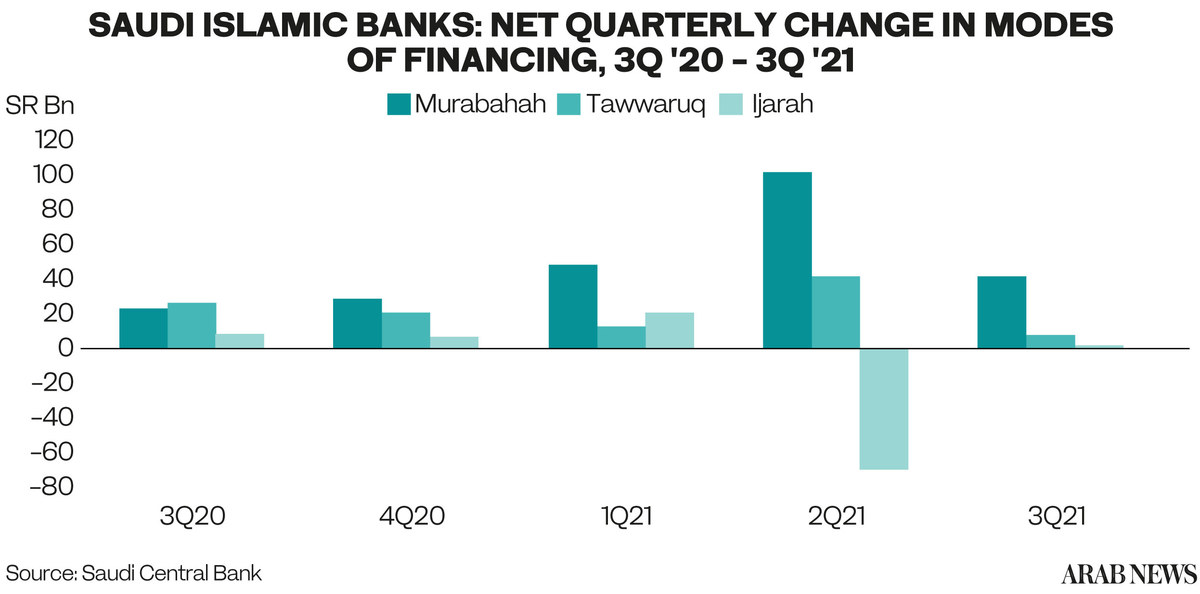
The value of these two types of financing contracts at the end of the third quarter saw the fastest annual rates of growth compared to other modes of financing. 

The annual growth rate in total value of Murabaha contracts by the end of third quarter accelerated to 40 percent from 19 percent in the same period last year.

It was followed by Tawarruq contracts as the total value of these at the end of the third quarter increased by 13 percent on a year-on-year basis.

Most noticeable is the slowdown in Ijarah financing as the total value of this mode of the Shariah-compliant financing provided by Saudi Islamic banks at the end of the third quarter fell 18 percent year-on-year. The total value of Ijarah contracts also saw a 16-percent annual fall in the second quarter after the 22-percent increase in the first quarter of 2021.

The share of Murabaha financing in total value of financing provided by Saudi Islamic banks as of the end of the third quarter 2021 grew to 45 percent, up from 38 percent as at the end of the same quarter a year ago.
The Murabaha mode is usually meant for a short-term Shariah-compliant financing while Ijara is used more for a longer-term financing. 

Tawarruq is where the bank or the financial institution buys an asset and sells it to the customer on a deferred payment basis. The buyer will, in turn, sell this asset to a third party in exchange for instant cash. In this way, this customer will have obtained the needed cash but will be required to repay the financial institution a deferred, marked-up price.

Ijarah is another Shariah-compliant structure of financing which is similar to a leasing contract under which one party transfers the right to use the property to another party for a specified period, in exchange for a specified consideration. 

Islamic banks use finance leases as a mode of financing after having amended the structure to meet Shariah principles.


ESG sukuk set to exceed $70bn by 2026 end: Fitch 

Updated 9 sec ago
Follow

ESG sukuk set to exceed $70bn by 2026 end: Fitch 

RIYADH: The global market for environmental, social and governance sukuk is on track to exceed $70 billion in outstanding value by the end of 2026, supported by refinancing needs, funding diversification and sustainability mandates, according to Fitch Ratings. 

Momentum in ESG sukuk issuance is expected to continue as net-zero targets, the prospect of lower interest rates and oil prices, and expanding regulatory frameworks encourage issuers across emerging markets, the ratings agency said in a report published this month. 

ESG sukuk are structured to finance environmentally and socially sustainable projects, including renewable energy, clean transportation and climate-resilient infrastructure. 

Earlier this month, a separate report by S&P Global set out similar views, noting that ESG sukuk issuance is set to accelerate as Gulf Cooperation Council countries step up climate transition efforts and roll out incentives for sustainable practices. 

Commenting on the Fitch report, Bashar Al-Natoor, global head of Islamic finance at the agency, said: “We expect ESG sukuk to maintain its solid momentum into 2026, supported by sustainability mandates, net-zero targets, new frameworks, robust demand, along with the upcoming Turkiye-hosted COP31.” 

He added: “While evolving Shariah and ESG requirements, geopolitical tensions and greenwashing remain key risks, the credit profile is robust: 92 percent of rated ESG sukuk are investment grade, all issuers have Stable Outlooks, and there have been no defaults.” 

According to Fitch, ESG sukuk accounted for around 40 percent of emerging-market ESG debt issuance in US dollar terms in 2025, up from 18 percent in 2024. 

Global ESG sukuk issuance rose more than 60 percent year on year to $18.5 billion in 2025, with Saudi Arabia accounting for 33 percent of the total. 

Malaysia followed with a 28 percent share, while the UAE and Indonesia accounted for 19 percent and 9 percent, respectively. 

Outstanding ESG sukuk reached $58 billion at the end of 2025, representing a 30 percent year-on-year increase. 

The report noted that social sukuk are also gaining traction globally, alongside sustainability-linked, orange and climate sukuk. 

Recent developments include Pakistan issuing its first sovereign green sukuk and Oman Electricity Transmission Co. SAOC launching Oman’s first ESG sukuk. 

Highlighting regulatory progress, Fitch said Malaysia has granted tax exemptions for Sustainable and Responsible Investment sukuk under its income tax rules. 
 
“Saudi Arabia’s Capital Market Authority issued guidelines for green, social, sustainable and sustainability-linked debt, while Qatar’s central bank launched a Sustainable Finance Framework. In addition, the UAE’s central bank has begun developing a Sustainable Islamic M-Bills program,” the agency said.