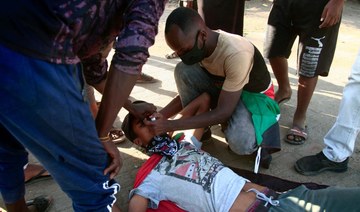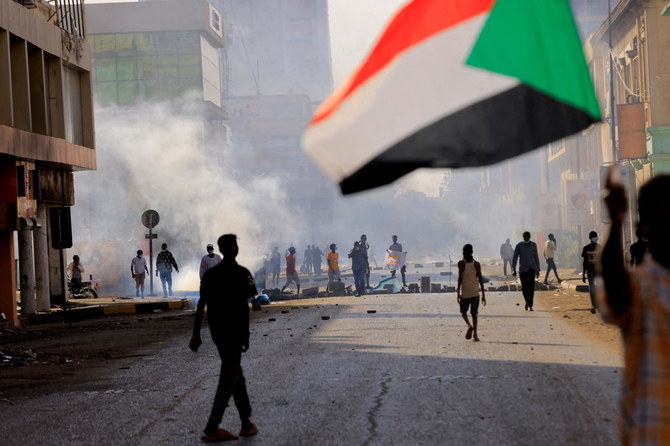

KHARTOUM: Sudanese security forces shot and killed four protesters Thursday as tens of thousands of demonstrators defied a security lockdown and severed communications to rally against military rule, medics said.
Pro-democracy activists have kept up a more than two-month-long campaign of street demonstrations against a military takeover in October.
The crackdown has now seen at least 52 people killed in protest-related violence, according to the independent Doctors’ Committee, which is part of the pro-democracy movement.
On Thursday, security forces killed with live rounds four protesters in Omdurman, twin city of the capital Khartoum, and wounded dozens, they said.
“We call on doctors to come to the Arbain hospital in Omdurman because the putschists are using live rounds against protesters and preventing ambulances from reaching them,” they added.
Their plea was posted on social media accounts of Sudanese living abroad as authorities had severed domestic and international phone lines.
Web monitoring group NetBlocks said mobile Internet services were also cut.
Saudi network Al-Arabiya said several of its journalists had been wounded in an attack by security forces on its Khartoum office.
Another Saudi channel, ASharq, also reported that security forces prevented its reporters from covering the anti-military rallies.
The head of the Sovereign Council Abdel Fattah Al-Burhan sent a delegate from his office along with one from Interior Ministry and a police spokesman to their offices to confirm an investigation into the attacks would be opened.
The police spokesman said that the perpetrators of the storming of the offices would be “punished.”
Nevertheless, tens of thousands of protesters braved tear gas chanting “no to military rule” as they marched in rallies in several part of Sudan demanding a transition to a civilian government.
Earlier in the day, demonstrators reached within a few hundred meters (yards) of the presidential palace, the headquarters of top General Abdel Fattah Al-Burhan who seized power on October 25.
Troops, police and paramilitary units launched multiple tear gas canisters into the crowd.
“The revolution continues,” protesters shouted, beating drums and waving flags.
“No to military rule” and “soldiers back to the barracks,” they chanted in Khartoum and Omdurman.
Security forces deployed in strength across the capital, using shipping containers to block the Nile bridges that connect the capital with Omdurman and other suburbs.
The authorities also installed new surveillance cameras on major thoroughfares for Thursday’s protests.
Witnesses reported similar anti-coup protests in Wad Madani, south of the capital, and the cities of Kassala and Port Sudan in the east.
Burhan, who held civilian leader Prime Minister Abdalla Hamdok effectively under house arrest for weeks, reinstated him on November 21 under a deal promising elections for July 2023.
Protesters said the deal had simply given a cloak of legitimacy to the generals, whom they accuse of trying to reproduce the former regime of autocratic president Omar Al-Bashir, toppled in 2019 following mass protests.
“Signing with the military was a mistake from the start,” one protester said, accusing the generals of being “Bashir’s men.”
The Nile bridges were also blocked for previous protests on December 25, when tens of thousands also rallied.
About 235 people were injured during those protests, according to the Doctors’ Committee, and tear gas fired at demonstrators.
The US embassy appealed for restraint, reiterating “its support for peaceful expression of democratic aspiration, and the need to respect and protect individuals exercising free speech,” a statement said.
“We call for extreme discretion in use of force and urge authorities to refrain from employing arbitrary detention.”
Activists have condemned sexual attacks during December 19 protests, in which the UN said at least 13 women and girls were victims of rape or gang-rape.
The European Union and the United States issued a joint statement condemning the use of sexual violence “as a weapon to drive women away from demonstrations and silence their voices.”
Sudan still has no functioning government, a prerequisite for the resumption of international aid cut in response to the coup.
More than 14 million people, a third of Sudan’s population, will need humanitarian aid next year, according to the UN Office for the Coordination of Humanitarian Affairs, the highest level for a decade.