

Saudi Arabia calls on UN Security Council to hold Houthis accountable

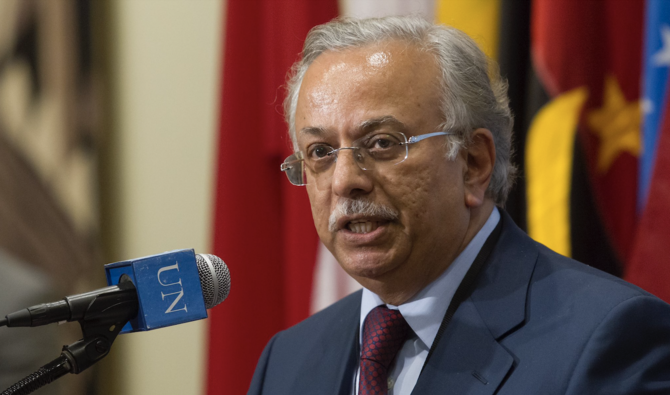
Saudi Arabia’s permanent representative to the UN in Geneva Abdallah Al-Mouallimi. (@ksamissionun)
Short Url
Updated 29 December 2021
Follow

Saudi Arabia calls on UN Security Council to hold Houthis accountable

  • Al-Mouallimi stressed that targeting civilians and civilian objects is a war crime
  • Kingdom will spare no effort to take all measures to preserve the safety of its people

RIYADH: Saudi Arabia called on the UN Security Council to hold the Houthi militia and those who supply it with arms and resources accountable in a bid to stop the militia threatening international peace and security.

The request was made by the Kingdom’s permanent representative to the UN Abdallah Al-Mouallimi in a letter to the organization’s Secretary-General Antonio Guterres and the Security Council.

“I write about the continuation of terrorist attacks launched by the Iranian-backed terrorist Houthi militia on civilians and civilian objects in Saudi Arabia. This includes a military projectile hitting a shop in Samtah, Jazan on Dec. 24 which resulted in the deaths of a Saudi citizen and a Yemeni resident. Seven civilians including six citizens and a Bangladeshi resident were also injured and two shops and 12 vehicles were damaged,” the letter said. 

Al-Mouallimi stressed that targeting civilians and civilian objects is a war crime, and that the Houthi militia must be held accountable in accordance with international law.

He said the Kingdom will spare no effort to take all necessary measures to protect its territory and preserve the safety of its citizens and residents in accordance with international laws.

“It is clear that the absence of strict measures by the international community, especially the Security Council, toward those who supply weapons to the Houthi militia, will allow the militia to continue its terrorist acts in the region,” the envoy said.

“It is therefore of paramount importance that the Security Council assume its responsibility towards the Houthis and those who supply their arms and the resources that finance their terrorist acts, in order to stop their threats to international peace and security.”


Saudi Arabia decorates former Centcom commander with King Abdulaziz Medal

Updated 9 sec ago
Follow

Saudi Arabia decorates former Centcom commander with King Abdulaziz Medal

  • The King Abdulaziz Medal is one of the highest and most prestigious civilian and military honors in Saudi Arabia
  • As CENTCOM chief, Kurilla was instrumental in deepening the eight-decade military partnership between the US and Saudi Arabia

RIYADH: Saudi Arabia has bestowed the King Abdulaziz Medal of Excellent Class upon the former commander of the US military’s Central Command (CENTCOM), retired General Michael Kurilla.

Minister of Defense Prince Khalid bin Salman conferred the award upon the directives of King Salman, the Saudi Press Agency reported.

The ceremony took place at the defense minister’s office in Riyadh on Thursday.

The King Abdulaziz Medal, often referred to as the Order of King Abdulaziz, is one of the highest and most prestigious civilian and military honors in Saudi Arabia. Named after the Kingdom’s founder, King Abdulaziz Al Saud, the order was officially inaugurated by King Faisal on March 20, 1971.

Prince Khalid bin Salman, right, receiving and General Michael Kurilla (ret.) at his Ministry of Defense office on Thursday. (SPA)

General Kurilla, who retired from active duty in August 2025, served as the 15th commander of CENTCOM, overseeing US military operations across 21 countries in the Middle East, Central Asia, and South Asia.

During his tenure at CENTCOM from April 2022 to August 2025, Kurilla was instrumental in deepening the eight-decade military partnership between the United States and Saudi Arabia. He made numerous strategic visits to the Kingdom, working closely with top defense leaders, including Chief of General Staff Gen. Fayyad bin Hamed Al-Ruwaili.

Their frequent engagements focused on advancing joint military readiness, expanding regional security integration, and addressing evolving threats, such as Houthi attacks in the Red Sea and the Gulf of Aden.