

Israel approves plan to double settlers in occupied Golan

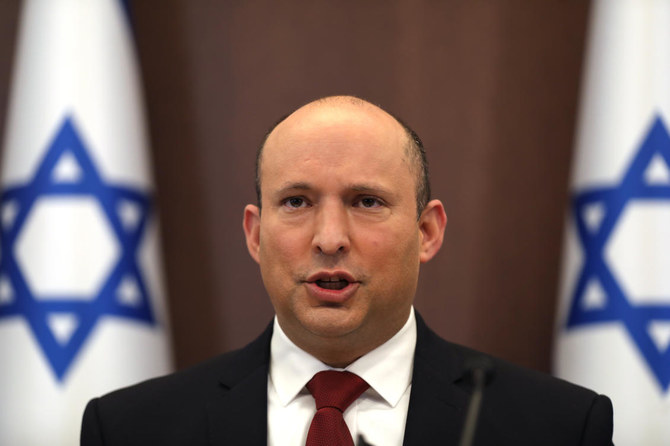
Israeli Prime Minister Naftali Bennett said Sunday his country intends to double the amount of settlers living in the occupied Golan Heights with a multimillion-dollar plan. (AP)
Short Url
Updated 26 December 2021
Follow

Israel approves plan to double settlers in occupied Golan

  • Prime Minister Naftali Bennett's cabinet voted in favour of the plan that aims to build 7,300 settler homes
  • Around 25,000 Israeli settlers live in the Golan Heights, along with about 23,000 Druze, who remained on the land after Israel seized it

GOLAN HEIGHTS: Israel's government on Sunday approved a $317 million plan to double the Jewish settler population in the Golan Heights, 40 years after it annexed the territory captured from Syria.

Prime Minister Naftali Bennett's cabinet voted in favour of the plan that aims to build 7,300 settler homes in the region over a five-year period, during a meeting held at the Mevo Hama community in the Golan.

It calls for 1 billion Israeli shekels to be spent on housing, infrastructure and other projects with the goal of attracting roughly 23,000 new Jewish settlers to the area, seized during the 1967 Six Day War.

"Our goal today is to double the population of the Golan Heights," the right-wing Bennett said ahead of the meeting.

He was forced to leave the meeting after his 14-year-old daughter tested positive for the coronavirus, putting him into isolation, but a vote on the programme went ahead after a delay.

Around 25,000 Israeli settlers live in the Golan Heights, along with about 23,000 Druze, who remained on the land after Israel seized it.

Israel annexed the territory on December 14, 1981, in a move not recognised by most of the international community.

Former US president Donald Trump, widely viewed as pro-Israeli, granted US recognition to Israeli sovereignty over the Golan in 2019.

"The Golan Heights are Israeli. This is self-evident," Bennett said.

"The fact that the Trump administration recognised this, and the fact that the (President Joe) Biden administration has made it clear that there has been no change in this policy, are also important."

Shortly after Biden took office in January, his Secretary of State Antony Blinken suggested there were legal questions surrounding Trump's move, which Syria condemned as a "flagrant violation" of its sovereignty.

But Blinken indicated there was no thought of reversing course, especially with the Syrian civil war continuing.

Bennett claimed that after a decade of conflict in Syria, international calls to restore Syrian control of the Golan were muted.

"Every knowledgeable person in the world understands that it is preferable to have Israeli heights that are quiet, flourishing and green as opposed to the alternative," he said.

Bennett leads an ideologically disparate eight-party coalition that counts on support from left-wingers.

Some in his cabinet, notably from the dovish Meretz party, have vocally opposed plans to expand settlements in the West Bank, a Palestinian territory also occupied by Israel since 1967.

Roughly 475,000 settlers now live in the West Bank in communities widely regarded as illegal under international.

Bennett is a the former head of a settler lobbying council who opposes Palestinian statehood.

But he argued that unity on the Golan plan demonstrated that Israeli control of the area was a matter of "national consensus."

"The Golan Heights, the need to strengthen, cultivate and live in it, is certainly a principle that unites everyone here," he said.

Israel and Syria, which are still technically at war, are separated by a de facto border at the Golan Heights.


Lebanon’s south could become US-backed economic zone, according to local paper Nidaa Al-Watan

Updated 7 sec ago
Follow

Lebanon’s south could become US-backed economic zone, according to local paper Nidaa Al-Watan

  • Lebanese daily quotes sources as saying the US plan casts southern Lebanon as a key gateway for broader economic transformation
  • White House fails to respond to Arab News’ request for comment

LONDON: Lebanese daily Nidaa Al-Watan has reported that the office of Jared Kushner, son-in-law and senior adviser to US President Donald Trump, has prepared detailed maps for a so‑called “Trump Economic Zone” in southern Lebanon. 

According to columnist Tarek Abou Zeinab, the Kushner plan has been formally submitted to the White House for consideration. 

Citing unnamed sources, the column said that the idea is no longer just a “whispered” concept among political circles but has entered what it described as “concrete border‑related discussions aimed at fast‑tracking the plan onto the US administration’s Middle East implementation agenda.” 

Arab News asked the US Embassy in Beirut and the US State Department for comment, but was directed to the White House for any official response. The White House was subsequently contacted but has not responded. 

Lebanon has been mired in prolonged political paralysis. Large parts of the south remain under Hezbollah’s influence, while Israel illegally occupies at least five outposts along the border that are within Lebanese sovereign land. 

According to Nidaa Al‑Watan’s sources, the US concept frames southern Lebanon as a key gateway for a wider economic transformation, tying large‑scale investment and infrastructure projects to security arrangements on the ground. 

The reported plan would seek to attract international capital, establish factories and logistics hubs, upgrade infrastructure, and build a port connected to global shipping routes. 

Its aim, according to the column, would be to open new export channels through a free‑zone model and lure major energy companies by linking southern Lebanon to wider schemes such as the India–Middle East–Europe Economic Corridor. 

Supporters of the plan argue it could trigger large Arab and international investments, raise living standards and create long‑term jobs, thereby lowering the risk of renewed conflict. 

However, Lebanese political and media sources quoted by the daily have warned that the proposal follows a new “hegemonic” approach and carries major political implications that cannot be ignored. 

The critics say the reported US vision goes beyond development to include the establishment of Jewish settlements in parts of southern Lebanon, justified on religious and security grounds to protect northern Israel. 

One source expressed concern that such moves would create a geographic and symbolic link between Israel and southern Lebanon, deepening fears over sovereignty and the region’s future political trajectory. 

The paper said Kushner is focussed on areas stretching from Mount Hermon to Shebaa and Naqoura in the far south at a time when Israel has been pressing for a buffer zone along the border, citing security concerns since the end of major clashes with Hezbollah in November 2024. 

The proposed zone would cover more than 27 southern towns, raising questions over Lebanese sovereignty. 

In parallel, the Lebanese army has been tasked with bringing all weapons under state control and asserting government authority in areas long dominated by Hezbollah, as part of a broader disarmament and security plan. 

Despite a ceasefire, Israel has continued to carry out attacks inside Lebanese territory and maintains control over parts of the south, saying the measures are necessary for security. 

Lebanese and Israeli delegations held talks in Naqoura earlier in December to shore up the ceasefire and discuss reconstruction in the south.