Suicide bomber killed at Kabul passport office gate

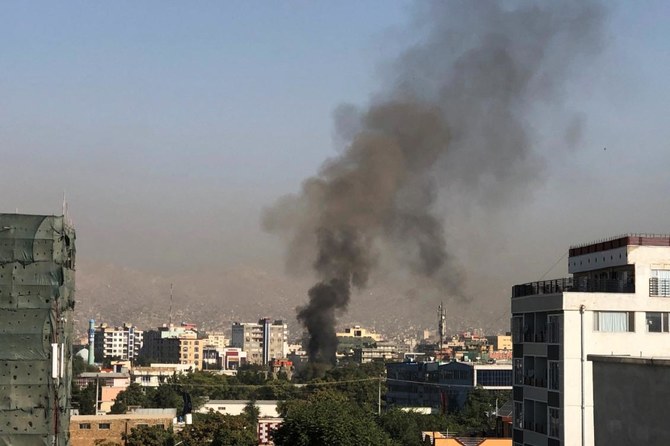
A smoke plume rises following an explosion targeting the convoy of Afghanistan's vice president Amrullah Saleh in Kabul on September 9, 2020. (File/AFP)
Short Url
Updated 23 December 2021
Follow

Suicide bomber killed at Kabul passport office gate

  • The nature of the blast was not immediately clear

KABUL: A suicide bomber was killed at the gate of a passport office in the Afghan capital Kabul on Thursday, a government spokesman said, and several people were injured in the blast, according to unconfirmed reports.
A spokesman for Afghanistan’s interior ministry said the attacker was shot and killed while trying to enter the passport office premises.
One member of the Taliban who was a witness told Reuters multiple people were injured, and the building and streets around the area were locked down by Taliban security forces.
Large crowds of Afghans have been thronging outside the passport office in a bid to get travel documents in recent days after the service was restarted after weeks of suspension.
Officials said that Thursdays are reserved as a special day for Taliban officials to visit the passport office to make travel documents. 


Prabowo, Trump expected to sign Indonesia-US tariff deal in January 2026

Updated 23 December 2025
Follow

Prabowo, Trump expected to sign Indonesia-US tariff deal in January 2026

  • Deal will mean US tariffs on Indonesian products are cut from a threatened 32 percent to 19 percent
  • Jakarta committed to scrap tariffs on more than 99 percent of US goods

JAKARTA: Indonesia expects to sign a tariff deal with the US in early 2026 after reaching an agreement on “all substantive issues,” Jakarta's chief negotiator said on Tuesday.

Indonesia’s Coordinating Minister for Economic Affairs Airlangga Hartarto met with US trade representative Jamieson Greer in Washington this week to finalize an Indonesia-US trade deal, following a series of discussions that took place after the two countries agreed on a framework for negotiations in July.

“All substantive issues laid out in the Agreement on Reciprocal Trade have been agreed upon by the two sides, including both the main and technical issues,” Hartarto said in an online briefing.

Officials from both countries are now working to set up a meeting between Indonesian President Prabowo Subianto and US President Donald Trump. 

It will take place after Indonesian and US technical teams meet in the second week of January for a legal scrubbing, or a final clean-up of an agreement text.

“We are expecting that the upcoming technical process will wrap up in time as scheduled, so that at the end of January 2026 President Prabowo and President Trump can sign the Agreement on Reciprocal Trade,” Hartarto said.  

Indonesian trade negotiators have been in “intensive” talks with their Washington counterparts since Trump threatened to levy a 32 percent duty on Indonesian exports. 

Under the July framework, US tariffs on Indonesian imports were lowered to 19 percent, with Jakarta committing to measures to balance trade with Washington, including removing tariffs on more than 99 percent of American imports and scrapping all non-tariff barriers facing American companies. 

Jakarta also pledged to import $15 billion worth of energy products and $4.5 billion worth of agricultural products such as soybeans, wheat and cotton, from the US. 

“Indonesia will also get tariff exemptions on top Indonesian goods, such as palm oil, coffee, cocoa,” Hartarto said. 

“This is certainly good news, especially for Indonesian industries directly impacted by the tariff policy, especially labor-intensive sectors that employ around 5 million workers.” 

In the past decade, Indonesia has consistently posted trade surpluses with the US, its second-largest export market after China. 

From January to October, data from the Indonesian trade ministry showed two-way trade valued at nearly $36.2 billion, with Jakarta posting a $14.9 billion surplus.