

Perfectly preserved dinosaur embryo was preparing to hatch like a bird

This undated illustration shows a redition of a close-to-hatching oviraptorosaur dinosaur embryo, which is based on the new specimen ‘Baby Yingliang’ found in the Ganzhou, Jiangxi Province, southern China. (AFP)
Short Url
Updated 22 December 2021
Follow

Perfectly preserved dinosaur embryo was preparing to hatch like a bird

  • Researchers believe the creature is between 72 and 66 million years old, and was probably preserved by a sudden mudslide that buried the egg, protecting it from scavengers for eons

WASHINGTON: Scientists on Tuesday announced the discovery of an exquisitely preserved dinosaur embryo from at least 66 million years ago that was preparing to hatch from its egg just like a chicken.
The fossil was discovered in Ganzhou, southern China and belonged to a toothless theropod dinosaur, or oviraptorosaur, which the researchers dubbed “Baby Yingliang.”
“It is one of the best dinosaur embryos ever found in history,” University of Birmingham researcher Fion Waisum Ma, who co-authored a paper in the journal iScience, told AFP.
Ma and colleagues found Baby Yingliang’s head lay below its body, with the feet on either side and back curled — a posture that was previously unseen in dinosaurs, but similar to modern birds.
In birds, the behavior is controlled by the central nervous system and called “tucking.” Chicks preparing to hatch tuck their head under their right wing in order to stabilize the head while they crack the shell with their beak.
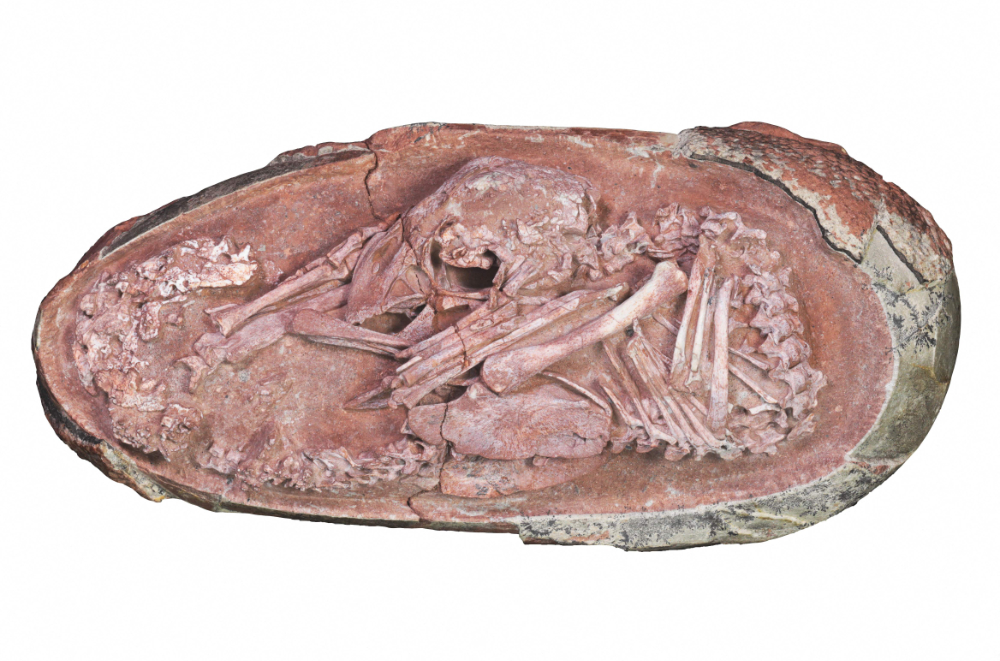


This undated photo courtesy of Lida Xing and the University of Birmingham shows the oviraptorosaur embryo ‘Baby Yingliang’ found in the Ganzhou, Jiangxi Province, southern China. (AFP)

Embryos that fail to tuck have a higher chance of death from an unsuccessful hatching.
“This indicates that such behavior in modern birds first evolved and originated among their dinosaur ancestors,” said Ma.
An alternative to tucking might have been something closer to what is seen in modern crocodiles, which instead assume a sitting posture with the head bending upon the chest up to hatching.

Oviraptorosaurs, which means “egg thief lizards,” were feathered dinosaurs that lived in what is now Asia and North America during the Late Cretaceous period.
They had variable beak shapes and diets, and ranged in size from modern turkeys at the lower end to massive Gigantoraptors, that were eight meters (26 feet) long.
Baby Yingliang measures around 27 centimeters (10.6 inches) long from head to tail, and lies inside a 17 centimeter-long egg at the Yingliang Stone Nature History Museum.
Researchers believe the creature is between 72 and 66 million years old, and was probably preserved by a sudden mudslide that buried the egg, protecting it from scavengers for eons.
It would have grown two to three meters long if it had lived to be an adult, and would have likely fed on plants.
The specimen was one of several egg fossils that were forgotten in storage for decades.
The research team suspected they might contain unborn dinosaurs, and scraped off part of Baby Yingliang’s egg shell to uncover the embryo hidden within.
“This dinosaur embryo inside its egg is one of the most beautiful fossils I have ever seen,” said Professor Steve Brusatte of the University of Edinburgh, part of the research team, in a statement.
“This little prenatal dinosaur looks just like a baby bird curled in its egg, which is yet more evidence that many features characteristic of today’s birds first evolved in their dinosaur ancestors.”
The team hopes to study Baby Yingliang in greater detail using advanced scanning techniques to image its full skeleton, including its skull bones, because part of the body is still covered by rock.


Second doctor in Matthew Perry overdose case sentenced to home confinement

Updated 17 December 2025
Follow

Second doctor in Matthew Perry overdose case sentenced to home confinement

  • Dr. Mark Chavez, 55, a onetime San Diego-based physician, pleaded guilty in federal court in October
  • Judge Sherilyn Peace Garnett also sentenced Chavez to 300 hours of community service

LOS ANGELES: A second California doctor was sentenced on Tuesday to eight months of home confinement for illegally supplying “Friends” star Matthew Perry with ketamine, the powerful sedative that caused the actor’s fatal drug overdose in a hot tub in 2023.
Dr. Mark Chavez, 55, a onetime San Diego-based physician, pleaded guilty in federal court in October to a single felony count of conspiracy to distribute the prescription anesthetic and surrendered his medical license in November.
Judge Sherilyn Peace Garnett also sentenced Chavez to 300 hours of community service. As part of his plea agreement, Chavez admitted to selling ketamine to another physician Dr. Salvador Plasencia, 44, who in turn supplied the drug to Perry, though not the dose that ultimately killed the performer. Plasencia, who pleaded guilty to four counts of unlawful drug distribution, was sentenced earlier this month to 2 1/2 years behind bars.
He and Chavez were the first two of five people convicted in connection with Perry’s ketamine-induced death to be sent off to prison.
The three others scheduled to be sentenced in the coming weeks — Jasveen Sangha, 42, a drug dealer known as the “Ketamine Queen;” a go-between dealer Erik Fleming, 56; and Perry’s former personal assistant, Iwamasa, 60.
Sangha admitted to supplying the ketamine dose that killed Perry, and Iwamasa acknowledged injecting Perry with it. It was Iwamasa who later found Perry, aged 54, face down and lifeless, in the jacuzzi of his Los Angeles home on October 28, 2023.
An autopsy report concluded the actor died from the acute effects of ketamine,” which combined with other factors in causing him to lose consciousness and drown.
Perry had publicly acknowledged decades of substance abuse, including the years he starred as Chandler Bing on the hit 1990s NBC television series “Friends.”
According to federal law enforcement officials, Perry had been receiving ketamine infusions for treatment of depression and anxiety at a clinic where he became addicted to the drug.
When doctors there refused to increase his dosage, he turned to unscrupulous providers elsewhere willing to exploit Perry’s drug dependency as a way to make quick money, authorities said. Ketamine is a short-acting anesthetic with hallucinogenic properties that is sometimes prescribed to treat depression and other psychiatric disorders. It also has seen widespread abuse as an illicit party drug.
