
PESHAWAR: A senior spokesperson of Khyber Pakhtunkhwa administration on Tuesday denied the assertion of opposition factions that the ruling Pakistan Tehreek-e-Insaf (PTI) party’s weak performance in the local bodies’ polls showed it had been rejected by the masses.
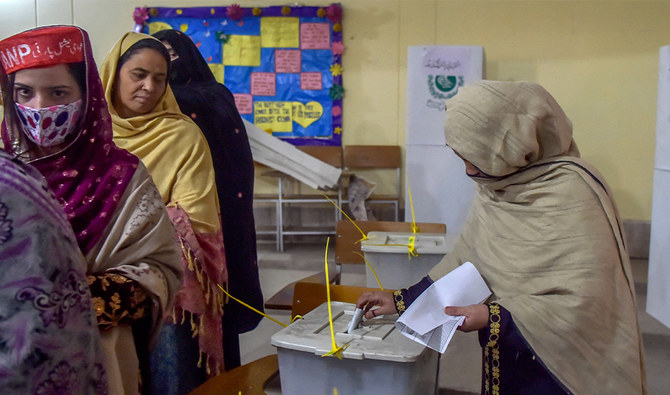
The elections were held in 17 districts of the Pakistani province on Sunday, in what is the first time such polls have been held in the region that used to be part of the Federally Administered Tribal Areas (FATA), which were merged with KP in 2018.
In a second phase, local elections will be held in the remaining 18 districts of KP on January 16. Local polls are also planned in the coming months in Pakistan’s other provinces.
“The opposition’s narrative about our failure has no weight,” Barrister Muhammad Ali Saif, the provincial administration’s spokesperson, told Arab News on Tuesday. “I think most of the PTI workers have serious reservations over distribution of tickets, which left the party workers angry and dejected.”
He said nearly 9,000 PTI votes were rejected by the election regulatory authority which reflected that the disappointed workers had “intentionally wasted” their votes.
“The party high-ups, including the prime minister, have taken serious notice of the situation that emerged during these elections,” he continued. “Things will be investigated through the party’s internal mechanism. In the second phase of the polls, the party’s lawmakers and members will be bound not to give tickets to their relatives.”
Earlier in the day, Prime Minister Imran Khan acknowledged in a Twitter post his party had paid the price for its “mistakes” in the recent elections and he would personally supervise its future strategy after the PTI lost the coveted mayoral seat in the province it has ruled since 2013.
Hassan Khan, a senior journalist and analyst, told Arab News the PTI had mainly suffered since its leaders had been fielding their immediate relatives in the polls.
“There are many reasons for the PTI defeat,” he said. “There is a lot of internal rift and leg pulling within the party. Apart from that, many of the PTI’s provincial lawmakers went against their party’s pledge and preferred to field their immediate relatives.”
According to Jalil Jan, the provincial spokesperson of Jamiat-e-Ulama-e-Islam-Fazl (JUI-F) party which won maximum number of seats in the contest, the PTI administration had failed to deliver on all of its promises.
This, he added, included the pledge to bring greater economic prosperity to the nation and implement an independent foreign policy.
“The ruling party’s narrative that its wrong distribution of tickets caused its downfall is nothing but a lame excuse,” he maintained. “Let me tell PTI leaders that people don’t want you to stay in power anymore.”
Asked about the relatively weak performance of the Awami National Party and Pakistan Peoples Party, journalist Hasan Khan said the two parties mostly stayed aloof when people of Khyber Pakhtunkhwa were dealing with rising inflation and tough economic challenges.
“However, the JUI-F held protests to exploit the situation in the province,” he added.
Irfanullah Khan, a political analyst, said there were widespread reports that the PTI was using administrative machinery to win the electoral contest, adding the ruling party’s defeat was even more significant for the same reason.
“The PTI long blamed other political parties for promoting hereditary politics,” he maintained. “Now it is deeply involved in carrying forward the same trend. Given that voters are more well informed today due to the social media, they gave their verdict against the ruling party as soon as they got a chance.”