

International community needs to strengthen Lebanon support, says UN chief

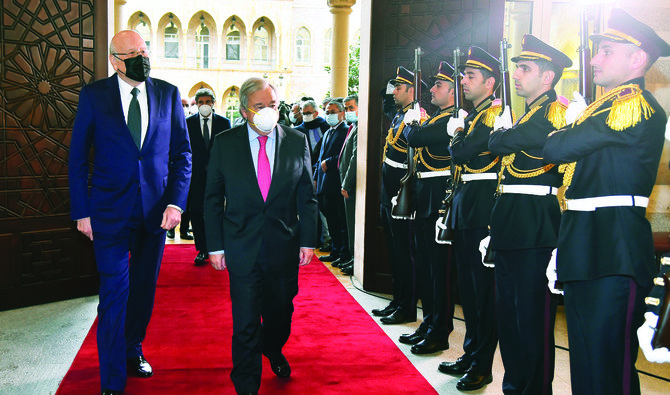
Lebanese Prime Minister Najib Mikati and UN Secretary-General Antonio Guterres review an honor guard at the government house in Beirut on Monday. (AP)
Short Url
Updated 20 December 2021
Follow

International community needs to strengthen Lebanon support, says UN chief

  • UN Secretary-General Antonio Guterres calls for impartial probe into last year’s Beirut Port explosion

BEIRUT:  The international community needs to strengthen its support to Lebanon to overcome the country’s current “very difficult circumstances,” UN Secretary-General Antonio Guterres said in Beirut on Monday.

Guterres also said Lebanon needed proper accountability for last year’s port explosion and that elections due to be held next year could usher in political stability in the country.

His comments followed a meeting with Parliament Speaker Nabih Berri and a visit to the port, where he laid a wreath at a memorial for the hundreds who died when chemicals stored at the facility for nearly seven years exploded.

Guterres was keen to record his observations on the second day of his official visit to Lebanon.

He said that only the Lebanese could solve Lebanese problems, and he renewed his call for political leaders “to come together” to overcome divisions.

He inspected the blast site for the first time, reviewing the damage to the port and its surroundings, despite the stormy and rainy weather.

A minute’s silence was observed in front of a plaque honoring victims of the explosion.

In notes distributed by his media office, the secretary-general said he visited the port to pay tribute to the victims who had lost their lives and to express his solidarity to the wounded and their families.

“I know the suffering and I know the will of the people to know the truth. The will of the people is to have proper accountability and I want to express my very deep solidarity to all the victims of that tragedy.”

His day included an extensive meeting with representatives of international bodies and organizations, chaired by Guterres and Lebanese Prime Minister Najib Mikati.

Arab News learned that the importance of the meeting stemmed from its conclusion that the efforts of UN agencies “must coordinate with each other on the ground in order to produce more effective work.”

Guterres said that Mikati confirmed “the government’s commitment to conduct negotiations with the IMF and its commitment to carry out a number of necessary administrative and financial reforms” to promote economic recovery.

FASTFACT

UN Secretary-General Antonio Guterre says Lebanon needs proper accountability for last year’s port explosion and that elections due to be held next year could usher in political stability in the country.

Mikati stressed Lebanon’s “adherence to the role of the UN Interim Force in Lebanon in the south, respecting international resolutions.”

He highlighted Lebanon’s “commitment to the policy of disassociation from any dispute between Arab countries, as was its decision in 2011” and that Lebanon would not “in any case, be anything but a unifying factor among the Arab brothers, and is keen on the best relations with all its friends.”

He said Lebanon needed urgent aid in many areas, with a focus on delivering aid to the poorest and middle-class groups, in addition to marginalized segments.

He stressed the need to give special importance to expanding the social protection network, and said the government was “determined” to hold parliamentary elections on time without delay. “We look forward to the unwavering support of the UN,” he added.

The UN chief took part in an important meeting with religious authorities and listened to the positions of Lebanese sects on the developments in Lebanon.

Their speeches reflected the political divergence in Lebanon.

They affirmed their “commitment to the values of openness, tolerance and coexistence, as they are the essence of Lebanon’s identity and stability” in a joint statement, and encouraged “the adoption of dialogue as a means of resolving differences in the spirit of consensus and teamwork.”

The UN chief also visited the northern city of Tripoli, where he inspected centers and schools that provide services to residents and refugees. He met women leaders and activists.

His talks with Berri focused on the presence of UNIFIL forces in southern Lebanon and “the need to end all violations of the ceasefire.”

Guterres said the speaker had drawn his attention to the “violations of the airspace of Lebanon, and also the need for total implementation of the resolutions of the UN Security Council.”

“We discussed the importance of the cooperation between UNIFIL and the Lebanese Armed Forces that the international community needs also to support much more strongly. In the scope of our activities, we will also be doing everything we can in order to facilitate the negotiations that hopefully will lead to a rapid solution for the delimitation of the maritime border.”

During a joint press conference, Berri said: “If there is a disturbance in a place, the responsibility lies with Israel, which occupies our land, and not with us. Every day, there is an Israeli violation of the Lebanese airspace, and they even use our airspace to strike Syria.”

His words came against the backdrop of a UN demand for Lebanon to facilitate the mission of UNIFIL forces during their work on the ground.

Hezbollah often obstructs the work of these patrols on the pretext that they are entering private property.


Gaza’s Nasser Hospital condemns move by MSF to suspend most services

Updated 16 sec ago
Follow

Gaza’s Nasser Hospital condemns move by MSF to suspend most services

  • On Saturday, MSF said the security breaches, arrests and intimidation put staff and patients at serious risk
  • Nasser Hospital rejects the claims, and says civilian police are inside to protect patients and staff
CAIRO: One of Gaza’s last functioning large hospitals condemned the move by an international organization to pull out of operations over concerns about armed men, claiming on Sunday that the hospital had installed civil police for security. The move comes as at least 10 Palestinians were killed in clashes with the Israeli military in Gaza.
Doctors Without Borders, also known by its acronym MSF, said in a statement Saturday that all its noncritical medical operations at Nasser Hospital were suspended due to security breaches that posed “serious” threats to its teams and patients. MSF said there had been an increase in patients and staff seeing armed men in parts of the compound since the US-brokered October ceasefire was reached.
Nasser Hospital said Sunday that the increase in armed men was due to a civilian police presence aimed at protecting patients and staff and said MSF’s “allegations are factually incorrect, irresponsible, and pose a serious risk to a protected civilian medical facility.”
Nasser Hospital one of few functioning hospitals left in Gaza
Nasser Hospital in Khan Younis is one of the territory’s few functioning hospitals. Hundreds of patients and war-wounded have been treated there daily, and the facility was a hub for Palestinian prisoners released by Israel in exchange for Israeli hostages as part of the current ceasefire deal.
“MSF teams have reported a pattern of unacceptable acts including the presence of armed men, intimidation, arbitrary arrests of patients and a recent situation of suspicion of movement of weapons,” the organization said. The suspension occurred in January but was only recently announced.
Nasser Hospital staff say that in recent months it has been repeatedly attacked by masked, armed men and militias, which is why the presence of an armed civilian police force is crucial. Hamas remains the dominant force in areas not under Israeli control, including in the area where Nasser Hospital is located. But other armed groups have mushroomed across Gaza as a result of the war, including groups backed by Israel’s army in the Israeli-controlled part of the strip.
Throughout the war, which began with the Hamas-led attack on Israel on Oct. 7, 2023, Israel has repeatedly struck hospitals, including Nasser, accusing the militant group of operating in or around them. Hamas security men often have been seen inside hospitals, blocking access to some areas.
Some hostages released from Gaza have said they spent time during captivity in a hospital, including Nasser Hospital.
Ten Palestinians killed in strikes across Gaza
At least 10 Palestinians were killed Sunday by Israeli fire in the Gaza Strip, hospital authorities said.
The dead include five men, all in their 20s, who were killed in an Israeli strike in the eastern part of Khan Younis city, according to the Nasser Hospital, which received the bodies. The strike hit a group of people in an area close to the Yellow Line which separates Israeli-controlled areas from the rest of Gaza, it said.
The Israeli military did not comment on the strike but has said in the past it will attack militants if its troops are threatened, especially near the Yellow Line.
Rami Shaqra said his son, Al-Baraa, was among the militants who were securing the area from potential attacks by the Israeli forces or Israeli-backed armed groups, when they were hit by the Israeli military. He said that they were killed by an airstrike.
Associated Press footage from the morgue showed at least two of the men had headbands denoting membership in the Qassam Brigades, the militant arm of Hamas. In northern Gaza, a drone strike hit a group of people in the Falluja area of Jabaliya refugee camp, killing five people, according to the Shifa Hospital.
The Israeli military said it was striking northern Gaza in response to several ceasefire violations near the Yellow Line, including militants attempting to hide in debris and others who attempted to cross the line while armed.
The Oct. 10 US-brokered ceasefire deal attempted to halt a more than two-year war between Israel and Hamas. While the heaviest fighting has subsided, the ceasefire has seen almost daily Israeli fire.
Israeli forces have carried out repeated airstrikes and frequently fire on Palestinians near military-held zones, killing 601 Palestinians, according to Gaza health officials. The ministry, which is part of the Hamas-led government, maintains detailed casualty records that are seen as generally reliable by UN agencies and independent experts. But it does not give a breakdown of civilians and militants.
Militants have carried out shooting attacks on troops, and Israel says its strikes are in response to that and other violations. Four Israeli soldiers have been killed.