

US special envoy hails Pakistan’s efforts to arrange OIC summit to help Afghanistan

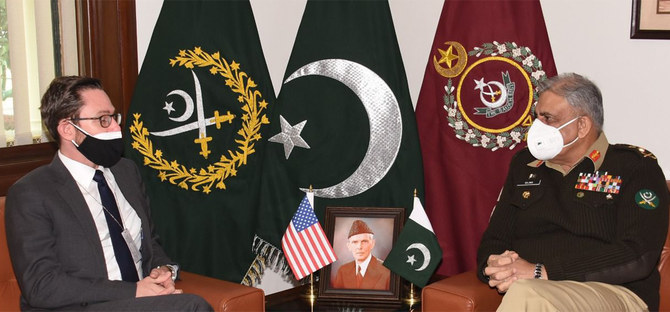
US Special Representative for Afghanistan, Thomas West (left) meets Pakistan's Chief of Army Staff, General Qamar Javed Bajwa, in Rawalpindi, Pakistan, on December 20, 2021. (ISPR)
Short Url
Updated 20 December 2021
Follow

US special envoy hails Pakistan’s efforts to arrange OIC summit to help Afghanistan

  • Special envoy on Afghanistan says OIC Council of Foreign Ministers summit “productive … with important outcomes”
  • Lauds OIC decision to set up humanitarian trust fund, appoint special envoy on Afghanistan to OIC Secretary General

Islamabad: US Special Representative for Afghanistan, Thomas West, on Monday met Pakistani chief of army staff (COAS) General Qamar Javed Bajwa and hailed Pakistan’s efforts to organize and host the 17th Extraordinary Session of the Organization of Islamic Corporation’s Council of Foreign Ministers.
The summit was held in Islamabad on Sunday with a focus on the looming economic and humanitarian crisis in Afghanistan. Around 70 delegations from OIC member states, non-members and regional and international organizations attended the summit in Islamabad. Around 20 delegations were led by foreign ministers and 10 by deputies or ministers of state.
Other than foreign ministers from Islamic countries, delegations from the European Union and the P5+1 group of the UN Security Council, including the United States, Britain, France, Russia, China and Germany, were also in attendance.
“COAS thanked the dignitary for participating in the 17th Extraordinary Session of Council of Foreign Ministers,” the Pakistan army said in a statement.
“The visiting dignitary appreciated Pakistan’s role in Afghan situation, special efforts for effective Pak-Afghan border management and pledged to play his part for further improvement in diplomatic cooperation with Pakistan at all levels. He hailed Pakistan’s efforts for organizing CFM’s 17th Extraordinary Session of OIC.”
On Sunday at the conclusion of the summit, OIC member nations said they would establish a humanitarian trust fund to channel assistance to Afghanistan, including in partnership with other international actors, and would appoint a special envoy on Afghanistan to the OIC Secretary General.
“A productive OIC session today with important outcomes — not least the creation of a humanitarian trust fund and the naming of an OIC Special Envoy,” West said on Twitter on Monday. “The US warmly welcomes the OIC’s role and contributions.”

A draft resolution shared with media after the summit said the humanitarian trust fund would be set up under the aegis of the Islamic Development Bank. The resolution called on the Bank to operationalize the fund by the first quarter of 2022 and called on OIC member states, Islamic financial institutions, donors and other international partners to announce pledges to the fund as well as provide humanitarian assistance to Afghanistan.
The OIC also decided to appoint Ambassador Tarig Ali Bakheet, Assistant Secretary General for Humanitarian, Cultural and Family Affairs at the OIC General Secretariat, as the special envoy on Afghanistan to the OIC Secretary General. Bakheet will be supported by a secretariat and the OIC Office in Afghanistan to coordinate aid and assistance efforts.
The United Nations is warning that nearly 23 million people — about 55 percent of the population of Afghanistan — face extreme levels of hunger, with nearly 9 million at risk of famine as winter takes hold in the impoverished, landlocked country.


Pakistan urges diplomacy on Iran nuclear issue, warns sanctions would hurt civilians

Updated 10 sec ago
Follow

Pakistan urges diplomacy on Iran nuclear issue, warns sanctions would hurt civilians

  • Pakistan warns the situation has become more complex since Israel’s attack on Iran and US bombing of nuclear sites
  • It cautions against invoking the snapback mechanism, saying sanctions will further deepen mistrust, derail diplomacy

ISLAMABAD: Pakistan demanded on Tuesday that diplomacy be given a chance in addressing all issues related to Iran’s nuclear program, warning the United Nations Security Council that sanctions would hurt ordinary Iranians, as tensions remain heightened following this year’s war between Israel and Iran.

Pakistan’s comments came amid renewed debate at the Security Council over Iran’s nuclear program and the future of the Joint Comprehensive Plan of Action (JCPOA), which sought to limit Tehran’s nuclear activities in exchange for sanctions relief.

The conflict in June was dubbed the Twelve-Day War and erupted after Israel carried out a surprise attack on Iranian military and nuclear facilities while international diplomacy was still underway. The strikes derailed negotiations, with the United States later bombing Iranian nuclear sites and declaring that the attacks had substantially degraded Iran’s nuclear capabilities.

Addressing the Security Council, Pakistan’s Acting Permanent Representative Ambassador Usman Jadoon said Islamabad believed that “diplomacy and dialogue should be the guiding principles for the resolution of all outstanding issues concerning Iran’s nuclear program in accordance with the rights, obligations and responsibilities of the parties concerned.”

“Coercive measures would not help in bringing the parties closer and only exacerbate the trust deficit,” he said. “Sanctions directly hurt ordinary people the most, impact trade, affect economic development and diminish the prospects of regional connectivity.”

Jadoon said the council last met on the issue in September following developments related to the JCPOA’s “snapback” mechanism — a provision that allows the automatic re-imposition of UN sanctions on Iran in cases of alleged non-compliance — adding that Pakistan opposed what it viewed as a rushed move and cautioned against hasty action.

He said Pakistan’s stance was grounded in the belief that disputes over Iran’s nuclear program should be resolved through dialogue, with more time allowed for diplomacy to succeed, while preserving the JCPOA framework until a successor arrangement is reached.

The ambassador said divisions within the council had widened in recent months, further complicating efforts to resolve the issue.

While acknowledging that the JCPOA was not implemented as intended, Jadoon said the agreement had nonetheless provided an essential framework rooted in international law and mutual respect, and could still prove useful if there was a shared willingness to move forward in a spirit of compromise.

He stressed the need to revive the agreement’s underlying principles and restore trust in diplomatic engagement that had been damaged in recent months, urging all parties to avoid confrontation and work toward a solution-oriented approach.