

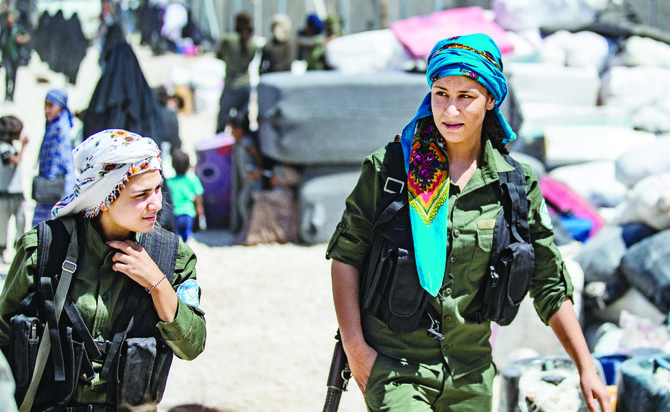

BEIRUT: Six people, including four women, were killed in Syria’s Al-Hol camp for displaced people by Daesh in December, a Britain-based war monitor group said on Sunday.
The camp, which is controlled by the Kurdish-led autonomous administration in northeastern Syria, houses about 62,000 displaced people, including relatives of Daesh terrorists.
About 93 percent are women and children, and about half come from Iraq.
According to the Syrian Observatory for Human Rights, which has a wide network of sources in Syria, “six assassinations were committed” in the camp by Daesh cells since the start of December.
The last victim to date was shot dead on Saturday.
The victims include three Iraqis — two men and one woman — as well as two Syrian women and one woman whose identity is unknown, the observatory said.
Since the start of the year, the number of killings in the camp has been on the rise.
Some 86 people were killed, including 63 Iraqi refugees who resided in Al-Hol, according to the monitor’s toll.
Observatory head Rami Abdel Rahman warned that “chaos and insecurity persist within the camp,” labelling it a “ticking time bomb” in comments to AFP.
In March, the Kurdish-led authorities launched a major operation in the camp during which they arrested 125 alleged Daesh members.
The UN has repeatedly warned of the deteriorating security conditions in Al-Hol, which has also seen breakout attempts in recent months.
The overcrowded camp hosts about 10,000 foreign women, children and relatives of terrorists.
Since the fall of Daesh’s self-styled “caliphate” in March 2019, Syria’s Kurds and the UN have repeatedly urged foreign countries to repatriate their nationals held in northeast Syria.
But most Western countries have refused to repatriate their nationals from the camp.
Calls by the Kurdish administration for the formation of international tribunals for the fighters have also been overlooked.
Meanwhile, the New York Times, citing newly obtained Pentagon documents, reported that the US air wars in the Middle East had been marked by “deeply flawed intelligence” and resulted in thousands of civilian deaths, including many children,
It said a trove of confidential documents covering more than 1,300 reports of civilian casualties undercuts the government’s portrayal of a war fought with precision bombs.
Pledges of transparency and accountability, it said, had regularly fallen short.
“Not a single record provided includes a finding of wrongdoing or disciplinary action,” the paper reported in what it said was the first of a two-part series.
Asked for comment, Capt. Bill Urban, spokesman for the US Central Command, told the Times that “even with the best technology in the world, mistakes do happen, whether based on incomplete information or misinterpretation of the information available. And we try to learn from those mistakes.
“We work diligently to avoid such harm. We investigate each credible instance. And we regret each loss of innocent life.”
While several of the cases mentioned by the Times have been previously reported, it said its investigation showed that the number of civilian deaths had been “drastically undercounted,” by at least several hundred.


