

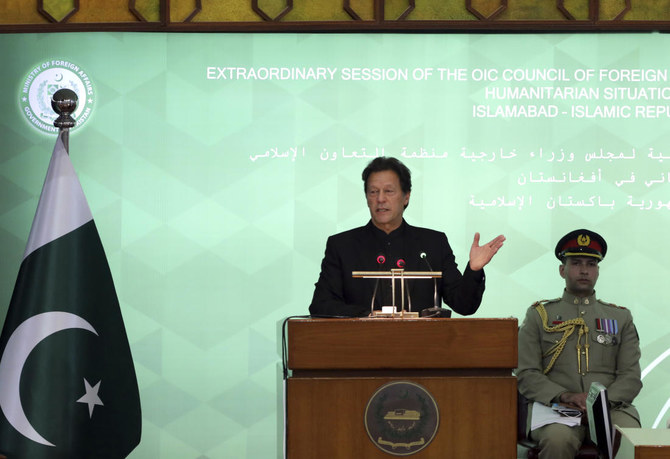



ISLAMABAD: Muslim nations pledged on Sunday to set up a fund to help Afghanistan avert an imminent economic collapse they say would have a “horrendous” global impact.
At a special meeting in Pakistan of the 57-member Organization of Islamic Cooperation (OIC), delegates also resolved to work with the United Nations to try to unlock hundreds of millions of dollars in frozen Afghan assets.
The promised fund will provide humanitarian aid through the Islamic Development Bank (IDB), which would provide a cover for countries to donate without dealing directly with the country’s Taliban rulers.
An OIC resolution released after the meeting said the IDB would lead the effort to free up assistance by the first quarter of next year.
The meeting was the biggest conference on Afghanistan since the US-backed government fell in August and the Taliban returned to power.
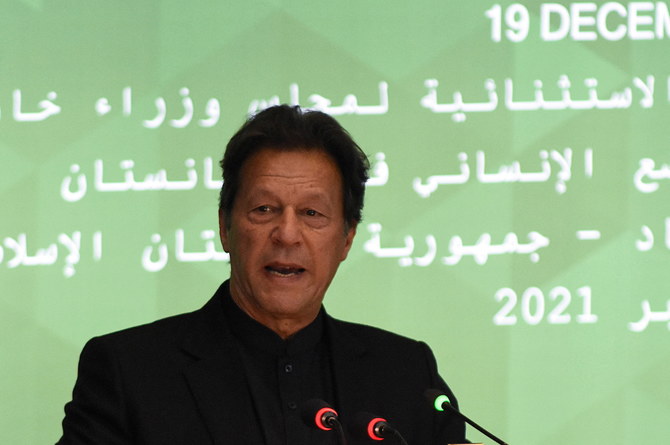
Pakistan Prime Minister Imran Khan earlier warned of chaos if the worsening emergency was not urgently addressed.
“Unless action is taken immediately, Afghanistan is heading for chaos,” Khan told he meeting of OIC foreign ministers in Islamabad.
The crisis is causing mounting alarm but the international response has been muted, given Western reluctance to help the Taliban government, which seized power in August.
Billions of dollars in aid and assets have been frozen by the international community, and the nation is in the middle of a bitter winter.eKhan directed his remarks to the US, urging Washington to drop preconditions for releasing desperately needed funds and restarting Afghanistan’s banking systems.
“I speak to the United States specifically that they must delink the Afghanistan government from the 40 million Afghan citizens,” he said, “even if they have been in conflict with the Taliban for 20 years.”
He also urged caution in linking recognition of the new government to Western ideals of human rights.
“Every country is different... every society’s idea of human rights is different,” he said.
Engaging the Taliban
The OIC also resolved Sunday to arrange for a team of international Muslim scholars to engage with the Taliban on issues “such as, but not limited to, tolerance and moderation in Islam, equal access to education and women’s rights in Islam.”
No nation has yet formally recognized the Taliban government and diplomats face the delicate task of channelling aid to the stricken Afghan economy without propping up the hard-line Islamists.
It also urged Afghanistan’s rulers to abide by “obligations under international human rights covenants, especially with regards to the rights of women, children, youth, elderly and people with special needs.”
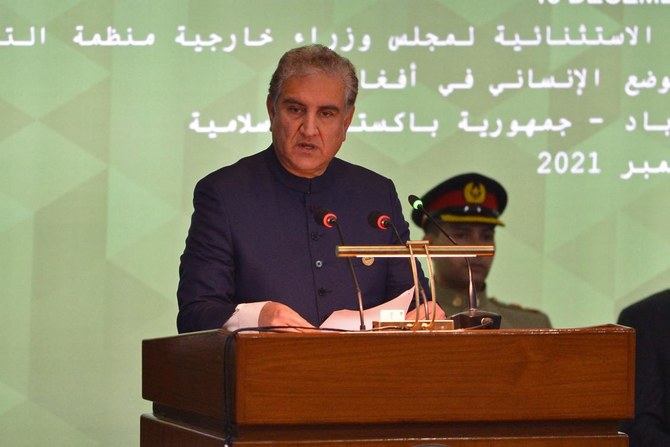
Pakistan Foreign minister Shah Mahmood Qureshi said the deepening crisis could bring mass hunger, a flood of refugees and a rise in extremism.
“We cannot ignore the danger of complete economic meltdown,” he told the gathering, which also included Taliban foreign minister Amir Khan Muttaqi alongside delegates from the United States, China, Russia, the European Union and UN.
Although the Taliban have promised a lighter version of the hard-line rule that characterized their first stint in power from 1996 to 2001, women are largely excluded from government employment, and secondary schools for girls have mostly remained shuttered.
Asked if the OIC had pressed the Taliban to be more inclusive on issues such as women’s rights, Qureshi said “obviously they feel they are moving in that direction.”
“They are saying ‘let us decide in our own time’,” he added.
The OIC meeting did not give the new Taliban government the formal international recognition it desperately craves and the new regime’s foreign minister Amir Khan Muttaqi was excluded from the official photograph taken during the event.
Muttaqi told reporters, however, that his government “has the right to be officially recognized.”
The 31-point OIC resolution was short on specifics and gave no figure for financial assistance.
“There are many who want to donate but do not want to donate directly, they want some mechanism that they are comfortable with,” said Qureshi.
“This mechanism has been devised, and pledges will now be made. Obviously, they are aware of the importance of time.”
The meeting was held under tight security, with Islamabad on lockdown, ring-fenced with barbed wire barriers and shipping-container roadblocks where police and soldiers are standing guard.
'Donations alone are not enough'
Martin Griffiths, the UN undersecretary for humanitarian affairs and emergency relief coordinator, warned that Afghanistan cannot survive on donations alone. He urged donor countries to show flexibility, allowing their money to pay salaries of public sector workers and support “basic services such as health, education, electricity, livelihoods, to allow the people of Afghanistan some chance to get through this winter and some encouragement to remain home with their families.”
Beyond that, Griffiths said, “we need constructive engagement with the de facto authorities to clarify what we expect from each other.”
Afghanistan’s teetering economy, he added, requires decisive and compassionate action, or “I fear that this fall will pull down the entire population.”
Griffiths said families simply do not have the cash for everyday purchases like food and fuel, as prices soar. The cost of fuel is up by around 40 percent, and most families spend 80 percent of their money just to buy food.
He rattled off a number of stark statistics.
“Universal poverty may reach 97 percent of the population of Afghanistan. That could be the next grim milestone,” he warned. “Within a year, 30 percent of Afghanistan’s GDP (gross domestic product) could be lost altogether, while male unemployment may double to 29 percent.”
Next year the UN would be asking for $4.5 billion in aid for Afghanistan — it’s single largest humanitarian aid request, he said.
In what appeared to be a message to the Taliban delegation, Qureshi and subsequent speakers, including Taha, emphasized the protection of human rights, particularly those of women and girls.
In an interview with The Associated Press last week, Muttaqi said that Afghanistan’s new rulers were committed to the education of girls and women in the workforce.
Yet four months into Taliban rule, girls are not allowed to attend high school in most provinces, and though women have returned to their jobs in much of the health care sector, many female civil servants have been barred from coming to work.
At the summit’s conclusion Qureshi said the OIC agreed to appoint a special representative on Afghanistan. The 20 foreign ministers and 10 deputy foreign ministers in attendance also agreed to establish a greater partnership with the United Nations to get help to desperate Afghans.
They participants also emphasized the critical need to open Afghanistan’s banking facilities, which have been largely closed since the Taliban takeover on Aug. 15. The Taliban has limited withdrawals from the country’s banks to $200 a month.
“We collectively feel that we have to unlock the financial and banking channels because the economy cannot function and people cannot be held without banking services,” Qureshi said.
(With agencies)


