

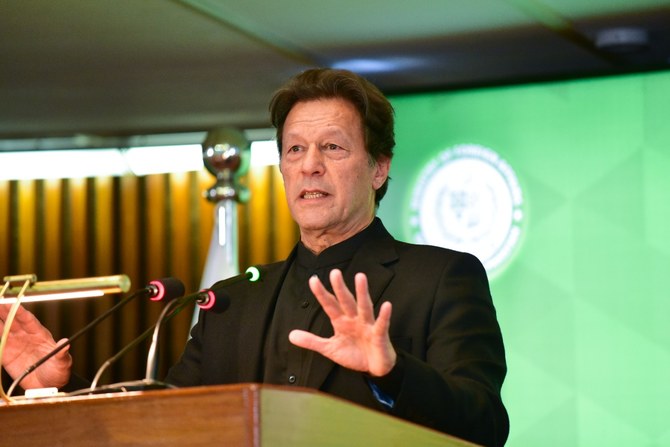

ISLAMABAD: Prime Minister Imran Khan said on Sunday he looked forward that foreign ministers attending an ongoing summit of the Organization of Islamic Cooperation (OIC) in Islamabad would come up with a “roadmap” by the evening to help Afghanistan, which is facing a looming economic meltdown and humanitarian catastrophe.
Pakistan is hosting the 17th Extraordinary Session of the OIC’s Council of Foreign Ministers, called by Saudi Arabia, at the Parliament House in Islamabad. The purpose of the summit is to rally Muslim and other countries to come in aid of Afghanistan.
Around 70 delegations from OIC member states, non-members and regional and international organizations are attending the summit. Around 20 delegations are led by foreign ministers and 10 by deputies or ministers of state. The foreign ministers of Saudi Arabia, Tukey, Azerbaijan, Iran, Oman, Kuwait, Indonesia and Malaysia were present at the Parliament House on Sunday for the summit.
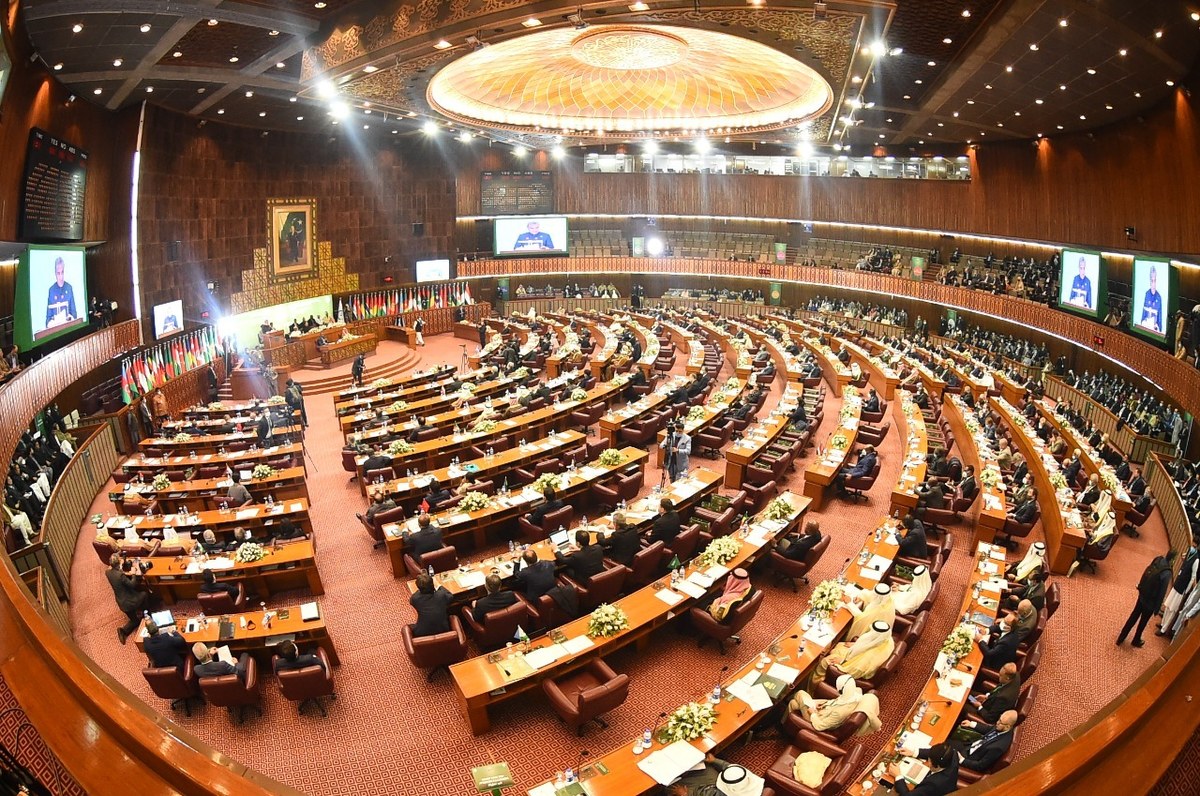
The National Assembly of Pakistan, hosting the extraordinary meeting of OIC Foreign Ministers in Islamabad, Pakistan, on December 19, 2021. (Foreign Office of Pakistan)
Other than foreign ministers from Islamic countries, delegations from the European Union and the P5+1 group of the UN Security Council, including the United States, Britain, France, Russia, China and Germany, are also in attendance.
“I will look forward to the foreign ministers, that they will come up with a roadmap by the end of this evening,” Khan said during his keynote speech at the summit. “That roadmap not only should be pushed by the OIC but also the United Nations, European Union and United States.”
“If the world doesn't act, this will be the biggest man-made crisis which is unfolding in front of us,” the PM added.
The international community, which has frozen billions in central bank funds and development spending for Afghanistan, has made women’s rights and an inclusive government key elements of any future engagement with the country.
But Khan warned that attaching “pre-conditions” o humanitarian aid would further worsen the situation.
“It is time to act and to act now,” he said. “The chaos in Afghanistan does not suit anyone, even western countries and the US.”
Without a stable Afghan government, Khan said, militant groups like Daesh would gain ground in Afghanistan and use its territory to carry out international terror attacks.
Addressing the OIC session, Saudi Minister of Foreign Affairs Prince Faisal bin Farhan Al Saud said delegates at the summit “would come up with a proper resolution as well as recommendations to alleviate the difficulties being faced by the Afghans.”
“Our meeting is the message to Afghan people that we are committed to put an immediate end to the sufferings of Afghan people,” he added. “Let our organization play a major role in urging the member states and others to pledge necessary support to Afghan people.”
In his inaugural address, Pakistani foreign minister Shah Mahmood Qureshi offered a six-point “framework” to help Afghanistan stave off a humanitarian disaster, including creating a mechanism to channel capital to the war-torn country and setting up a group of experts to facilitate Afghanistan’s access to legitimate banking services.
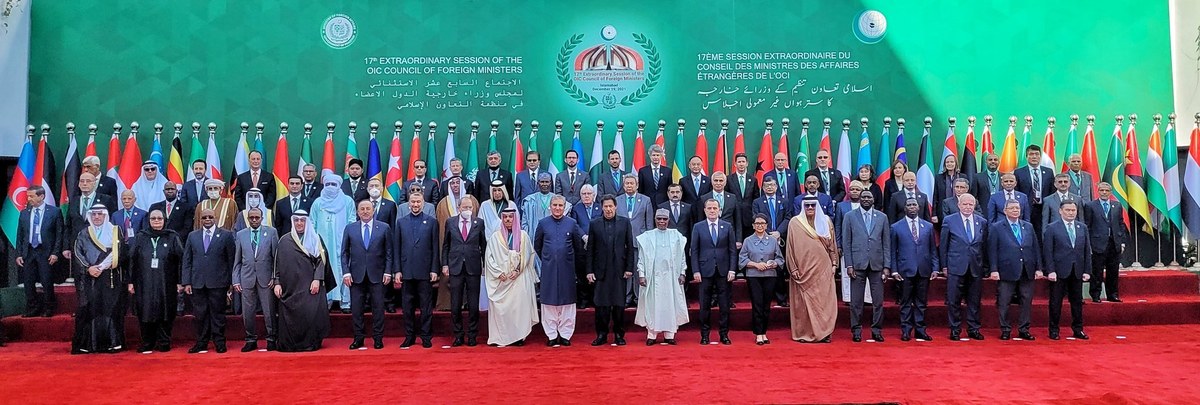
Group photo of the participants of the 17th Extraordinary Session of the Organization of Islamic Corporation’s Council of Foreign Ministers in Islamabad, Pakistan, on December 19, 2021. (APP)
“We could create a vehicle within the OIC to channel immediate and sustained humanitarian and financial support to the Afghan people, including from pledges by the OIC Member States and other donors,” Qureshi said. “Second, we should agree to increase investment in the people of Afghanistan, bilaterally or through the OIC, in areas such as education, health and technical and vocational skills to the Afghan youth.”
Qureshi suggested that a group of experts comprising the OIC, the United Nations and international financial institutions be established to consider ways and means to facilitate Afghanistan’s access to legitimate banking services, and to ease the liquidity challenge to the Afghan people.
“Fourth, we should focus on enhancing food security of the Afghan people. The Islamic Organization for Food Security can and must lead this effort,” the Pakistani foreign minister said. “Fifth, invest in building capacity of Afghan institutions in countering terrorism and combating illicit trade in narcotics.”
Finally, Qureshi said, the OIC needed to engage with Afghan authorities “to help advance the expectations of the international community, in particular, regarding political and social inclusivity; respect for human rights, especially the rights of women and girls; and combating terrorism.”
In his opening remarks, OIC Secretary General Hissein Brahim Taha said the OIC had always supported the Afghan people and the role of OIC member countries in delivering humanitarian assistance was more urgent now than ever before.
"This effort gives a universal message of harmony and solidarity," he said. “We also call for all parties concerned to cooperate with the OIC mission in Kabul to provide relief to the affected Afghan people.”
"OIC is ready to carry out a follow-up of the outcome and to play its role in supporting humanitarian action in coordination with the relevant OIC missions and relief agencies across the Muslim world.”
Turkish Foreign Minister Mevlut Cavusoglu stressed that the OIC play a leading role in mobilizing international support for the Afghan people. Under-Secretary-General for Humanitarian Affairs and Emergency Relief Coordinator Martin Griffiths said the UN stood “firmly” with the OIC in its efforts to contribute to humanitarian efforts in Afghanistan.
The United Nations is warning that nearly 23 million people - about 55 percent of the population - face extreme levels of hunger, with nearly 9 million at risk of famine as winter takes hold in the impoverished, landlocked country.




