



ISLAMABAD: The stage to recognize the Afghan Taliban government “has not come yet,” Pakistani foreign minister Shah Mahmood Qureshi said on Friday, ahead of a special session of the Organization of Islamic Cooperation (OIC) being hosted by Islamabad as Afghanistan faces a looming economic meltdown and humanitarian catastrophe.
The statement by Pakistan, which will be hosting the 17th Extraordinary Session of the OIC’s Council of Foreign Ministers on Sunday, will come as a blow to the Afghan Taliban, who have for months argued that a failure to recognize their government would prolong the financial and humanitarian crisis, which could eventually turn into a world-scale problem.
The new Taliban administration in Kabul has been sanctioned by the international community since the insurgents’ takeover in mid-August, which saw an abrupt end to financial aid from the United States and other donors on which Afghanistan became dependent during 20 years of war. More than $9 billion of the country’s hard currency assets were also frozen after the Taliban takeover.
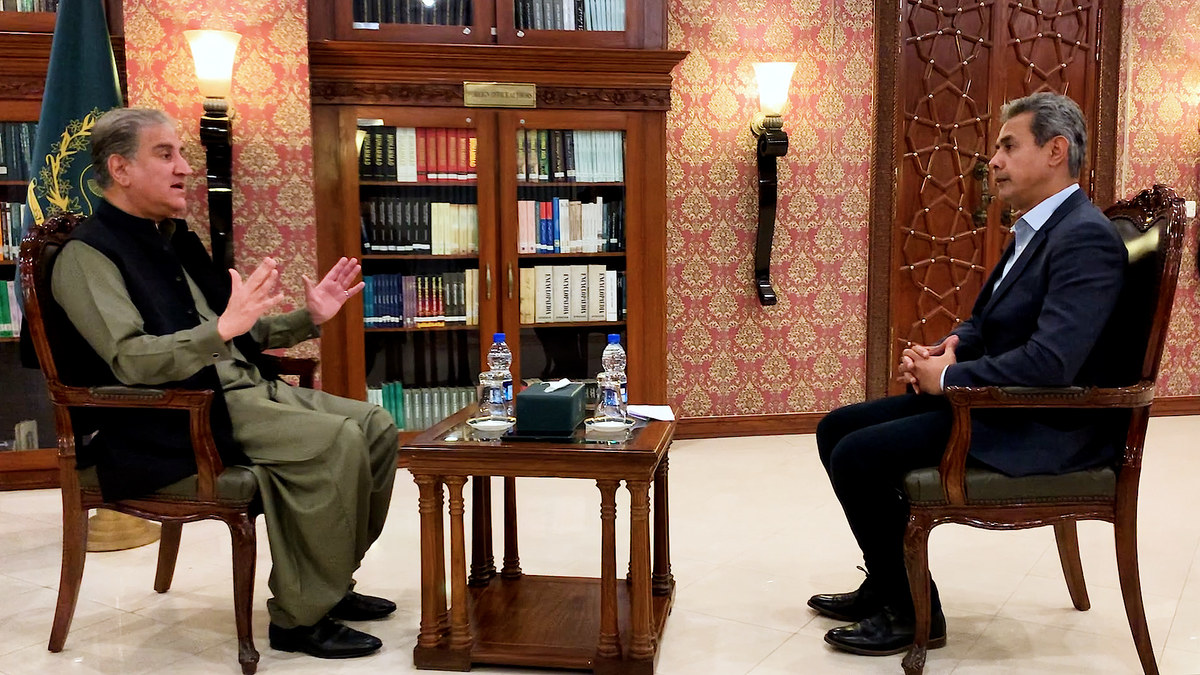
Pakistan's foreign minister, Shah Mahmood Qureshi, speaks to Arab News in Islamabad on December 17, 2021. (AN photo)
But the world is waiting before extending any formal recognition to the new rulers in Kabul, wary the Taliban could impose a similarly harsh regime as when they were in power 20 years ago — despite their assurances to the contrary.
“This stage has not come yet. I do not think there is an international appetite for recognition at this stage,” Qureshi told Arab News in an exclusive interview. “The international community has several expectations.”
These include an inclusive government in Afghanistan and assurances surrounding human rights, especially for minorities, women and girls, whose role Taliban had strictly curtailed when they ruled the country from 1996 until they were ousted by a US-led invasion in 2001.
Qureshi said he had told Taliban leaders the international community expected them to deliver on four issues: “They want you to have an inclusive political landscape. They want you to respect human rights, particularly women’s rights. They want you do not allow space to international terrorist organizations, like Al-Qaeda and Daesh. And they want safe passage for people who want to leave.’“
Speaking about Sunday’s OIC summit, Quereshi said he was “happy to facilitate” a meeting between Afghanistan’s acting foreign minister Amir Khan Muttaqi and US Special Representative for Afghanistan Tom West, both of whom are attending the moot.
Other than foreign ministers from Islamic countries, delegations from the European Union and the P5+1 group of the UN Security Council, including the United States, Britain, France, Russia, China and Germany, are also invited.
“I think this [summit] can provide an opportunity to the international community, through the OIC conference of foreign ministers, to listen to what they [Afghan Taliban] have to say,” Qureshi said. “What I expect is to draw the attention of the international community through the OIC platform to the entire conditions in Afghanistan. There is a looming international crisis in the making.”
Afghanistan’s financial crunch, with the currency crashing and prices skyrocketing, has forced Afghans to sell their household goods to raise money for food and other essentials.
The United Nations is warning nearly 23 million people — about 55 percent of the population — face extreme levels of hunger, with 9 million at risk of famine as winter takes hold in the impoverished, landlocked country.
Qureshi said economic stability and peace in Afghanistan was not just a domestic or regional issue but one that would also pose challenges for Western countries if left unaddressed. At the top of the list of concerns is a mass exodus of economic migrants.
“If things go wrong, I see a fresh influx of refugees. And most of these refugees will be economic migrants,” the foreign minister said. “Those economic migrants would not want to stay in Pakistan, Iran, Tajikistan, or Turkmenistan. They will travel all the way to Europe.”
“Europe has to pay attention to that,” he added, “and the best you have is to ensure there is peace and stability in Afghanistan.”


