Israeli missile strike kills soldier in Syria, state media says

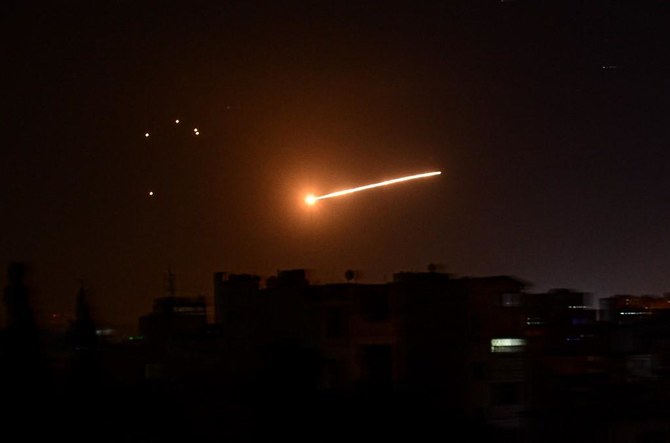
Syrian air defenses intercept an Israeli missile in the sky in this handout photo on Feb. 24, 2020. Israel has mounted frequent attacks against what it has described as Iranian targets in Syria. (SANA via AFP file photo)
Short Url
Updated 17 December 2021
Follow

Israeli missile strike kills soldier in Syria, state media says

  • Israel has mounted frequent attacks against what it has described as Iranian targets in Syria

CAIRO: An Israeli airstrike killed a soldier in southern Syria on Thursday, Syrian state media reported, in an attack in a frontier area where Israel has expressed concern about deployments of Iran-backed forces.

An Israeli military spokesperson refused to comment on the report.

Israel has mounted frequent attacks against what it has described as Iranian targets in Syria, where Tehran-backed forces including Lebanon’s Hezbollah have deployed over the last decade to support President Bashar Assad in Syria’s war.

Citing a military source, Syrian state news agency SANA said “the Israeli enemy carried out an aerial aggression,” firing missiles from the Golan Heights, territory Israel captured from Syria in 1967.

Syrian air defenses shot down most of the rockets, SANA said. The attack led to “the martyrdom of a soldier and some material losses,” it added.

FASTFACT

Iranian-backed forces have in the past attacked US troops with drones and rockets in eastern Syria and Iraq.

In 2019, then US President Donald Trump broke with other world powers by recognizing Israel as sovereign on the Golan Heights, which it annexed in 1981 in a move not recognized internationally.

Separately, a British warplane that is part of a US-led coalition shot down a drone this week near a base where US troops are stationed in southern Syria, officials said on Thursday.

The base, known as Tanf, is located in a strategic area near Syria’s Tanf border crossing with Iraq and Jordan and houses a small number of US troops. Tanf is the only position with a significant US military presence in Syria outside the Kurdish-controlled north.

Britain’s Defense Ministry said a Typhoon warplane shot down a “small hostile drone” that was a threat to coalition forces. It said this was the first air-to-air engagement for a Royal Air Force Typhoon.

US Central Command spokesman, Navy Captain Bill Urban, said two drones entered the Tanf garrison “deconfliction” zone on Tuesday and one was shot down as it moved closer to the base. He said there were no casualties or damage to facilities.


IMF approves reviews, unlocks $240m in funding for Jordan

Updated 55 min 38 sec ago
Follow

IMF approves reviews, unlocks $240m in funding for Jordan

  • The decision allows Jordan to draw about $130 million under the EFF and about $110 million under the RSF

AMMAN: The International Monetary Fund’s executive board has completed the fourth review of Jordan’s Extended Fund Facility and the first review under the Resilience and Sustainability Facility, unlocking immediate access to about $240 million to support the kingdom’s economic program.

The decision allows Jordan to draw about $130 million under the EFF and about $110 million under the RSF, bringing total disbursements under the IMF arrangement to about $733 million.

In a statement issued on Saturday, the IMF said Jordan’s economy “remains resilient,” supported by sound macroeconomic policies and strong international backing.

Growth accelerated to 2.7 percent in the first half of 2025 and is expected to reach about 3 percent in the coming years, driven by major investment projects, deeper regional integration and continued structural reforms.

Inflation remains anchored at about 2 percent, while the current account deficit is projected to narrow to below 5 percent of GDP over the medium term. The IMF also noted that Jordan’s banking sector is stable and international reserves remain strong.

Fiscal performance continues to align with program targets, underpinned by robust revenue collection and disciplined current spending. The authorities remain committed to reducing public debt to 80 percent of GDP by 2028 through gradual fiscal consolidation, while protecting social and development spending and reducing losses at public utilities.

The IMF said progress under the RSF is ongoing, with reforms addressing vulnerabilities in the water and electricity sectors and strengthening health emergency preparedness. All reform measures scheduled for the current review have been completed.

Commenting after the board discussion, IMF Deputy Managing Director Kenji Okamura said Jordan’s continued macroeconomic stability amid persistent external headwinds reflects the authorities’ commitment to sound policies, supported by strong international assistance.

He said growth continues to recover, inflation remains low and reserve buffers are strong, stressing the importance of maintaining prudent fiscal and monetary policies amid regional tensions and global uncertainty.

Okamura added that accelerated structural reforms are essential to foster job-rich growth, improve the business environment, enhance labour market flexibility, tackle youth unemployment and low female labour force participation, and attract private investment.

He also underlined the importance of sustained donor support to help Jordan manage external challenges and the economic cost of hosting large numbers of refugees, while noting that progress under the RSF would help address long-term vulnerabilities and strengthen balance-of-payments stability.