

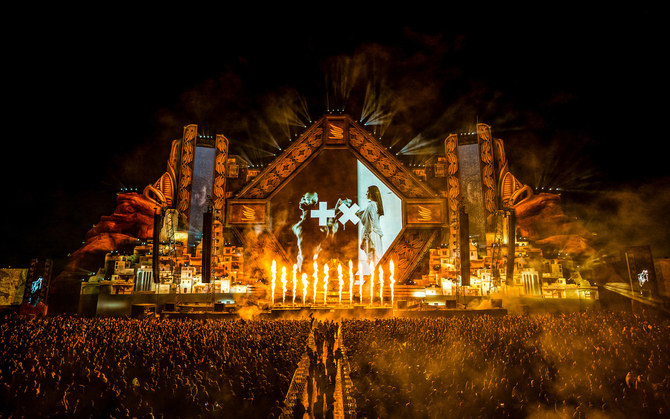
Riyadh feels the beat with region’s biggest music festival

Held in Banban in Riyadh, MDLBEAST SOUNDSTORM will run from Dec. 16-19 and feature over 200 DJs and stage performers. (File/Supplied)
Short Url
Updated 16 December 2021
Follow

Riyadh feels the beat with region’s biggest music festival

  • Held in Banban in Riyadh, MDLBEAST SOUNDSTORM will run from Dec. 16-19
  • SOUNDSTORM organizers put 8,000 security staff on ground, use latest tech solutions to offer best-possible experience for fans

RIYADH: The region’s biggest music festival begins in Riyadh on Thursday featuring a star-studded line-up of more than 200 EDM DJs and stage performers.

Held in Banban in Riyadh, MDLBEAST SOUNDSTORM will run from Dec. 16-19 following the XP Music Conference that has been going on this week.  

Top international acts taking part in MDLBEAST SOUNDSTORM include Armin Van Buuren, David Guetta, Deadmau5, DJ Snake, Eric Prydz, Martin Garrix, Paul Kalkbrenner, Tiesto, Steve Aoki, Adam Beyer, Amelie Lens, Carl Cox, Charlotte de Witte, Jeff Mills, Nina Kraviz, and Sven Vath.

Regional artists Anmarz, Cosmicat, Spaceboi, and Zone+ will be among those performing at the festival. There are so many performers that organizers have added a day to the festival, which will now run from Dec. 16 to 19.

“There’s a lot of surprises definitely with MDLBEAST this year, like two additional stages to the overall offering at the festival,” said MDLBEAST chief executive Ramadan Al-Haratani.

Organizers of MDLBEAST said an additional day was added to accommodate the plus 200 artists expected to perform at the music festival. 

“We’re also introducing an app to help navigate and ensure the guests’ journey and experience goes smoothly. We want people to have the choice and freedom of where to go and who to see at the festival,” Al-Haratani said.

Al-Haratani also reaffirmed MDLBEAST's commitment to delivering the best-possible experience for fans with unprecedented security measures at SOUNDSTORM this year.

More than 8,000 security professionals and response teams will be on the ground — approximately one member of security staff for every 30 attendees — and 335 CCTV cameras will monitor every part of the venue.

According to event organizers, this year’s beefed-up security measures have been brought in to help prevent unsocial behavior and create a safe space for festivalgoers.

“COVID-19 was actually positive in a way, as it gave us some time to plan a bit more for the festival in terms of the security measures and tech solutions we could implement. Global ratios are typically one security guard to 70 attendees, but we have managed to double that this year.

“We have zero tolerance toward any and all forms of harassment, as well as illegal substances on the ground. All the staff have been trained to prevent all that. We urge people to read and go through our code of conduct that can be found on our website,” Al-Haratani added. 

People attending SOUNDSTORM have been advised by organizers to familiarize themselves in advance with security and safety points to be used in case of any emergency, and encouraged to become active bystanders in reporting any incidents of wrongdoing via the official MDLBEAST app.

While MDLBEAST has taken steps to minimize congestion, festival ticket holders have been asked to arrive early to ensure smooth entry to the venue. Restrictions will be in place on roads around the site and, where possible, ridesharing has been recommended to help reduce traffic. There will be no access to the festival through King Fahd Road and taxis and drops-off will be at the park and ride area.

MDLBEAST has advised that only Storm Blazer and VIB ticket holders will be allowed to use King Khalid Road and Salbukh Road to access parking. Storm Chasers have been told to use park and ride facilities to enter the festival, accessible via Abi Bakr Al-Siddiq Road or Prince Faisal Ibn Bandar Ibn Abdulaziz Road. 

No Storm Chaser ticket holders will be granted access via King Khalid Road and Salbukh Road unless they are travelling with a VIB or Storm Blazer visitor with a parking pass. Any category of ticket holder can travel in the same car as a VIB or Storm Blazer who have been requested to collect their passes in advance of the event from the Virgin Megastore at Nakheel Mall or Riyadh Boulevard.

A limited number of festival tickets are available from https://tickets.mdlbeast.com/


Saudi Arabia, Estonia strengthen cyber defense cooperation

Updated 09 February 2026
Follow

Saudi Arabia, Estonia strengthen cyber defense cooperation

  • Renowned for its leadership in digital governance, Estonia sees cybersecurity as central to its partnership potential with Saudi Arabia, building on years of regional engagement through its technology firms

RIYADH: Estonia aims to deepen defense, cybersecurity, and artificial intelligence cooperation with Saudi Arabia as both nations look to advance technology‑driven defense and cybersecurity capabilities.

Hanno Pevkur, Estonia’s minister of defense, told Arab News at the World Defense Show in Riyadh on Monday that Estonia’s defense industry is eager to contribute to the Kingdom’s fast‑growing defense ecosystem.

“In the modern world, cooperation built on trust and technology is the best defense,” he said. “It is important for us to be here because we clearly see there is a possibility to increase cooperation, not only bilaterally between Saudi Arabia and Estonia, but across the region.”

At Estonia’s pavilion, a cooperation agreement was signed between an Estonian company and a Saudi firm during the show, he noted.

Pevkur also said Estonia’s defense sector has expanded rapidly in recent years, driven by technological innovation and partnership.

“Our defense industry is growing very rapidly, and we continue to see strong momentum,” he said.

He said Estonia’s strengths lie in digital and smart‑system integration rather than large‑scale weapons production.

“We will not build airplanes or tanks, but what we can do is integrate robotics, automation and drones to make existing systems smarter,” he said.

The minister said effective defense collaboration must link businesses and governments to achieve meaningful results.

“When we want to have real cooperation, we need it on all levels,” he said. “The biggest client for any defense company is the government, so we must treat this as one ecosystem where the public and private sectors work hand in hand.”

Renowned for its leadership in digital governance, Estonia sees cybersecurity as central to its partnership potential with Saudi Arabia, building on years of regional engagement through its technology firms.

Pevkur said several Estonian companies, including Nortal, have already assisted Gulf governments in developing open IT and digital‑service systems.

“As the most digitalized nation in the world, almost every service in Estonia can be done online, except getting married,” he said. “But with such digitalization, we also need strong cyberdefense.”

He said data protection and digital resilience are treated as matters of national sovereignty in Tallinn, the capital of Estonia.

“Data is what we own. When someone steals that data, it becomes a serious threat,” he added. “That is why cyberdefense is not just about technology, it is about trust, sovereignty and protection.”

Pevkur said Saudi Arabia’s advances in AI offer promising opportunities for collaboration.

“I know that Saudi Arabia is doing great work when it comes to AI,” he said. “For us, as a small country with limited human resources, AI is essential not just for defense but for everyday life.”

Pevkur added that Estonia has launched a national AI strategy to promote responsible development and closer coordination between government and industry. One Estonian company, he said, has developed a system that allows a single operator to control hundreds of drones through AI.

“It is quite easy to put a weapon into the hands of a robot, but we also need to define who is accountable for its actions,” he said.

“The big question for the future is whether we can allow a war to be fought entirely by AI, or if humans must always make the final ethical decisions.”

He said in his conclusion that governments must reach a common understanding on how AI will be used and regulated on the battlefield.