Parents of suspect in Michigan school shooting due in court

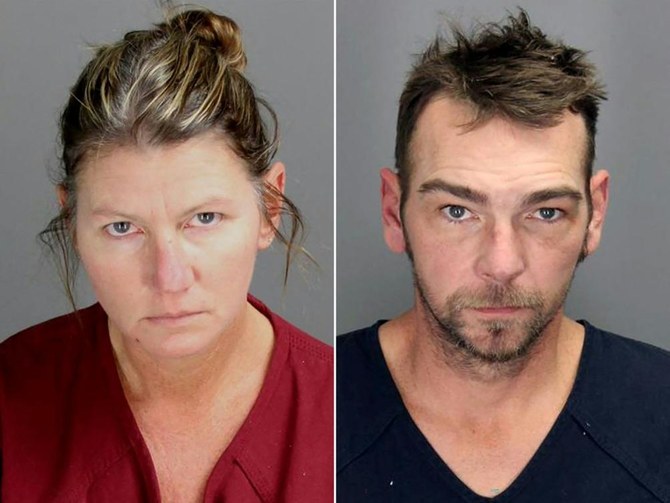
James and Jennifer Crumbley are accused of failing to intervene on the day of the tragedy despite being confronted with a drawing and chilling message — “blood everywhere” — that was found at the boy’s desk. (AFP)
Short Url
Updated 14 December 2021
Follow

Parents of suspect in Michigan school shooting due in court

  • The Crumbleys committed “egregious” acts, from buying a gun on Black Friday and making it available to Ethan Crumbley to resisting his removal from school when they were summoned a few hours before the shooting

ROCHESTER HILLS, Michigan: The parents of a Michigan teen charged with killing four students at Oxford High School are scheduled to return to court on charges of involuntary manslaughter.
A probable cause conference was scheduled Tuesday in Rochester Hills District Court for James and Jennifer Crumbley.
Police said the Oxford, Michigan, couple was found Dec. 4 hiding in a commercial building in Detroit after warrants were issued for their arrests.
Probable cause conferences typically are procedural and involve discussions between defense attorneys, prosecutors and a judge on bond and other matters.
Their son, Ethan Crumbley, is charged as an adult with murder, terrorism and other crimes.
His probable cause conference was adjourned from Monday to Jan. 7 to allow his court-appointed lawyer to review evidence including witness statements from the Nov. 30 shooting that also left six other students and a teacher wounded.
James and Jennifer Crumbley are accused of failing to intervene on the day of the tragedy despite being confronted with a drawing and chilling message — “blood everywhere” — that was found at the boy’s desk.
The Crumbleys committed “egregious” acts, from buying a gun on Black Friday and making it available to Ethan Crumbley to resisting his removal from school when they were summoned a few hours before the shooting, Oakland County prosecutor Karen McDonald has said.
They entered not guilty pleas to each of the four involuntary manslaughter counts against them at their arraignment.
They were captured in a commercial building that housed artwork. The Crumbleys’ attorney, Shannon Smith, had said the day before that the pair had left town earlier in the week “for their own safety” and would be returning to Oxford to face charges.
Detroit Police Chief James White has said the couple “were aided in getting into the building” and that a person who helped them may also face charges.
Oxford High School, about 30 miles (50 kilometers) north of Detroit, has been closed since the shooting. Students on the school’s sports teams began returning Monday to competition.
The district says it has consulted with mental health experts and law enforcement officials on the return of athletics, and the recommendation was to give students and the community opportunities to interact with their peers.
The district also will hold its first school board meeting Tuesday evening since the shooting.


Asylum applications drop to 40-year low in Sweden

A picture taken on June 26, 2023, shows migrants receiving food and clothes from an NGO in Athens. (AFP)
Updated 7 sec ago
Follow

Asylum applications drop to 40-year low in Sweden

  • Asylum seekers and their family members accounted for just 6 percent of the total, compared with 31 percent in 2018, when total immigration was 133,000

STOCKHOLM: The number of people applying for asylum in Sweden dropped by 30 percent in 2025 to the lowest level since 1985, with the ​right-of-center government saying it planned to further tighten rules this year ahead of an election in September.
The ruling minority coalition, which is supported by the anti-immigration Sweden Democrats, has made cutting the number of asylum seekers a key policy platform since taking power in 2022. It blames a surge ‌in gang ‌crime on decades of loose ‌asylum laws and ​failed ‌integration measures under previous Social Democrat-led governments.

FASTFACT

The Swedish government has cracked down on asylum seekers, made it more difficult to gain residency and citizenship, and introduced financial incentives for immigrants to leave the country.

“The change is not just about numbers in terms of lower immigration, it’s also about the way that’s made up, who is coming to Sweden with the proportion from asylum at a record low,” said Immigration Minister Johan Forssell.
The number of immigrants, excluding refugees from Ukraine, fell to 79,684 last year from 82,857 in 2024, according to figures from the Migration Board. 
Asylum seekers and their family members accounted for just 6 percent of the total, compared with 31 percent in 2018, when total immigration was 133,000.
The number of people either voluntarily returning to another country or being expelled by authorities was also up.
“This is an area which is a high priority for us,” Forssell said.
The government has cracked down on asylum seekers, made it more difficult to gain residency and citizenship, and introduced financial incentives for immigrants to leave the country since it came to power.
Forssell said the government planned to further tighten regulations in the coming year, including a new law to increase the number of returnees and stricter citizenship rules, among other measures.
Swedes will ‌vote in what is expected to be a tight general election in September.
Meanwhile, Denmark’s strict immigration policies drove asylum admissions to a historic low in 2025, with 839 requests granted by the end of November, the government said.
“It is absolutely critical that as few foreigners as possible come to Denmark and obtain asylum. My main priority is to limit the influx of refugees,” said Immigration Minister Rasmus Stoklund in a press release.
According to the ministry, “there have been very few years when the annual total remained below 1,000 ... 2025 will be a year with a historically low number of residence permits granted on asylum grounds.”
Denmark registered 1,835 asylum requests by November 2025.
The country’s immigration approach has been influenced by far-right parties for more than 20 years, and Prime Minister Mette Frederiksen, leader of the Social Democrats, has pursued a “zero refugee” policy since taking office in 2019.
Copenhagen has, over the years, implemented a slew of initiatives to discourage migrants and make Danish citizenship harder to obtain.
In 2024, the country of 6 million people accepted some 860 of the 2,333 asylum requests lodged that year.