

Iranian animal lovers decry proposal to ban pets

An Iranian woman plays with her dog in a yard near her house in northern Tehran, on December 5, 2021. (AFP)
Short Url
Updated 12 December 2021
Follow

Iranian animal lovers decry proposal to ban pets

TEHRAN: “No, my cat is not dangerous,” says Iranian animal lover Mostafa, outraged by a proposal from ultraconservative lawmakers to ban pets.

The 25-year-old, who runs a pet supplies shop on busy Eskandari Street in downtown Tehran, is stunned.
“Crocodiles can be called dangerous, but how can rabbits, dogs and cats be dangerous?” he asked incredulously about the bill introduced a month ago.
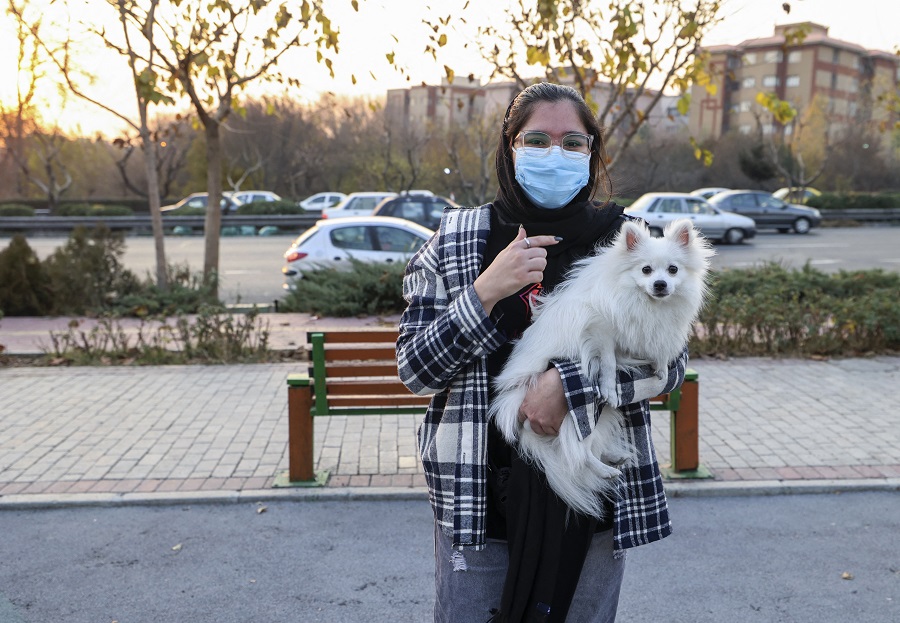


An Iranian woman poses for a picture with her dog at a park in the capital Tehran, on December 7, 2021. (AFP)


The proposed law pits growing numbers of people with pets against those who consider the practice decadent.
According to media reports, 75 MPs, or one quarter of parliamentarians, recently signed a text entitled “Support for the rights of the population in relation to harmful and dangerous animals”.
In their introduction, the authors condemn the practice of humans living under one roof with domesticated animals as a “destructive social problem”.
The phenomenon, they explain, could “gradually change the Iranian and Islamic way of life” by “replacing human and family relationships with feelings and emotional relationships towards animals”.
The proposed law would prohibit “importing, raising, assisting in the breeding of, breeding, buying or selling, transporting, driving or walking, and keeping in the home wild, exotic, harmful and dangerous animals”.
It lists the animals to be banned as “crocodiles, turtles, snakes, lizards, cats, mice, rabbits, dogs and other unclean animals as well as monkeys.”
Offenders would risk a fine equivalent to 10 to 30 times the “minimum monthly working wage” of about $98 and the “confiscation” of the animal.
In addition, vehicles used to transport the animal would be confiscated for three months.
While Iran is engaged in difficult negotiations on its nuclear program and enduring a painful economic downturn because of US sanctions, the bill has sparked criticism in the press, mockery on social networks and anger among residents of the capital.
“These projects will certainly cause chaos, corruption and collective disobedience to this law because... living with animals is now a cultural phenomenon,” warned the reformist daily Shargh.
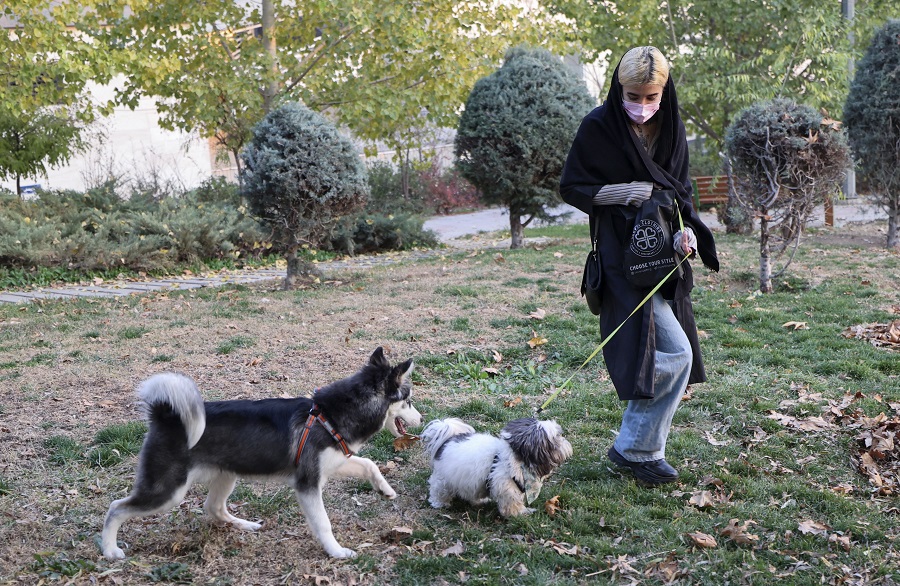


An Iranian woman walks her dog in a park in the capital Tehran. (AFP)


Some internet users reacted with irony and sarcasm.
“How many times have cats sought to devour you so that you consider them wild, harmful and dangerous?” journalist Yeganeh Khodami asked on Twitter.
Another posted a photo of his kitten with the message: “I have renamed my cat ‘Criminal’ since I heard this proposed law.”
An actress who asked to remain anonymous said she had planned a demonstration against the pet ban plan in front of parliament but then dropped the idea because of pressure on her.
In the face of the public outcry, few parliamentarians are willing to strongly defend the bill.
“I agree with the project in general, but I certainly disagree with some of its clauses,” said the head of parliament’s judicial commission, Moussa Ghazanfarabadi, who signed the text.
“It is just a bill, but whether it succeeds is another matter,” he told AFP.
Another lawmaker from Tehran, the environmentalist Somayeh Rifiei, said she believes that a law is needed on which animals can be kept, and which cannot.
“No one can deny the services that animals provide to humans, but this area must be regulated,” she said. “That is the basis of social life.”
She said that, aside from the pet ban bill, “the government has drafted a bill that gives special attention to biodiversity and wildlife. It deals with both animal rights and human rights.
“Basically, I would prefer to see this bill on the agenda rather than a proposal that focuses only on criminalisation.”
On Eskandari Street, vendors fear the consequences of any such law.
“It might destroy thousands of jobs,” said Mohsen, 34.
His wife Mina, said she was more worried about her dog.
“Why should I imprison him at home?” she said of her canine companion. “The MPs probably assume that young couples today don’t have children because they have a pet dog, but that’s stupid.
“It’s not the dogs but the economic conditions that don’t allow us to have children,” she added.
“At one time they banned satellite television, yet people continued to use it, but with fear and anxiety. People will keep their animals at home to protect them.”


Egypt reveals restored colossal statues of pharaoh in Luxor

Updated 14 December 2025
Follow

Egypt reveals restored colossal statues of pharaoh in Luxor

  • Amenhotep III, one of the most prominent pharaohs, ruled during the 500 years of the New Kingdom, which was the most prosperous time for ancient Egypt

LUXOR: Egypt on Sunday revealed the revamp of two colossal statues of a prominent pharaoh in the southern city of Luxor, the latest in the government’s archeological events that aim at drawing more tourists to the country.
The giant alabaster statues, known as the Colossi of Memnon, were reassembled in a renovation project that lasted about two decades. They represent Amenhotep III, who ruled ancient Egypt about 3,400 years ago.
“Today we are celebrating, actually, the finishing and the erecting of these two colossal statues,” Mohamed Ismail, secretary-general of the Supreme Council of Antiquities, said ahead of the ceremony.
Ismail said the colossi are of great significance to Luxor, a city known for its ancient temples and other antiquities. They’re also an attempt to “revive how this funerary temple of King Amenhotep III looked like a long time ago,” Ismail said.
Amenhotep III, one of the most prominent pharaohs, ruled during the 500 years of the New Kingdom, which was the most prosperous time for ancient Egypt. The pharaoh, whose mummy is showcased at a Cairo museum, ruled between 1390–1353 BC, a peaceful period known for its prosperity and great construction, including his mortuary temple, where the Colossi of Memnon are located, and another temple, Soleb, in Nubia.
The colossi were toppled by a strong earthquake in about 1200 BC that also destroyed Amenhotep III’s funerary temple, said Ismail.
They were fragmented and partly quarried away, with their pedestals dispersed. Some of their blocks were reused in the Karnak temple, but archeologists brought them back to rebuild the colossi, according to the Antiquities Ministry.
In late 1990s, an Egyptian German mission, chaired by German Egyptologist Hourig Sourouzian, began working in the temple area, including the assembly and renovation of the colossi.
“This project has in mind … to save the last remains of a once-prestigious temple,” she said.
The statues show Amenhotep III seated with hands resting on his thighs, with their faces looking eastward toward the Nile and the rising sun. They wear the nemes headdress surmounted by the double crowns and the pleated royal kilt, which symbolizes the pharaoh’s rule.
Two other small statues on the pharaoh’s feet depict his wife, Tiye.
The colossi — 14.5 meters and 13.6 meters respectively — preside over the entrance of the king’s temple on the western bank of the Nile. The 35-hectare complex is believed to be the largest and richest temple in Egypt and is usually compared to the temple of Karnak, also in Luxor.
The colossi were hewn in Egyptian alabaster from the quarries of Hatnub, in Middle Egypt. They were fixed on large pedestals with inscriptions showing the name of the temple, as well as the quarry.
Unlike other monumental sculptures of ancient Egypt, the colossi were partly compiled with pieces sculpted separately, which were fixed into each statue’s main monolithic alabaster core, the ministry said.
Sunday’s unveiling in Luxor came just six weeks after the inauguration of the long-delayed Grand Egyptian Museum, the centerpiece of the government’s bid to boost the country’s tourism industry. The mega project is located near the famed Giza Pyramids and the Sphinx.
In recent years, the sector has started to recover after the coronavirus pandemic and amid Russia’s war on Ukraine — both countries are major sources of tourists visiting Egypt.
“This site is going to be a point of interest for years to come,” said Tourism and Antiquities Minister Sherif Fathy, who attended the unveiling ceremony. “There are always new things happening in Luxor.”
A record number of about 15.7 million tourists visited Egypt in 2024, contributing about 8 percent of the country’s GDP, according to official figures.
Fathy, the minister, has said about 18 million tourists are expected to visit the country this year, with authorities hoping for 30 million visitors annually by 2032.