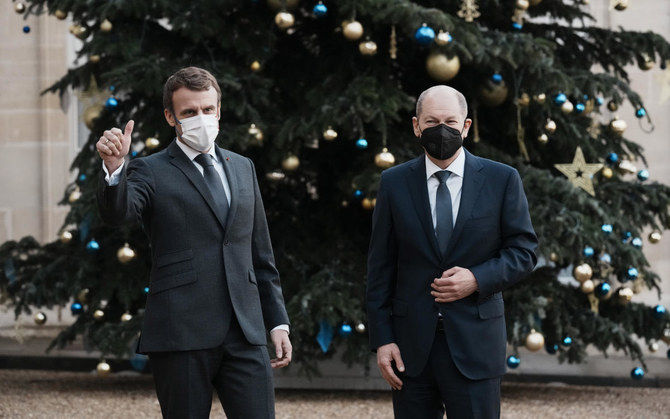
PARIS: German Chancellor Olaf Scholz met with French President Emmanuel Macron in Paris on Friday as their governments worked to de-escalate tensions between Russia and Ukraine.
The leaders held a joint news conference during Scholz’s first trip abroad following his coalition government’s swearing-in on Wednesday. They said they would meet with Ukrainian President Volodymyr Zelenskyy next week on the sidelines of a European Union summit in Brussels.
“We all view the situation on the Ukrainian border with concern,” Scholz said. “We’re clear that the inviolability of borders in Europe is one of the principles that all in Europe must accept for our common security … This rule goes for everyone.”
Scholz plans to go from France to Brussels to meet with EU and NATO officials. Macron said he and Russian President Vladimir Putin are scheduled to talk next week.
“Our first goal is to avoid any useless tension,” Macron said. “Our will ... Europeans and Americans, is to show that we are very vigilant about the situation, but that there must be no escalation, in any way.”
US President Joe Biden this week moved to take a more direct role in diplomacy between Ukraine and Russia. In recent years, France and Germany have played mediator roles in the conflict.
Biden has pressed Putin to pull back a massive Russian troop buildup near Ukraine’s border that has created growing concern in Washington and European capitals, as well as in Ukraine itself.
Macron spoke with Zelenskyy over the phone on Friday, and said France and Germany are determined to preserve Ukraine’s sovereignty and territorial integrity, according to a statement from the French presidency.
Macron and Scholz discussed other bilateral and European issues Friday, including the economic recovery from the COVID-19 pandemic. Macron has made boosting growth and jobs a priority of France’s upcoming six-month EU presidency, which starts in January.
Scholz, who was previously Germany’s finance minister, noted that he and Macron both have tried to show “what is possible in Europe when we work together.” Europe’s 750 billion-euro ($846 billion) pandemic recovery fund “is an emphatic symbol of the possibilities connected with this,” he said.
“And so I am very confident that we can solve the tasks that lie ahead of us — this is about continuing to make possible and maintain the growth that we set on track with the recovery fund, and at the same time providing for solid finances,” Scholz said.
Scholz, a 63-year-old center-left politician, became Germany’s ninth post-World War II chancellor this week, opening a new era for the EU’s most populous nation and largest economy after Angela Merkel’s 16-year tenure.
His government is composed of a coalition of his center-left Social Democrats, the environmentalist Greens and the pro-business Free Democrats.


![]()


Scholz meets with Macron in 1st trip as German chancellor
Short Url
https://arab.news/pp28c
Scholz meets with Macron in 1st trip as German chancellor
- The leaders held a joint news conference during Scholz's first trip abroad
- Scholz plans to go from France to Brussels to meet with EU and NATO officials


Journalists in Bangladesh demand protection amid rising attacks
- Media industry in the South Asian country is being systematically targeted
- Interim government blamed for failing to adequately respond to the incidents
DHAKA: Journalists, editors and owners of media outlets in Bangladesh on Saturday demanded that authorities protect them following recent attacks on two leading national dailies by mobs.
They said the media industry in the South Asian country is being systematically targeted in the interim government headed by Nobel Peace Prize laureate Muhammad Yunus. They said the administration failed to prevent attacks on the Daily Star, the country’s leading English-language daily, and the Prothom Alo, the largest Bengali-language newspaper, both based in Dhaka, the capital.
In December, angry mobs stormed the offices of the two newspapers and set fire to the buildings, trapping journalists and other staff inside, shortly after the death of a prominent Islamist activist.
The newspaper authorities blamed the authorities under the interim government for failing to adequately respond to the incidents despite repeated requests for help to disperse the mobs. Hours later, the trapped journalists who took shelter on the roof of the Daily Star newspaper were rescued. The buildings were looted. A leader of the Editors Council, an independent body of newspaper editors, was manhandled by the attackers when he arrived at the scene.
On the same day, liberal cultural centers were also attacked in Dhaka.
It was not clear why the protesters attacked the newspapers, whose editors are known to be closely connected with Yunus. Protests had been organized in recent months outside the offices of the dailies by Islamists who accused the newspapers of links with India.
On Saturday, the Editors Council and the Newspapers Owners Association of Bangladesh jointly organized a conference where editors, journalist union leaders and journalists from across the country demanded that the authorities uphold the free press amid rising tensions ahead of elections in February.
Nurul Kabir, President of the Editors Council, said attempts to silence media and democratic institutions reflect a dangerous pattern.
Kabir, also the editor of the English-language New Age daily, said unity among journalists should be upheld to fight such a trend.
“Those who want to suppress institutions that act as vehicles of democratic aspirations are doing so through laws, force and intimidation,” he said.
After the attacks on the two dailies in December, an expert of the United Nations said that mob attacks on leading media outlets and cultural centers in Bangladesh were deeply alarming and must be investigated promptly and effectively.
“The weaponization of public anger against journalists and artists is dangerous at any time, and especially now as the country prepares for elections. It could have a chilling effect on media freedom, minority voices and dissenting views with serious consequences for democracy,” Irene Khan said in a statement.
Yunus came to power after former Prime Minister Sheikh Hasina fled the country amid a mass uprising in August, 2024. Yunus had promised stability in the country, but global human rights groups including Human Rights Watch and Amnesty International have blamed the government for its failure to uphold human and other civil rights. The Yunus-led regime has also been blamed for the rise of the radicals and Islamists.
Dozens of journalists are facing murder charges linked to the uprising on the grounds that they encouraged the government of Hasina to use lethal weapons against the protesters. Several journalists who are known to have close links with Hasina have been arrested and jailed under Yunus.
They said the media industry in the South Asian country is being systematically targeted in the interim government headed by Nobel Peace Prize laureate Muhammad Yunus. They said the administration failed to prevent attacks on the Daily Star, the country’s leading English-language daily, and the Prothom Alo, the largest Bengali-language newspaper, both based in Dhaka, the capital.
In December, angry mobs stormed the offices of the two newspapers and set fire to the buildings, trapping journalists and other staff inside, shortly after the death of a prominent Islamist activist.
The newspaper authorities blamed the authorities under the interim government for failing to adequately respond to the incidents despite repeated requests for help to disperse the mobs. Hours later, the trapped journalists who took shelter on the roof of the Daily Star newspaper were rescued. The buildings were looted. A leader of the Editors Council, an independent body of newspaper editors, was manhandled by the attackers when he arrived at the scene.
On the same day, liberal cultural centers were also attacked in Dhaka.
It was not clear why the protesters attacked the newspapers, whose editors are known to be closely connected with Yunus. Protests had been organized in recent months outside the offices of the dailies by Islamists who accused the newspapers of links with India.
On Saturday, the Editors Council and the Newspapers Owners Association of Bangladesh jointly organized a conference where editors, journalist union leaders and journalists from across the country demanded that the authorities uphold the free press amid rising tensions ahead of elections in February.
Nurul Kabir, President of the Editors Council, said attempts to silence media and democratic institutions reflect a dangerous pattern.
Kabir, also the editor of the English-language New Age daily, said unity among journalists should be upheld to fight such a trend.
“Those who want to suppress institutions that act as vehicles of democratic aspirations are doing so through laws, force and intimidation,” he said.
After the attacks on the two dailies in December, an expert of the United Nations said that mob attacks on leading media outlets and cultural centers in Bangladesh were deeply alarming and must be investigated promptly and effectively.
“The weaponization of public anger against journalists and artists is dangerous at any time, and especially now as the country prepares for elections. It could have a chilling effect on media freedom, minority voices and dissenting views with serious consequences for democracy,” Irene Khan said in a statement.
Yunus came to power after former Prime Minister Sheikh Hasina fled the country amid a mass uprising in August, 2024. Yunus had promised stability in the country, but global human rights groups including Human Rights Watch and Amnesty International have blamed the government for its failure to uphold human and other civil rights. The Yunus-led regime has also been blamed for the rise of the radicals and Islamists.
Dozens of journalists are facing murder charges linked to the uprising on the grounds that they encouraged the government of Hasina to use lethal weapons against the protesters. Several journalists who are known to have close links with Hasina have been arrested and jailed under Yunus.
Latest updates


© 2026 SAUDI RESEARCH & PUBLISHING COMPANY, All Rights Reserved And subject to Terms of Use Agreement.