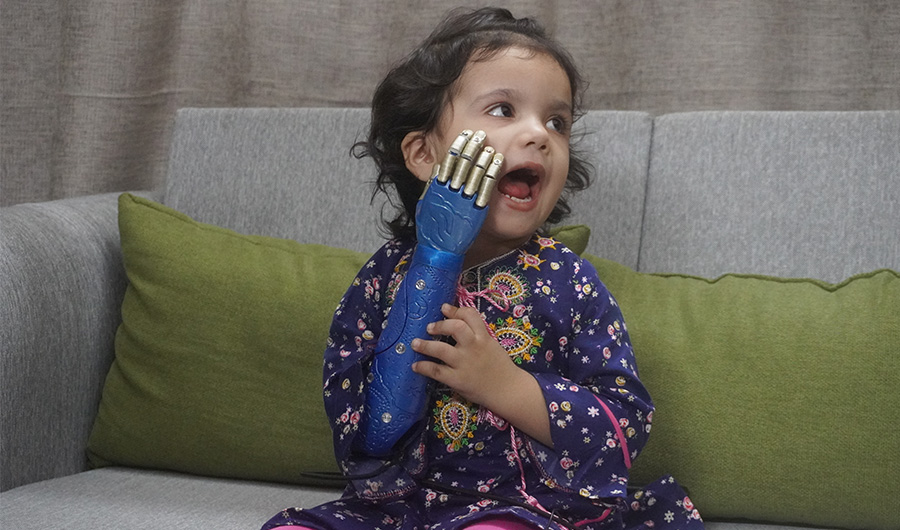
- Born without a right arm, Momina Aamir last week became the youngest person in the world to get a prosthetic limb
- Parents say most people want skin-colored prosthetic limbs but they wanted to let daughter have the arm she truly wanted
KARACHI: Three-year-old Momina Aamir’s father was overwhelmed with emotion in August this year when his daughter, who was born without her right arm, asked her father if she could borrow his hand so she could prostrate properly while performing the Muslim ritual of prayer.
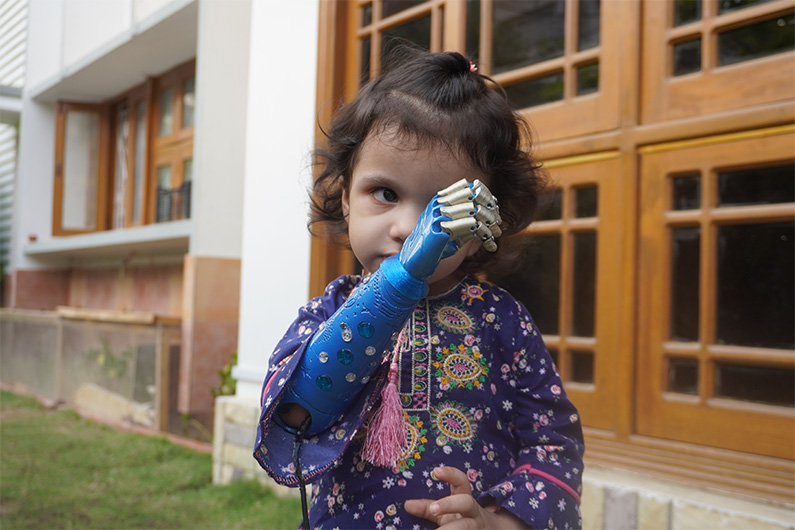
After that moment, Aamir Abbas said he was more determined than ever to find a solution, which turned out to be a blue-colored multigrip bionic arm customized to the exact wishes of Momina, a huge fan of Princess Elsa in the Walt Disney animated film, Frozen.
“I had just finished praying when Momina came to me and said: ‘Baba, give me your hand so I may pray like you as well’,” Abbas told Arab News. “It is hard for me to put my feelings in words. I had never felt or made her feel that she was missing something. But this pushed me to think hard and look for solutions.”
According to the World Health Organization, about 30 million people around the world require prosthetic limbs, but fewer than 20 percent have them and these tend to be costly and heavy, with limited to no movement. According to Karachi’s Aga Khan University Hospital, one in every 20 children in Pakistan is born with some kind of a hand deformity.
But with the help of the Karachi-based startup BIONIKS, which provides orthotics and prosthetics services, Abbas has been able to make his daughter’s dream come true.
Earlier this year, the firm made a world record when they fitted four-year-old Muhammad Sideeq with a multigrip bionic arm. The story was covered by Arab News and Abbas said the media coverage was instrumental in connecting the family to BIONIKS.
“That story gave me hope and made me visit BIONIKS,” Saadia Aamir, Momina’s mother, said.
After getting her new arm last week, Monima, at three years and four months of age, is the youngest recipient ever of an advanced prosthetic limb.
Among treatment options for children born with hand or arm deformities — based on the nature and severity of the problem — are limb manipulation and stretching, tendon transfer, attaching a splint to stretch the finger to its original position or repairing the constrictions in muscles, ligaments, and skin.
In some cases, skin grafts can also be used to address the deformity. Surgeries are also sometimes performed to cure the condition.
Unfortunately, not all children are able to get the right treatment in Pakistan, due to a paucity of expertise as well as the high cost of suggested procedures.
And even though Momina is among a handful of fortunate children, it was not easy to design the required limb for her due to her age and congenital situation as the design is fitted with sensors that enable users to move the prosthetic limbs by thinking about making the movements.
“It was far more difficult to integrate all the things in her case since she never had a hand,” Ovais Hussain Qureshi, co-founder of BIONIKS, told Arab News. “She had not experienced those senses in her mind that allow us to use our right hand.”
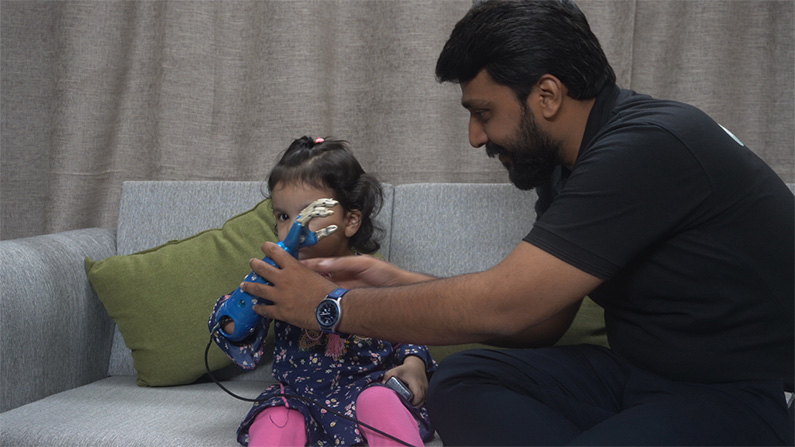
For example, he said, when Momina was first asked to close the fingers of her right hand, she would move the entire artificial arm.
But the girl was “quite intelligent” and the team did not find it difficult to communicate with her and quickly teach her how to use the limb.
“She is very friendly and talkative,” Qureshi said with a smile. “She used to freely roam around in our office, visit the research and development room, sit with our designers and talk to them: ‘I don’t like this or that part. Can you make the shade of blue a little light? How about adding diamonds or crystals to the arm?’“
“It will not be wrong to say,” Qureshi said, “that she got a truly customized arm. In fact, she almost made it herself!”
Momina’s mother said her daughter decided she wanted a blue arm because of Princess Elsa in Frozen.
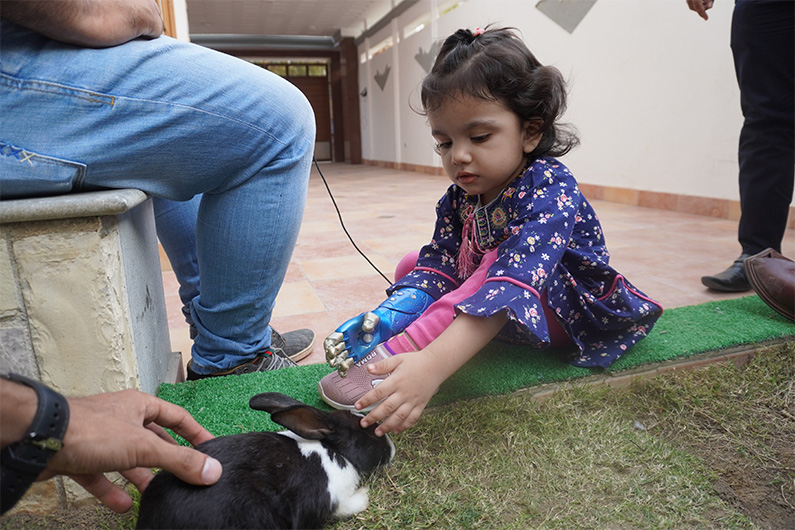
“The day she got her arm, we left our home late at night and she slept in the car,” she said. “While I was removing her arm, she woke up and asked me not to. When she went into deep sleep, I took it off and was surprised to see her restlessness in the morning. She looked impatiently for the arm but was happy when I brought it back.”
Momina’s mother said her daughter was so deeply attached to her “magical” arm that she was very upset when it was taken back to the firm for minor changes and adjustments.
Her parents said most people wanted their children to get skin-colored prosthetic limbs but they decided to let their daughter have the arm she truly wanted.
“She is happy with the color,” her mother said. “Sometimes she even makes fun of our ordinary arms and says she has a more beautiful one! We want her to grow with it.”