

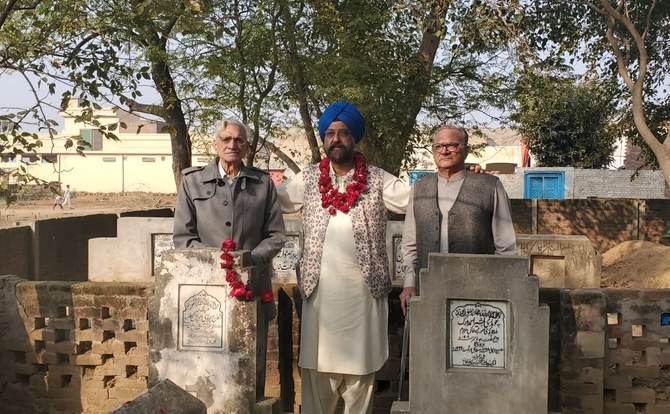

KARACHI: In August 1947, as British India was being partitioned into independent India and Pakistan, Dr. Tarunjit Singh Butalia’s grandparents fled their village in Gujranwala district, in what was soon to become Pakistan, for Ferozepore, in what was soon to become India.
All around them was carnage — a bloody orgy of violence and communal rioting that they were able to escape by sheltering for over a month at the home of a Muslim couple in what is now the central Pakistani city of Lahore.
Last month, Butalia, an American Sikh of Indian descent who has a PhD in civil engineering, arrived at his ancestral village in Gujranwala district from Colombus, Ohio, to visit the graves of the Muslim friends who had saved his grandparents’ lives over seven decades ago.
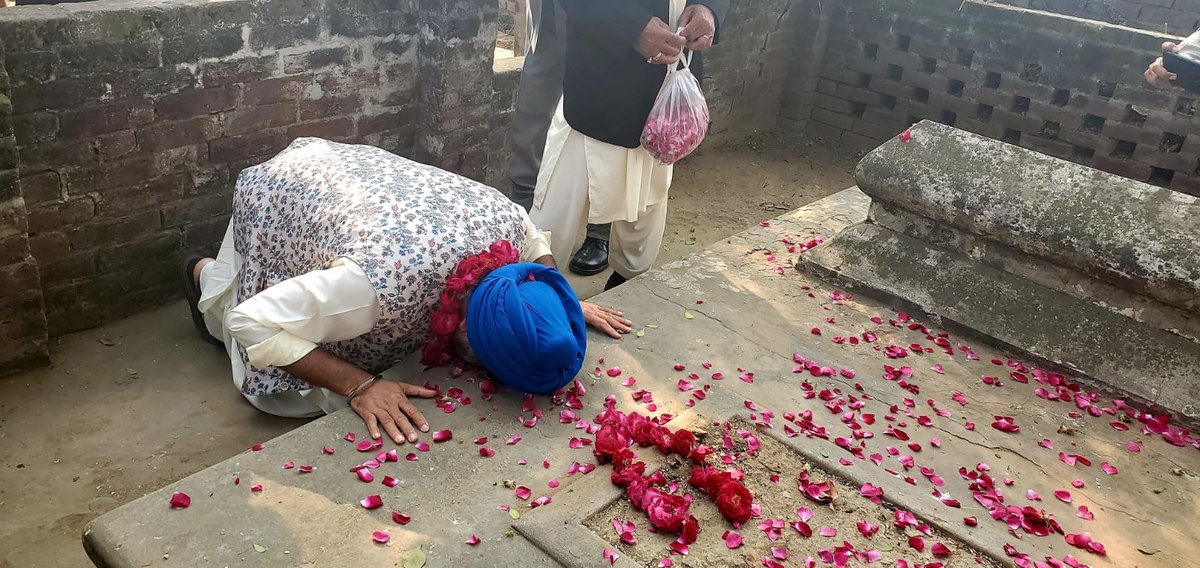
Dr. Tarunjit Singh Butalia, an American Sikh of Indian descent, kisses the grave of Bashir Ahmed Virk, a Pakistani Muslim who saved his grandparents’ lives during independence riots in 1947. Photo taken in Gujranwala, Pakistan, on November 28, 2021 (Photo Courtesy Dr. Tarunjit Singh Butalia)
The partition in 1947, following India’s independence from British rule, triggered one of the biggest forced migrations in history, marred by bloodshed, as about 15 million Muslims, Hindus and Sikhs, fearing discrimination and violence, swapped countries in a political upheaval that cost more than a million lives.
During the chaotic transition, train cars full of bodies arrived at railway stations in the twin cities of Lahore and Amritsar in the province of Punjab, split roughly down the middle at partition on August 14, 1947.
Many survivors of the bloodshed found themselves separated from family on the other side of a hastily drawn-up border.
It was in these circumstances that Bashir Ahmed Virk, a Muslim tax and revenue officer posted in Lahore, provided shelter to his friend Captain Ajit Singh Butalia, along with his wife Narinder Kaur and their two little children, as they tried to make their way to Indian Punjab.
“Virk and his family took extremely good care of them,” Butalia, 56, told Arab News in a telephone interview this week, saying he grew up hearing stories about the Virk family’s generosity from his grandparents and parents.
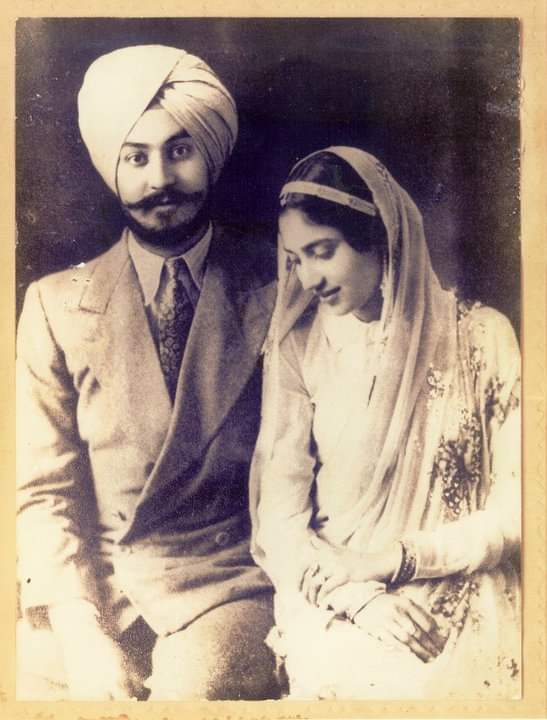
An undated photo of Captain Ajit Singh Butalia and his wife Sardarni Narinder Kaur (Photo Courtesy: Dr. Tarunjit Singh Butalia)
In a book called “My Journey Home” that Butalia published last year, he said his grandparents had initially decided to stay put in their ancestral village of Butala in what is today the Pakistani part of the Punjab after being assured of safety by local Muslims. But when the family home was set on fire by a Muslim mob in September 1947, it became clear that the place where the Butalia family had lived for generations was no longer home.
“It was September 1947 — the Butala Sardars left their ancestral village Butala Sardar Jhanda Singh near Gujranwala,” Butalia wrote. “My grandfather Capt. Ajit Singh Butalia (retired) wore a round turban similar to a Muslim man, my grandmother (Sardarni Narinder Kaur Butalia) a burqa, holding their 3 month old son Col. Sarabjit Singh Butalia (retired) in her arms, put 2 year old Squadron Leader Narinderjit Singh Butalia (retired) on a donkey and the Butala Sardars left their ancestral village on foot for good — never to return again.”
“My grandparents walked several days toward a refugee camp, near Gujranwala. When they arrived, the British officer in charge discovered that my grandfather had served in the British Army and took it upon himself to facilitate his family across the border. On the way from the camp to the border, a mob of Muslims stopped the vehicle and demanded that the Sikh family be handed over to them. My grandfather recognized some of the men in the mob and they decided instead to take the family to Lahore to stay with one of my grandfather’s friend. What a change of heart — from mobsters to shelter providers.”
For about a month, the Butalias then lived in the home of Virk, whose family provided them with clothing and food (including non-halal meat).
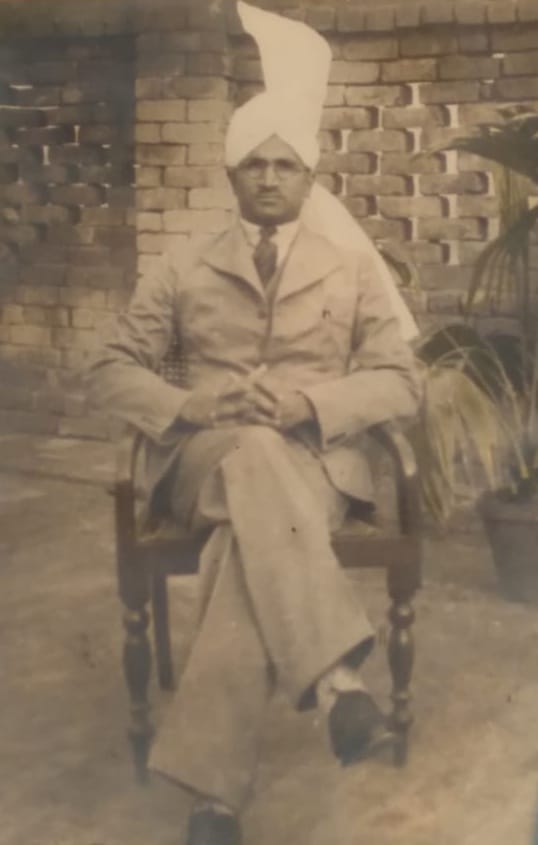
An undated photo of Bashir Ahmed Virk, a Pakistani official who saved the lives of a Sikh couple by giving refuge to them at his Lahore house in September 1947 (Photo Courtesy: Dr. Tarunjit Singh Butalia)
“The neighbors began to suspect that a Sikh family might be hiding in the home of a Muslim,” Butalia wrote in his book. “One Friday when my grandfather’s friend went to the mosque for prayers, the Imam pulled him aside and inquired about who was staying at his home. He replied that it was his brother and his family. The Imam then asked him to swear upon the Qur’an that it was his brother’s family. This unknown friend of my grandfather swore upon the Qur’an that this was his brother’s family.”
Explaining that the oath had not been a false one, Butalia told Arab News: “He truly looked at my grandfather as his brother.”
“For every partition story of human failings, of horror and savagery, there is an even more compelling human story of compassion, love, and friendship at great personal peril,” Butalia wrote.
Indeed, such stories of camaraderie as found between the Butalias and Virks were not rare in pre-partition India, even if they are hard to imagine since 1947 when departing British colonial administrators ordered the creation of two countries, one mostly Muslim and one majority Hindu. Today, India and Pakistan are arch-rivals who have fought three wars and continue to have tense relations, particularly when it comes to the disputed Himalayan region of Kashmir, which both claim in full.
Ties between family and friends on either side of the border continue to be unimpeded by travel curbs or poisoned by nationalist bluster.
But this did not stop Butalia from hoping to visit his family’s ancestral village in Pakistan and pay homage to their Pakistani friends.
When his book was published in December last year, a Pakistani academic in Lahore, Kalyan Singh, who was already aware of the link between the Butalias and the Virks, helped Butalia find the family in Gujranwala. Singh also subsequently introduced Butalia to Mahmood Bashir Virk, a successful politician from Gujranwala and the son of Bashir Ahmed Virk.
“This is how I got connected,” Butalia said. “It almost sounds impossible, but I finally found the family after 70 years!”
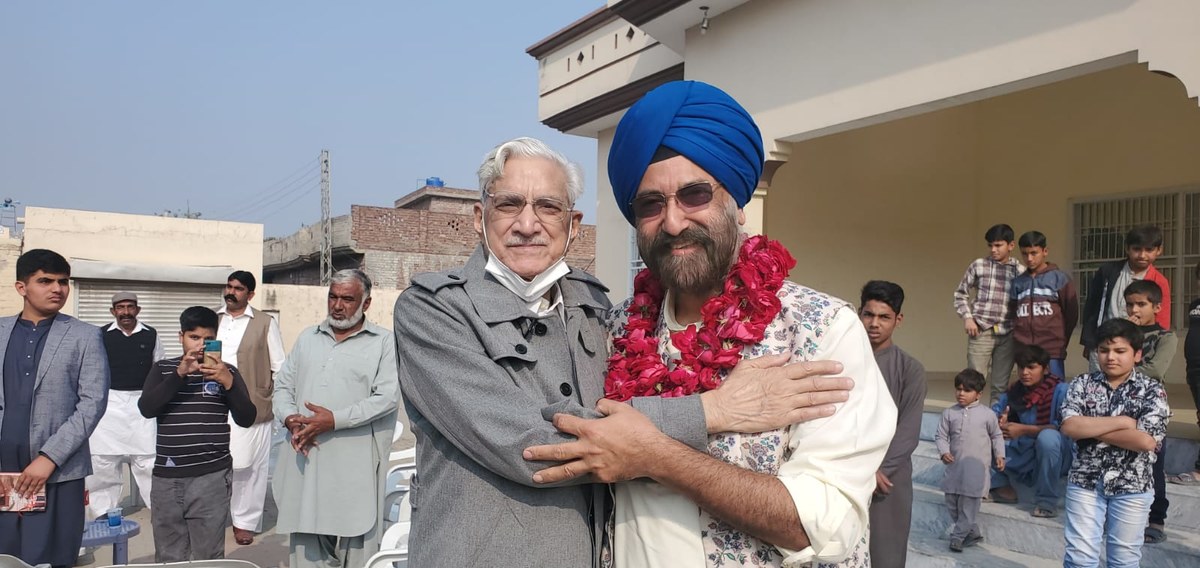
Dr. Tarunjit Singh Butalia, an American Sikh of Indian descent, meets with Pakistani lawmaker Chaudhry Mehmood Bashir Virk (left) at Virk’s village in Gujranwala, Pakistan, on November 28, 2021 (Photo Courtesy: Dr. Tarunjit Singh Butalia)
“I was a child but I still remember there were killings going on in the surrounding villages,” Mahmood told Arab News. “However, our village was peaceful, which was largely because of my father. He told me during the last days of his life that he saved people since he was trying to prepare for the hereafter.”
Last year, Butalia arrived in Gujranwala and met Virk. This year, he returned with one goal: to visit the graves of his family’s saviors.
“I visited their resting places, though I know I can never thank them enough for what they have done,” he said. “As I bode farewell to them, I knelt down to kiss their graves and prayed: ‘May everyone in the world be like you, Bashir Ahmed Virk and Amna Bibi.’”


