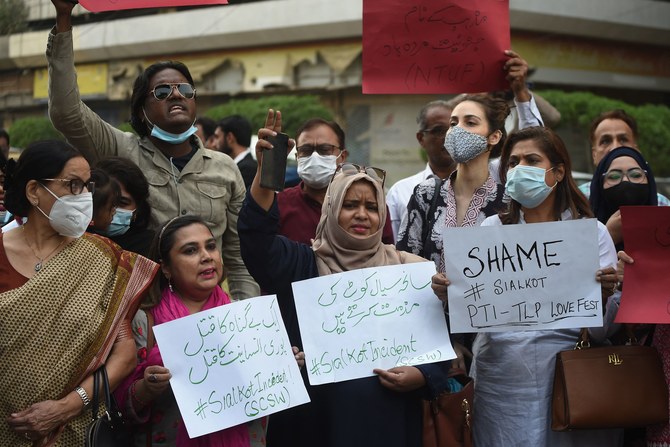
COLOMBO: Sri Lanka will bolster security for international cricketers after an expatriate factory manager was beaten and set ablaze by a mob in Pakistan over blasphemy allegations, an official said Monday.
A dozen players from Pakistan are taking part in the Lanka Premier League (LPL) T20 competition, including veterans Shoaib Malik and Mohammad Hafeez.
An official from Sri Lanka Cricket (SLC) told AFP that extra precautions will be taken in light of Friday’s vigilante lynching in Pakistan, which has caused outrage across Sri Lanka.
“We have enhanced security across the board, not just for the Pakistani players,” the official said, speaking on condition of anonymity.
The remains of the expat factory manager Priyantha Diyawadana were repatriated to Colombo on Monday, and authorities in Sri Lanka have asked for the culprits to be punished for the “brutal and fatal attack.”
Few issues are as galvanizing in Pakistan as blasphemy, and even the slightest suggestion of an insult to Islam can supercharge protests and incite lynchings.
The five-team LPL began Sunday and ends with a December 23 final.

Sri Lanka to bolster cricket security after Pakistan lynching
https://arab.news/2kxrc
Sri Lanka to bolster cricket security after Pakistan lynching
- A dozen players from Pakistan are taking part in Lanka Premier League T20 competition
- Friday's vigilante lynching in Pakistan has caused outrage across Sri Lanka
Pakistan partially rolls back solar policy, keeps old net-metering terms for pending applicants
- Decision applies to applications submitted before Feb. 8, which will be processed under previous net-metering regulations
- Move follows public backlash after Pakistan cut buyback rates for rooftop solar power under new billing framework
ISLAMABAD: Pakistan’s power minister has ordered electricity distribution companies to process all rooftop solar net-metering applications submitted before Feb. 8 under the previous, more favorable rules, according to a government statement released Thursday.
The decision comes after days of public criticism over new regulations that lowered the rate paid to solar users for surplus electricity, part of broader reforms aimed at easing financial pressure on loss-making power utilities.
The directive by Power Minister Sardar Awais Leghari applies nationwide, including the private utility K-Electric, and affects thousands of households and businesses awaiting approval to connect solar systems to the national grid.
“All electricity distribution companies, including K-Electric, will provide the net-metering facility for applications submitted up to February 8,” the ministry said in the statement, adding immediate implementation orders had been issued.
Authorities said 5,165 pending applications fall under the decision, adding about 250.822 megawatts of capacity to the national grid. The ministry said the move would remove uncertainty for consumers and directed companies to maintain transparency in processing requests.
Pakistan introduced grid-connected rooftop solar and net-metering in 2015 during a worsening power shortage, allowing consumers to sell excess electricity to the grid at the same tariff they paid utilities, a policy designed to encourage renewable adoption and reduce outages.
Over the past three years, soaring electricity prices and frequent blackouts triggered a rapid solar boom, with households and businesses installing panels to cut costs. Solar’s share of the energy mix rose sharply and tens of thousands of new connections were added annually.
Earlier this month, however, regulators replaced the net-metering regime with a net-billing framework separating purchase and sale prices, meaning consumers would receive a lower, market-linked rate for exported electricity while paying full tariffs for grid power.
Officials argued the change was necessary because widespread rooftop generation was reducing utility revenues and worsening the country’s circular debt crisis. Consumers and industry groups criticized the move, saying it undermined investment certainty.
The government has since moved to protect existing users and now pending applicants from the revised pricing mechanism, while new connections after the cutoff date will fall under the updated billing system.


